
Acknowledgement of Generative AI Tools
I declare that I have used Claude (Anthropic) in the generation of this thesis in the following way:
—I acknowledge a combined operation in which Claude Opus inferenced over source material I assembled and structured. This was arranged by the Hjelmslev net, as Deleuze and Guattari (1987) extend it, to develop the analytical tool Appendix 1: Double Articulation in Control Society: Becoming Under Modulatory Capture.
—The tool was used to run a sentence-by-sentence register-discipline audit of an earlier draft (February 2026). The audit identified the corticocentric bias Parvizi (2009, p. 354) specifies, surfacing nearly forty instances of digital-cortical register violation in both analysis and theory. The check ran on coordinates I supplied rather than on categories native to the model, and each digital-cortical removal or replacement at the intensive-semiotic register was my own (see Appendix 1b Application: The Register Discipline Audit in Operation). The instrument is in this sense a combined operation rather than a delegated one, the register discipline produced between the model’s inference at scale and my judgement on each return.
—I acknowledge the use of Midjourney to co-create a figurative image, ‘rain-soaked red queen’, with a research participant (Appendix 5, Katharine Hepburn).
Signed David Monson
Cover image: bush stone-curlew, Milton, Brisbane, 3 May 2023. Photograph by Katharine Hepburn, reproduced with permission. This edition is set for A4 single-sided printing and left-edge ring binding; Appendix 1 prints as two A3 landscape fold-out sheets. Appendix 4 (information sheet and consent form) is available from the author on request.
Abstract
Chronic pain under structural marginalisation operates at a register the dominant pain pedagogies do not reach. The evidence base assembled by prevalent Explain Pain and the biopsychosocial model locates the operative work at what this thesis develops as the intensive-semiotic register, the level at which affect is modulated below signification, while the pedagogies themselves treat pain as a signified cognition to be reframed. This thesis asks how people living with chronic pain in a supportive housing context develop figurative compositional practices at this register, and what their recognition requires of social work. Through assemblage thinking as methodology (Wåhlberg, 2022) and Deleuze and Guattari’s (1987) generative pragmatics, the study documents figurative style-practices across a dispensation gradient, where access to disability income determines whether figurative work supplements or substitutes for material provision, and differentiates three affective capacities these practices mobilise: acuity, generation, and responsivity. Practice requires conceptual resources for recognising a-signifying encounter as skilled work. Policy should provision the durational and material conditions figurative practice requires. Research extends the framework toward physiological actualisations open to participatory measurement.
Keywords: chronic pain · social work · supportive housing · assemblage thinking · figurative practice · intensive-semiotic register · Explain Pain · dispensation
Contents
Acknowledgments
Aileen Moreton-Robinson’s (2015) framework of ontological sovereignty and the Turrbal and Yugara Peoples continually displaced by the White Possessive where this thesis is written. Acknowledging your vast composition with the past and emerging future of Country
Paddy O’Regan for sitting with me in the ground of Nietzsche, pain neuroscience and experimental autoethnographic writing when this study held little prospect of an apparatus pass
Karyn Walsh and the ‘Act Justly, Love Tenderly, Walk Humbly’ tone you held for this project and many others in the Micah assemblage
Acronyms
Key Terms
A short key to the terms that carry the argument. Fuller definitions appear in the Glossary (Appendix 6).
Introduction and Background
Introduction
The merest schoolgirl, when she falls in love, has Shakespeare or Keats to speak her mind for her; but let a sufferer try to describe a pain in his head to a doctor and language at once runs dry. There is nothing ready made for him… (Virginia Woolf, 1926/2002, p. 7 On Being Ill)
Opening with these same lines, Bantel and Sörös (2021) read the medical abandonment of chronic pain to private subjective experience as defeatist, while their search of literary figures, found historical prose rife with expressivity about pain. What Bantel & Sörös’ search overlooked, and the occlusion of Woolf’s next lines is telling, was the situated and generative work of expressing with chronic pain, where the sufferer coins words by crushing pain and pure sound together until, “…a brand-new word in the end drops out. Probably it will be something laughable…” (Woolf, 1925/2002, p. 7).
This thesis tracked a specific instance of that crushing, composing and laughing. Across a one-year study window, three participants and I composed more than words. Where a short consultation with a general practitioner typically produces bewilderment for doctor or patient (Allegretti et al., 2010), chronic pain was worked and reworked to produce a therapeutic technology of figurative practices. For the participant ‘Katharine Hepburn’ this included the intensive figures Red Queening and White Rabbiting and the inferential concept ‘venerably vulnerable’. A lifelong creative and sufferer of chronic pain, Katharine was an old hand at dropping new words. Serial experiences of domestic violence and workplace bullying pushed her creativity to new thresholds. She composed with street life, supportive housing’s restrictions, and the shared activities through which our work proceeded. Those activities, myotherapy sessions, group meditation, community advocacy, operated as what Scandinavian social pedagogy names the ‘Common Third’ (Husen, 1996; McCreadie, 2020), co-composing through a shared activity instead of the traditional helper-helped dynamic of practitioner and participant.
Figurations are at once personal and collective. They arise from shared relational contexts and take specific forms threaded through activities, environments, and institutional structures. Social workers, somewhat unusual among the chronic pain professions, have themselves developed figurative arrangements in response to the structural conditions of an ethical working life: the Happy Sisyphus, the Trickster, the Octopus (Bozalek & Hӧlscher, 2023; Roose et al., 2012; S. White et al., 2006). What is shared, and what differs, between these and Katharine’s figurations? How might a relatively shared experience of marginalisation equip social workers to read the language of sufferers more readily than diagnostic science can? Can social workers grasp what Bantel and Sörös missed in Woolf? That is, the register in which chronic pain is generative.
The thesis’s central commitment is that this figurative compositional work operates at a level the dominant chronic pain frameworks do not reach. Chapter 2 develops this as the ‘intensive-semiotic’ register, converging psychoanalyst Guattari’s (1979/2011) typology of a-signifying semiotics with Panksepp and Biven’s (2012) primary-process affective neuroscience. The register operates prior to and beneath signifying-representational processing. It is the level at which compositional work occurs, including, I argue, chronic pain itself under sustained marginalisation. Social Work’s historical territory has always been pitched at the environmental, relational, and structural conditions of sustained marginalisation that operate as embodied intensities prior to cognitive interpretation. The register becomes specifiable at bounded shared events, the Common Third activities through which this study’s compositions took place.1
This project is future oriented, attending to practices already composing in the present that a different social work might take up. McAuliffe and Greenslade (2025) extend social work’s ethical decision-making model to the interdependence of people with the environmental and non-human world. In a ‘what if’ where social workers take interdependence seriously, what emerges from that interdependent field to become analytic?2 The question addresses what Deleuze and Guattari (1991/1994, p. 109) call a “people to come”, marginalised and contained within present conditions that are nonetheless acting purposively at the intensive-semiotic register, Katharine’s late-night curlew encounters, the humours and practices condensed around Red Queening, and the venerably vulnerable formulation that emerged at a specific administrative threshold and is meaningfully laughable to those who understand.
The methodology traces the operations through which figurative work emerges for three tenants composed with a supportive housing context. Katharine Hepburn is the focal participant in sustained analysis, with Bernadette and Caitlin as differentiated figures whose arrangements, by contrast with Katharine’s, specify what the focal analysis makes visible.
The bush stone curlew’s wails cut through Brisbane at 2am, a sound every Common Ground resident knows, neither quite cry nor call. In month two Katharine introduced the Cautious Curlew, not metaphor but teacher. This thesis emerges from the encounter between a figuration of myself as the Dead Letter Clerk, whose professional knowledge is of institutional futility, and the Cautious Curlew, whose embodied knowledge is of survival despite it. The Curlew taught what social work school could not, how to ‘prefer not to’ (Melville, 1853/1986) while continuing to type, how to document while knowing documentation fails.
The DLC/Curlew compound is elaborated in Chapter 4 as the coupling through which the researcher’s own positioning at the intensive-semiotic register became available for examination.
Background
Chronic pain affects approximately one in five adults in Australia, with elevated prevalence and severity among populations experiencing structural marginalisation (Deloitte Access Economics, 2019; Mills et al., 2019). The dominant framework for understanding its complexity is the biopsychosocial model (Engel, 1978), elaborated for chronic pain through Melzack’s neuromatrix theory (2001) and operationalised through multidisciplinary pain management programmes (Loeser, 2001). The dominant pedagogy operationalising the model in allied health practice is Explain Pain (Butler & Moseley, 2015/2021) which teaches patients pain neurobiology to reduce threat appraisal and thereby reduce pain.
Substantial critiques have accumulated against both the model and its pedagogy. The biopsychosocial model is routinely operationalised as biomedicine-plus-cognitive-behavioural-therapy, with the social dimension reduced to work and lifestyle variables and structural determinants systematically excluded (Mescouto et al., 2020; Webster et al., 2023). The Explain Pain programme converts those determinants into cognitive inventory through a mechanism called cognition-associated molecular patterns (CAMPs) that the programme’s own authors characterise as speculative (Moseley & Butler, 2017). The robust evidence within the same framework, behaviour-associated molecular patterns (BAMPs), points toward environmental, relational, and structural conditions as the operative mechanism through which structural marginalisation generates chronic pain. The focus on CAMPs, at the detriment of BAMPs and the external elements that contribute to chronic pain means cognitive interventions are required to do the work that the evidence does not warrant. People like Katharine, are required to use cognitive strategies to deal with pain that emerges from housing precarity, institutional hostility, intimate violence or workplace exploitation. What this asymmetry indicates, and what Chapter 2 develops, is that chronic pain under structural marginalisation operates at the intensive-semiotic register the apparatus’s cognitive operationalisation does not reach.
Social work’s historical operative register, focusing on the relational and structural conditions of a life, coincides with what the BAMP evidence specifies as the primary mechanism through which chronic pain is generated and maintained within marginalisation. The profession has nonetheless accepted a supportive rather than central position in chronic pain management (Larsson et al., 2019; MacDonald, 2000). Chronic pain remains peripheral to professional formation and social worker positions are consistently under-specified within the multidisciplinary team (Fang et al., 2024; Griffin & Hay-Smith, 2019; Park et al., 2013). Social work has, however, developed sustained figurative traditions, named practitioner orientations that produce professional coherence under hostile institutional conditions. Chapter 2 develops the case that these traditions are themselves register-performative compositional work that the pain-dominant professions of biomedicine, physiotherapy, and psychology have not produced. This thesis proposes the transitive deployment of figurative work toward recognising the parallel compositional work people living with chronic pain within marginalisation perform.
The apparatus that enables chronic pain care for people experiencing marginalisation extends to policy as well as the therapeutic. A housing right named in the United Nations Convention on the Rights of Persons with Disabilities is both enabled and foreclosed at the level that allocates a place to live, since domestic disability strategy takes up the right to choose one’s residence while omitting the guarantee against being obliged into a particular arrangement.3
Where the route the apparatus would recognise is foreclosed, the composition of a liveable arrangement falls to other means, and this is where the thesis’s attention to Style begins. Style here is not flourish but symptomatic necessity, the work of a sufferer who, like the artist Deleuze calls “a clinician of civilization”, groups the unbearable into the new figure of a disorder or illness that makes a life composable (1990, p. 237). The extensive foreclosure of a chosen arrangement is the rights-register counterpart to the clinical encounter, and the condition under which figurative Style-practice becomes necessary rather than ornamental.
Context
The research site is the Inclusive Health and Wellness Hub, operated by Inclusive Health Partnerships adjacent to Common Ground Brisbane, a supportive housing complex providing permanent accommodation for people who have experienced homelessness or housing precarity. Micah Projects Ltd provides the social support ecosystem, integrating allied health, advocacy, and community development under Housing First principles that decouple housing from compliance with treatment and behaviour conditions (Dodd et al., 2020; Parsell et al., 2015). The Hub has been the site of prior ethnographic study (Plage et al., 2023), establishing it as a field where spatio-temporal configurations shape relations of care.
My practitioner-researcher position sits within the Inclusive Health Wellness team, with four years of practice preceding the study window and continuing beyond it. The myotherapy role addressing chronic pain holds several functions, manual and movement therapist, meditation and discussion group facilitator, alongside episodic roles as Micah Projects support, advocacy and policy worker, all the roles operating as integrated practice within a single ethical-relational orientation. Scandinavian social pedagogy (Eichsteller & Holthoff, 2012; Hämäläinen, 2003) provides the theoretical resources for this configuration, which Anglo-American boundary-discourse has historically rendered an ethical violation to be eliminated (Shevellar & Barringham, 2016). Each role operates as a Common Third, locating the ethical work in what proceeds between practitioner and participant rather than in their separation (Husen, 1996).
The study window of October 2022 to October 2023 carried a two-phase shape. For the first three months, Hub services at Hope Street were closed for flood repairs, and I worked from Micah’s Boundary Street premises in a dual role joining a reduced myotherapy load with the organisation’s Disability Royal Commission work. Katharine Hepburn attended through this period, navigating chronic pain, street life, and intermittent inner-city accommodation, and her figurative work was prolific. The complex reopened in January 2023, and in June Katharine moved into a Common Ground tenancy, which let us reflect on the transition. This move from itinerant navigation to supportive housing occurred within the study window, providing the temporal-compositional shape against which Chapter 4 develops the focal analysis.
Three primary participants generated figurative material across the window, Katharine, Bernadette, and Caitlin, with research relationships extending beyond it. Chapter 3 develops the differentiation locating Katharine as focal and positioning Bernadette and Caitlin as figures whose arrangements specify, by contrast, what the focal analysis makes visible, an instance of assemblage thinking’s commitment to differentiation and selection as constitutive of analytical work rather than preliminary scoping (Wahlberg, 2022).
Consent was ongoing and iterative. Participants chose among identified self-presentation, pseudonymous attribution under a chosen name, and collaborative anonymisation, and could shift selection across iterations as identifying content became more or less appropriate (see App. 4). Where a selection would not protect content concerning third parties, the protective operation removed that content rather than adjusting identification alone. Consent thus operates as a compositional operation within the research assemblage rather than a single gateway at entry. Katharine Hepburn elected pseudonymous attribution, and the methodology (3.3) details how selections were elicited and respected.
Purpose and Research Question
The purpose of this thesis is threefold. First, it works toward a conceptual analytical vocabulary through which social work can identify, sustain, and transmit figurative compositional work occurring at the intensive-semiotic register. The vocabulary extends social work’s existing figurative tradition through what Chapter 2 develops as transitive compositional deployment, turning the discipline’s register-performative competence toward recognition of participant work at the register where chronic pain under sustained marginalisation actually presents.
Second, the research extends assemblage thinking as methodology (Baker & McGuirk, 2017; Wahlberg, 2022) through careful engagement with the primary authors’ four-component pragmatic method (Deleuze & Guattari, 1987), comprising generative tracing, transformational specification, diagrammatic extraction, and machinic effectuation. The methodology proceeds from my own experience of chronic pain and the compulsive force such a Problem exerts in initiating the Deleuzian method (Grosz, 2017). It draws on the post-qualitative warrant articulated by St. Pierre (2019) and MacLure (2013) and on assemblage methodology’s refusal to substitute representational capture for compositional attention (Fox & Alldred, 2022).
Finally, the thesis offers a purposive documentation of threshold-traversal compositional work under sustained far-from-equilibrium conditions, which services configured to register stabilisation outcomes reliably misrecognise (Parsell, 2018; Stambe & Parsell, 2024a). The focal analysis of Katharine’s figurative work under crisis is selected for what it makes of homelessness services, and how it makes the social work practices within them visible.
The research question is: How do people living with chronic pain in a supportive housing context develop figurative compositional practices at the intensive-semiotic register, and what does the recognition of such practices require of social work as a profession?
Thesis Outline
Chapter 2 (Literature Review) surveys four bodies of literature that covers the challenges with understanding chronic pain under marginalisation via the biopsychosocial model, under-utilisation of BAMPs in Explain Pain, and Social Work’s overreliance of cognitive frameworks despite its understanding of the person-in-the-environment. The chapter argues the profession has restricted its figurative practices to practitioner resourcing under moral duress, limiting ethical attunement to the empathic-homeostatic pole of the aesthetic-affective continuum present in the genealogy of empathy.
Chapter 3 (Research Design) elaborates assemblage thinking as methodology, and outlines the method and analysis used, including ethical considerations. Chapter 4 (Findings) documents Caitlin’s, Bernadette’s, and Katharine’s figurative compositional practices at the intensive-semiotic register. A relative relationship with disability, employment, and housing institutions constructs a dispensation continuum that structures the figurative presentation. The DLC/Curlew inferential-figurative operator is used as an analytical device to expose the practitioner-researcher’s positioning.
Chapter 5 (Discussion) examines the implications of the analysis for Social Work’s encounter framework at the intensive-semiotic register. It develops a tripartite differentiation of affective capacities, acuity, generation, and responsivity, as an alternative to the empathy-fatigue-burnout circuit that operates at the empathic-homeostatic register, and engages the limits of the discipline’s relational and post-humanist resources.
Chapter 6 (Conclusions and Recommendations) synthesises the contributions of the thesis and discusses the limitations. A proposal is made for parallel-register tracking to advance a robust return to affective studies, in the form of figurative-ethnographic and subcortical-scientific relays within one study assemblage.
Literature Review
Introduction
This chapter surveys the literature on chronic pain relevant to social work. Dominant models such as the biopsychsocial model and Explain Pain are reviewed, highlighting the disjuncture and explanatory power for figurative practices. This chapter argues the intensive-semiotic register is where chronic pain primarily operates and is not adequately understood or incorporated into current frameworks.
The chapter proceeds in four sections. Section 2.1 examines the biopsychosocial model and the finding across its critiques that it acknowledges social determinants in principle and loses them in operationalisation. Section 2.2 examines Explain Pain, identifies the molecular-evidentiary mechanism through which the social becomes cognitive, and develops the intensive-semiotic register as the level at which the critiques converge. Section 2.3 makes the case for Social Work’s positioning at this register, the figurative tradition that performs compositional work there, and the affective vocabulary the profession has restricted to empathy. Section 2.4 specifies the gap and contribution.
Chronic Pain and the Biopsychosocial Model
Chronic pain affects one in five adults globally and carries an estimated annual cost in Australia of $139 billion (Deloitte Access Economics, 2019; Mills et al., 2019). Its prevalence is stratified by social disadvantage, with unemployment, low income, occupational precarity, and marginalised social position associated with elevated occurrence and severity (Craig et al., 2020; Dassieu et al., 2019; Trost et al., 2019). Contemporary literature increasingly distinguishes nociplastic pain from nociceptive and neuropathic categories. Where nociceptive pain from localised injury or inflammation is well managed, nociplastic pain arises from altered nociceptive processing without clear tissue damage or nerve pathology and associates most strongly with psychosocial adversity (Fitzcharles et al., 2021; Kosek et al., 2021). Without objective evidence of injury or disease, chronic pain is not compensated by insurance, public or private (Collie et al., 2022; Feldman Barrett, 2018). It is also highly comorbid, with at least 60% of those affected experiencing chronic depression and anxiety (Pelizza et al., 2026), with opioid and amphetamine dependence complicating treatment (Dassieu et al., 2019), and with comorbidity extending across mental health symptomatology save the anomaly of schizophrenia (Grignon et al., 2014; Marchand et al., 2014).4
The dominant framework for understanding chronic pain is the biopsychosocial model, developed by Engel (1978) as a challenge to biomedical reductionism. It proposes that illness is produced through the interaction of biological, psychological, and social determinants, each irreducible to the others. In chronic pain the model has shaped the multidisciplinary programmes delivering coordinated medical, psychological, physical, and social intervention (Loeser, 2001). Melzack’s (2001) neuromatrix theory extended the model neurologically, positioning pain as an output of distributed neural processing shaped by sensory, affective, and cognitive inputs rather than as a readout of tissue damage.5
The model has attracted substantial critique despite its institutional authority. Mescouto et al. (2020), analysed 66 physiotherapy articles and found it routinely operationalised as biomedicine plus cognitive behavioural therapy, with the social dimension reduced to work and lifestyle variables and structural determinants excluded, reinforcing chronic pain as an individual problem. Dillon et al. (2023) found the model’s individualist ontology cannot accommodate the relational assemblages through which distress circulates in clinical encounters. Kapos et al. (2024) demonstrated, through a multilevel intersectional framework, how the social is lost when treated as a single variable rather than a nested set of structural conditions, and Webster et al.’s (2023) institutional ethnography offers chronic struggle to reposition pain as produced through political and institutional conditions rather than individual pathology.
These critiques converge on a shared diagnosis. The biopsychosocial model acknowledges the social in principle and loses it in operationalisation, though they do not yet share an account of why the loss recurs. The mechanism through which the social becomes cognitive in contemporary pain pedagogy is the subject of Section 2.2, which also develops the conceptual specification of the register at which the critiques stall.
Explain Pain and Its Critiques
Explain Pain, developed by Moseley, Butler, and the Neuro Orthopaedic Institute (NOI, 2015/2021; 2017), is the dominant contemporary pedagogy for chronic pain in physiotherapy and allied health. Its core proposition is that chronic pain results from a hypersensitive central nervous system misreading safe inputs as dangerous. Accordingly, patient education about pain neurobiology should reduce threat appraisal and thereby reduce pain (Louw et al., 2017). Dissemination through NOI publications, workshops, and professional education has produced what the authors term the “Explain Pain Revolution” (Moseley & Butler, 2017, p. 5), reskilling allied health around a common therapeutic apparatus.
The apparatus is operationalised through several devices. The ‘Protecto-meter’ presents the nervous system as a calibrable threat-monitor whose settings can be lowered through education (Moseley et al., 2015). The DIM-SIM mnemonic (‘danger and safety in-me’) sorts experience into danger and safety inputs across five categories of saying, thinking, bodily sensation, and relationship (Moseley & Butler, 2017). Drawing on Lakoff and Johnson’s (1985) conceptual metaphor theory, Moseley and Butler (2017) ask patients to replace machine metaphors such as ‘worn-out discs’ with organic ones such as ‘the body as a garden’, on the grounds that the brain processes metaphor concretely.
The molecular warrant for this cognitive focus rests on cognition-associated molecular patterns (CAMPs), one of five associated molecular patterns (AMPs) the programme identifies alongside pathogen-associated (PAMPs), damage-associated (DAMPs), xenobiotic-associated (XAMPs), and behaviour-associated (BAMPs) patterns (Moseley & Butler, 2017). CAMPs supply the inferential bridge from cognitive intervention to molecular effect: if thinking about threat generates molecular danger signalling then, remediating the thinking will remediate the signal.
The five AMPs hold unequal epistemic standing within the programme’s own account. PAMPs, DAMPs, and XAMPs rest on established immunological mechanisms (Akira et al., 2006). BAMPs, the molecular preparation the body makes in response to environmental threats such as an aggressive neighbour or an unsafe workplace, carry substantive cross-species evidence consistent with Panksepp’s affective-neuroscience account, alongside a robust human evidence base where social adversity reliably upregulates inflammatory molecular signalling (Slavich & Irwin, 2014).6 Moreover, the body is intrinsically prepared for environmental and social danger functions as an intensive modulation of RAGE and FEAR systems, which are already in presupposition with the neurobiological mechanisms of pain, rather than arising purely from learned association (Panksepp & Biven, 2012).
CAMPs occupy a different evidentiary position. Moseley and Butler (2017) introduced CAMPs under the heading “The speculative bit” (p. 60) and predicted cognitive processes will become associated with molecular patterns in the manner of the established AMPs drawing analogically from other studies (including a cytokine study by Stanton that Moseley and Butler acknowledge was unpublished). Importantly, Explain Pain as a model requires cognitive processes to come first in a cause-effect relationship but this is not supported by immunology or affective neuroscience. Rather, both the molecular response and the cognitive content are most plausibly expressions of one primary-process affective assemblage initiating subcortically, with cognition downstream rather than causal (Panksepp & Biven, 2012).
This asymmetry becomes specific in the clinical population. For people whose danger signals derive from housing precarity, institutional hostility, gendered medical dismissal, or workplace exploitation, the instruction to identify and remediate cognitive DIMs asks them to treat structural danger as a thinking problem. The perceived injustice literature makes the failure concrete. Perceived injustice names the recognition that one’s pain followed from preventable conditions for which those responsible were not held accountable (Sullivan et al., 2008). Perceived injustice also predicts life satisfaction more strongly than pain catastrophising (Sturgeon et al., 2017), correlates with perceived childhood neglect (Ziadni et al., 2020), and tracks racialised disparities in reported pain intensity (Trost et al., 2019). fMRI evidence locates associated plasticity in the mPFC/vmPFC-NAc pathway under chronic stress from social marginalisation rather than under immediate cognitive appraisal (Kosek et al., 2021). These are diffuse BAMP-level responses to actual conditions and adds evidence to the claims against the biosocial science literature that prioritisintg the cognitive over the social is not only inadequate for understanding pain, but undermines an individual’s meaning-making about their pain (Mescouto et al., 2020) and can reinforce the very threat beliefs the programme seeks to reduce (Caneiro et al., 2021).
Combining the evidentiary base for BAMPs and the critiques against CAMPs suggests a level of operation that is neither propositional nor cognitively accessible in the way the pedagogy presumes. However, two independent traditions specify it. Firstly, Guattari (1979/2011) developed a-signifying semiotics: sign-operations that function through intensities, triggers, and modulations rather than representational content (Lazzarato, 2007). Secondly, in affective neuroscience research has provided a model for seven primary-process affective systems with subcortical neuromodulatory organisation that operate prior to cortical-representational processing (Panksepp, 1998; Panksepp & Biven, 2012). Solms (2021) located consciousness itself at this subcortical affective level. These major developments in neuroscience speak to the importance of attending to the affective process of pain and rethinking the dominant approach that prioritises cognitive models.
This thesis names the level at which the traditions converge as the intensive-semiotic register. It is intensive in the sense of continuous variation rather than the step-by-step representational processes of the brain (De Landa, 2016), and semiotic in Guattari’s (1979/2011) sense of sign-operations that modulate, trigger, and activate without relying on representation. On the molecular anatomical side these operations include labilisation, the lowering of an affective threshold toward a state ready to change (Panksepp & Biven, 2012), developed as an operative term in Chapter 3 and traced in Chapter 4. The cognitive operationalisation of CAMPs that the programme’s own evidence cannot warrant is itself a product of what Parvizi (2009, p. 354) terms “corticocentric myopia”, the treatment of cortical operations as paradigmatic and of subcortical and bodily operations through cortical-register vocabulary.
Social Work at the Operative Register: Positioning, Figuration, and Aesthetic Capacity
The three subsections that follow form a compound argument about Social Work’s relation to the intensive-semiotic register. Section 2.3.1 establishes the profession’s positioning within pain management teams and identifies, through the AMP evidence hierarchy, why the BAMP-level evidence places the register on territory the profession has historically claimed, making its supportive positioning a disciplinary self-erasure rather than a professional-formation effect. Section 2.3.2 reads the figurations Social Work has developed affirmatively, drawing a typology that locates what the present study extends. Section 2.3.3 identifies the conceptual limit that typology makes legible, the restriction of the profession’s explicit affective vocabulary to a register other than the intensive-semiotic.
2.3.1 Social Work Positioning and the BAMP Claim
Social Work has a longstanding but peripheral relationship with chronic pain services. Early advocacy for Social Work involvement (Hudgens, 1978; Subramanian & Rose, 1988), established the profession’s person-in-environment framework (Gitterman & Germain, 2008) as well-matched to the biopsychosocial model’s stated commitments, with Cowles (2012) describing that model as “an elaboration of the person-in-environment view” (p. 12) and (1965) Lurie articulating a biopsychosocial perspective over a decade before Engel’s (1977) formalisation.
Despite this alignment, Social Work occupies a supportive rather than central position in pain services. Sieppert (1996), surveying 211 Canadian medical social workers, found only three reporting chronic pain management as their primary practice and under a fifth with any formal pain training, two-thirds of whom identified a brief presentation by a pain professional as its source. Loeser (2001) lists social workers as possible team members without assigning a specific role, and Larsson et al. (2019) found stress management, self-care, and community participation absent from significant portions of health Social Work assessments in specialised Swedish pain rehabilitation.7
The under-engagement is usually explained by professional formation or by the biopsychosocial model’s failure to operationalise its social commitments (Mescouto et al., 2022). The AMP evidence hierarchy offers a further account. BAMPs specify the environmental, relational, and structural conditions through which social disadvantage generates embodied distress, conditions that have historically been the domain of social work. These conditions operate at the intensive-semiotic register, modulating affective chemistry directly, while the dominant pedagogy intervenes at the signifying-cognitive layer. Housing precarity, relational insecurity and institutional hostility operates as BAMP-generating environmental intensities, upregulating PANIC, FEAR, and RAGE chemistry prior to cognitive processing (Davis & Montag, 2019; Panksepp & Biven, 2012). The perceived injustice literature indicates that distress from chronic structural marginalisation operates at this register and resists cognitive reappraisal (Trost et al., 2019, 2019).
The Explain Pain and biopsychosocial models works the AMP category that offers Social Work the least while bypassing the category in which the profession’s competencies would constitute the operative mechanism.
Social Work’s marginalisation within pain management teams is therefore a consequence of the Explain Pain apparatus’s operative choices, which the profession has largely accepted rather than contested on evidentiary grounds it already holds. The research closest to a person-in-environment account of living well with chronic pain was produced outside Social Work entirely: Lennox-Thompson et al.’s (2020) grounded theory identifies self-coherence, sense-making, and flexible persistence as the phases through which people learn to live well with pain, articulating a framework Social Work had claimed since Lurie (1965). The profession’s acceptance of its supportive positioning leaves its own historical territory, the intensive-semiotic register where structural conditions generate embodied chronic pain, occupied by adjacent disciplines working without the structural analysis Social Work has developed.
2.3.2 Figurations in Social Work: Stabilising, Inventive, and Exteriority Operations
A parallel body of Social Work literature addresses how practitioners sustain their practice under institutional hostility and contradictory mandates through figuration or named practitioner orientations. The figures generate professional coherence where conditions would otherwise produce fragmentation. I argue that social work could benefit from understanding how these figurations they use work, because its insecure conditions of operation require it, and it can help social workers engage with the intensive-semiotic register under marginalisation. In other words, social workers already engage with figurative practices and so are potentially already-competent and well-placed to draw on these figurative traditions at the register the dominant chronic pain apparatus does not reach.
The distinction organising this competence is Bergson’s (1932/1977) fabulation function as Deleuze reworks it (1985/1989, 1997): figurative operations that equip a subject to endure existing homeostatic conditions (stabilising fabulation) and figurative operations that produce new assemblages of enunciation, transforming those conditions (inventive fabulation). The distinction is operational rather than evaluative, since both functions perform necessary work at different registers.8 Three social work figurative positions can be traced through it.
Reflexive figuration turns inward to sustain the practitioner within institutional contradiction. Healy’s (2014) critical reflexive practice sustains the practitioner as a subject whose own discursive construction requires reflexive attention. White, Fook, and Gardner’s (2006) reflexive practitioner navigates contradictory mandates as a ‘Trickster’, Roose et al.’s (2012) ‘Happy Sisyphus’ finds ironic satisfaction within the repetition of impossible labour, and Bozalek and Hölscher’s (2023) post-anthropocene ‘Octopus’ holds incompatible mandates together through professional extension. In each, the figuration sustains the practitioner, and the participant does not enter as a compositional partner. These are stabilising fabulations: coherence functions for the practitioner within an impossible structural situation (Boundas, 2022).
Allied externalising figuration turns outward toward the apparatus that has captured the participant. White and Epston’s (White, 2007; 1990) externalising conversations refuse diagnostic capture by reattributing causality to the apparatus rather than the subject, so that the diagnostic label becomes an agent acting on the person and practitioner and participant ally against it. Re-authoring conversations extend this (White, 2007; White & Epston, 1990): unique outcomes that do not fit the problem-saturated story are woven into an alternative storyline about the participant’s preferred identity, structured as movement across the landscapes of action and identity.
White’s final workshop articulated narrative therapy’s aim as Deleuzian deterritorialisation, to “palpate the experience of difference” and connecting through resonance rather than client empathy (Winslade & Hedtke, 2008, p. 8). Here White moves from Foucauldian subjectivity, where power relations shape the subject, toward Deleuzian performativity, where experience forms continuously in practice (Winslade, 2009). In his late synthesis these intensive-semiotic operations coexisted with the Vygotskian scaffolding of action and identity that externalising and re-authoring continue to perform in his published writing (White, 2007), and no framework yet differentiated the registers at which each works.
This thesis proposes transitive compositional figuration as the operation White was reaching toward, figurative material that works the intensive-semiotic register (Guattari, 1979/2011), registering somatically and modulating affectively before it passes through identity-work or propositional narration. Woolf’s sufferer, who coins a word by crushing pain and sound together until a new one drops out, was already composing at this register (Woolf, 1925/2002). The practitioner’s task is to sustain what the participant has composed rather than translate it upward, so practitioner and participant meet as fellow composers under the apparatus’s evidentiary delegitimisation (Section 2.1). This competence continues the externalising and re-authoring operations of the narrative tradition for pain and suffering (Carr et al., 2017; Kelley & Clifford, 1997). What it adds is the register-specification, the means of differentiating intensive operations from the representational scaffolding alongside which White held them. It works at the inventive pole of empathy that Section 2.4 takes up.
What Social Work has not yet developed is a framework for identifying, sustaining, and transmitting transitive compositional figuration as professional knowledge at the intensive-semiotic register. Figurative competence is present in the discipline’s tradition. Its extension into recognition of participant compositional work at this register is the proposed contribution this study.
2.3.3 Affect, Aesthetics, and the Limit of Empathy
The transitive compositional deployment requires aesthetic and affective capacities the empathy-centred tradition constrains. Empathy has long been positioned as core to the profession: Gerdes and Segal (2011) defined it as affective response, cognitive processing, and conscious decision-making, and Howe (2013) extended it into identity, making empathy what social workers are rather than only what they do. Lynch’s (2025) scoping review of 32 studies across nine countries confirmed empathy’s centrality while finding the concept neither coherently nor consistently understood. The affective turn (Braidotti & Hlavajova, 2018; Connolly, 2002; Massumi, 2002) has supplied resources for thinking affect beyond cognitive models, drawing on neurobiology and phenomenology to theorise intensities that exceed representation, without resolving the incoherence Lynch identifies.
The genealogy of empathy suggests why the incoherence persists. Lanzoni (2018) explains how the English term entered the language in 1909 when Titchener translated the German Einfühlung, a concept originating in nineteenth-century aesthetics rather than in psychology. Lanzoni elaborates that Vischer in 1873 and Lipps in 1903 developed empathy as the capacity to project oneself into organic forms, feeling into an artwork or another body, an operation presupposing homeostatic coherence in the form entered. In short empathy is a homeostatic aesthetic operation oriented toward restoring formal coherence to socially recognisable norms (Lanzoni, 2018).
Worringer (1908/1953) identified a distinct and irreducible operation, Abstraktion. Where Einfühlung projects into recognisable organic forms, Abstraktion produces new sensory assemblages through intensive composition, presupposing organic coherence as neither ground nor goal.9 Deleuze and Guattari (1987, 1991/1994) developed this distinction into a general account of two modes of aesthetic engagement, positioning Worringer as having identified Abstraktion as the first expression of an artistic will, a compositional register operating through the production of assemblages that composition itself makes possible.
Social Work’s affective and aesthetic vocabulary is largely restricted to the Einfühlung pole. Trauma-informed approaches foregrounding polyvagal theory (Porges, 2011), alongside the empathy literature, presuppose an organic coherence on the service-user’s side worth feeling-into and restoring. The empathy-fatigue-burnout literature (Adams et al., 2006; Maslach, 1986) and the self-care reliance that follows from it (Lee & Miller, 2013) presuppose a depletion logic in which affective resources flow from practitioner to service user, exhaust, and require replenishment through withdrawal. This empathy-burnout-boundaries circuit is internally consistent at the Einfühlung register, yet operates at a register other than the intensive-semiotic one at which chronic pain under sustained marginalisation presents.
The narrative therapy tradition does not fit this characterisation cleanly. White’s externalising and re-authoring work (White, 2007; White & Epston, 1990) refuses the empathic-organic configuration by treating the problem as the apparatus’s capture, so the Einfühlung framework meets a partial limit at the boundary of the narrative tradition. What that tradition does not yet do is recognise the participant’s compositional work at the intensive-semiotic register, where material operates somatically and figuratively before narration.
Social Work thus carries two affective-aesthetic modes in parallel: an empathic-organic mode that has dominated the explicit vocabulary, and a compositional mode operating through the figurative tradition. The second has not yet been claimed as affective-aesthetic competence in its own right at the register where chronic pain under sustained marginalisation presents.
For people whose pain is generated by conditions that have disrupted organic coherence, including what constitutes a recognisable home, the Einfühlung framework reaches its structural limit. Chronic pain under sustained marginalisation presents as an intensive configuration operating through BAMP-driven subcortical modulation, in excess of the organic propositional forms through which Einfühlung operates, rather than as a recognisable suffering form. Reynolds’s (2014) solidarity practice and Jerwood et al.’s (2021) compassionate practice gesture toward something different but remain underdeveloped, and Lanzoni’s (2018) genealogy identifies the aesthetic origins of empathy without drawing the consequences for practice.
Social Work requires capacities at the compositional-abstract pole of Worringer’s distinction, operations that engage intensive configurations without presupposing organic coherence and produce new assemblages of relation without requiring the service user to present as a recognisable suffering subject (Stambe et al., 2023). Deleuze’s (1993/1998) clinical project on Style specifies what such capacities require, and its elaboration is the task of Chapter 3.
Gap in the Literature, Significance, and Contribution
The four bodies of literature converge on a single operative failure rather than four parallel gaps. The biopsychosocial model acknowledges the social determinants of chronic pain and loses them in operationalisation (Section 2.1). Explain Pain converts those determinants into cognitive inventory through a mechanism its own authors characterise as speculative, while the BAMP evidence it rests on points toward the intensive-semiotic register the apparatus bypasses (Section 2.2). Social Work’s person-in-environment framework names BAMP-level conditions as its operative territory, yet the profession has accepted a supportive positioning in pain management teams without engaging its own evidentiary grounds (Section 2.3.1). The figurations the profession has developed serve predominantly as reflexive operations sustaining the practitioner, and narrative therapy’s allied externalising operation refuses apparatus capture and recognises unique outcomes at the level of identity-narration without yet operating at the intensive-semiotic register (Section 2.3.2). The affective and aesthetic vocabulary through which the profession engages service users remains restricted to the Einfühlung pole, under-equipped for the intensive configurations chronic pain under structural marginalisation produces (Section 2.3.3). Each body stalls at the same point, the intensive-semiotic register at which chronic pain operates and at which transitive compositional figurative engagement remains undeveloped as professional knowledge.
Social work has read its own practice through Deleuze once, in Lynch’s (2020) account of the encounter, gathered with the discipline’s wider engagement of continental theory in Morley et al. (2020). That account opened the discipline to a Deleuzian frame and reached the encounter as the site of its therapeutic work, without specifying the intensive-semiotic register at which the encounter operates. The present study extends that single opening.
The study addresses this gap through assemblage thinking as methodology, examining the figurative practices people living with chronic pain develop in a supportive housing context. Its contribution is threefold. First, it documents figurative practices at the intensive-semiotic register in a population Social Work has historically served without developing chronic pain-specific conceptual resources. Second, it argues that the BAMP evidence base within the dominant pedagogy’s own framework supports a stronger account of Social Work’s contribution at this register, and specifies what that account requires at the clinical level. Third, it develops an analytical approach drawing on Bergson’s (1932/1977) fabulation function and Worringer’s (1908/1953) distinction between Einfühlung and Abstraktion, extending Social Work’s affective and aesthetic engagement beyond the empathy-centred tradition through transitive compositional deployment of the discipline’s existing figurative resources.
Together these address how Social Work lacks the conceptual and methodological resources for identifying, sustaining, and transmitting the figurative operations that people living with chronic pain under structural marginalisation develop.
Research Design
Theoretical and Conceptual Framework
Chapter 2 established that the operative register of chronic pain therapeutics is behaviour-associated rather than cognition-associated, what this thesis names the intensive-semiotic register. The methodology must therefore engage that register directly. A method that reads pain as a signified to be reframed addresses only the cognition-associated register. The design that follows attends to the register at which figurative compositional work is performed rather than the register at which pain is made to mean something.
This study proceeds through assemblage thinking, an approach established in the humanities (Buchanan, 2021), increasingly recognisable across critical policy research (Baker & McGuirk, 2017; Wahlberg, 2022) and health studies (Barlott & Setchell, 2023; Duff, 2014). Baker and McGuirk (2017) specify four epistemological commitments: multiplicity that undermines simple causality, processuality that emphasises verbs over nouns, attention to the distributed labours holding an assemblage together, and a stance of uncertainty and experimentation enacted through an “ethnographic sensibility” (p. 434) that unsettles the researcher’s technical assumptions.
Within health research, affective ethnography traces how care circulates through bodies rather than residing in individuals. Dillon et al. (2023) reconceptualised distress in chronic low back pain care as an affective assemblage, finding physiotherapist and person-in-pain were composed within the encounter, each affecting and affected by the other. Plage et al. (2023) examined the spatio-temporal configurations of the same inclusive health service as this study, showing that relations of care persisted across the dispersal of services after flood damage because they were carried relationally rather than by any fixed site.
A relative condition of embeddedness provides access to the intensive register at which figurative compositional work is performed. Plage et al. (2023) examined this service from an observational position incorporating practitioner knowledge through co-authorship, and Dillon et al. (2023) engaged with critical reflexivity to explore practitioner-researcher subjectivity. This study assumes the researcher’s practitioner roles are the condition under which the intensive-semiotic register becomes accessible. Several years in those roles preceded the study window and constituted the conditions under which the figurative style-practices became recognisable. Following Deleuze and Guattari (1987), the work begins in the middle, within an iterative and differentiating composition rather than at a designed point of entry (Deleuze & Guattari, 1991/1994; Grosz, 2017).
This embeddedness makes the research partially autoethnographic. It retains the autoethnographic commitment to exposing researcher vulnerability without becoming gratuitous (Holdsworth, 2022), departing from the social work autoethnographic tradition that takes the practitioner’s biography and reflexive learning as analytical object (Witkin, 2014). The object here is what the shared problem composes figuratively at the intensive-semiotic register, developed in Chapter 4 as diagrammatic extraction rather than as evocative self-narration (Bochner & Ellis, 2016). Recruitment named this orientation directly as the Social Pain Problem: a new-materialist autoethnography (Appendix 4), so the framing was constitutive from the outset.
3.1.1 Double Articulation
Engaging the operative register requires a specific analytic, because, as already developed in Chapter 2, the cognitive inferential register at which pain as affect is modulated is not the primary register at which pain is expressed. Double articulation supplies that analytic. It is also, arguably, the basis of assemblage thinking (De Landa, 2016). For a social work reader more familiar with structuralism, the distinction is best drawn against a single articulation.
Structuralism articulates once. A signifier couples to a signified within a closed system of differences, and the materiality the sign indexes is left as an inert referent without articulation of its own (Saussure et al., 1916/2011). The word pain attaches to a concept of pain, and the body appears only as what that concept points toward. Dominant pain therapeutics inherit this single articulation when they treat pain as a signified to be reframed, substituting one expression (‘my back is broken’) for another (‘hurt does not equal harm’) and locating change in the cognition-associated register (Moseley & Butler, 2017).
Double articulation grants content an articulation of its own. Following Deleuze on Foucault (1986/1988) and Deleuze and Guattari (1987), every stratum articulates twice. The first articulation orders the substance of content, which for this study is the affective and tonic modulation of the body. The second orders the form of expression, which here is the diagnostic and pedagogical regime that renders pain legible. Neither articulation is the signified of the other. The two stand in “mutual presupposition”, presupposing one another without resemblance and without one grounding the other (Deleuze, 1986/1988, p. 33).10 This commitment is materialist rather than post-structuralist. Where post-structuralist social work treats the social as discursively constituted (Healy, 2014), assemblage thinking grants the material an articulation irreducible to signification (DeLanda, 2006; Fox & Alldred, 2022).11 A method confined to signifier and signified tracks only the expressive articulation.12 For this research it would mistake the diagnostic regime for the site at which pain is modulated and forfeit the register where compositional work is performed.
The two articulations overlay with the two poles of the research assemblage without collapsing into them. DeLanda (2016) specifies these poles. The extensive pole is spatial, discrete, measurable, and institutionally recognisable, comprising elements such as the supportive housing complex, the funding contract, and contracted employment hours. The intensive pole is affective, modulatory, and gradient, comprising the tonicity of a body or the coefficient of trust sustaining an encounter. Extensive conditions can be counted. Intensive conditions only tracked. Much research reduces the intensive to the extensive, asking which category fits rather than what is occurring or emerging (Deleuze, 1968/2014). Chronic pain notoriously eludes extensive categorical signification (Cohen et al., 2023), which is precisely why the intensive pole must be held as primary. Appendix 1, developed iteratively from the project’s inception, maps this double articulation across the three strata of the study and specifies, for each, the modulatory mechanism through which control operates (Deleuze, 1990).13
Social work has already reached toward this register and described it well, without an account of the mechanism by which it works. Hallahan (2013), reading thirteen narratives of living with disability, identifies what amounts to a double articulation. She traces a signifying dimension through Goffman’s (1961/1986) moral career, the institutional complex assigning subject positions through diagnostic labels and the gaze of determining others, and an intensive dimension beneath signification through Weil’s affliction, recognising that affliction does not yield to signifying intervention. What the recognition reached toward, and could not specify, is the register at which affliction works and the articulation that holds it apart from the signifying regime. The analytic set out here supplies that specification, and Chapter 5 returns to what it lets social work see.
3.1.2 Pragmatics, Participant Differentiation, and the Operative Register
The analytic that operationalises double articulation is Deleuze and Guattari’s (1987) four-component pragmatics, deployed using Bonta and Protevi (2004; Protevi, 2009). The four components are (i) generative tracing of concrete mixed semiotics, (ii) transformational specification of regime translations, (iii) diagrammatic extraction of abstract machines, and (iv) machinic effectuation of assemblages. They are not sequential phases but mutually constitutive operations (Bonta & Protevi, 2004; Deleuze & Guattari, 1987).14 Introducing them before participant selection is deliberate, because pragmatics is what identifies which register a participant’s figurative work primarily occupies, and it is therefore what licenses inclusion and exclusion.
Generative tracing
Generative tracing outlines the regimes of signs operating in an assemblage and the points at which they break down. Table 1 specifies the five regimes: presignifying, signifying, countersignifying, postsignifying, and a-signifying (Deleuze & Guattari, 1987; Guattari, 1979/2011). The first four are drawn from Plateau 5 of A Thousand Plateaus (Deleuze & Guattari, 1987). The fifth, a-signifying semiotics, is a methodological addition from Guattari’s (1979/2011) solo specification, which is necessary because the four signifying regimes specify operations of meaning and subjectification but do not reach the operations through which figurative practices compose with intensity directly. A-signifying operations trigger, modulate, and activate without passing through interpretation (Guattari, 1979/2011). On the intensive side this is specified neuroanatomically through Panksepp and Biven’s (2012) primary-process affective circuits and periaqueductal grey threshold modulation (Tinoco Mendoza et al., 2023), and on the apparatus side through Deleuze’s (1992) control-society operations. Each runs in two modes, apparatus capture and figurative transduction, specified for each register in Appendix 3.
Table 1. Five semiotics through which the analytical operations are read
| Semiotic | Verb | Operation |
|---|---|---|
| Pre-signifying regime | indexes | Keeps signs indexed to a plurality of content, warding off the abstraction of a signifier (Deleuze & Guattari, 1987). |
| Signifying regime | overcodes | A transcendent signifier draws the mixed semiotic under its power and relays each sign onward to another (Deleuze & Guattari, 1987). |
| Counter-signifying regime | distributes | Operates by the numbering number, distributing across segments by directional units without subordination to a measuring centre (Deleuze & Guattari, 1987). |
| Post-signifying regime / subjectivation | subjectifies | Proceeds from a point of subjectification along a linear series, constructing subjectivity against the signifying regime while remaining bound to homeostatic signifiers (Deleuze & Guattari, 1987). |
| A-signifying | triggers | Connects expression and content directly, triggering and modulating without passing through signification (Guattari, 1979/2011). This is the entry operation only. Its full operational range is specified in Appendices 2 and 3. |
The triggered affect does not remain at the register that fired it. Once a circuit fires a-signifyingly, the apparatus captures it, and the capture runs through two operations at once. Appendix 3: Trigger-to-Capture Relay specifies the relay from the a-signifying trigger through that dual capture to the figurative re-modulation that works beneath it.
The triggered affect does not remain at the register that fired it. Once a circuit fires a-signifyingly, the apparatus captures it through two simultaneous operations, traced as the relay in Appendix 3. Inferential capture overcodes the fired affect into an interpretive chain and reattributes it to cognition, the move from the behaviour-associated pattern that fired to the cognition-associated pattern the apparatus can adjudicate, BAMP to CAMP (Moseley & Butler, 2017). Passional capture binds the same affect to a point of subjectification, where anger at apparatus refusal is recoded as deviant or defendable conduct and hope is installed as a placeholder that sustains the apparatus while its conditions remain intact (Stambe & Parsell, 2023). The two operate at once, and beneath both, figurative practice re-modulates or labilises the field toward transduction (see Glossary), working at the register that fired rather than at the registers that captured. Which capture predominates varies across the assemblages traced, a differentiation Chapter 4 develops.
Generative tracing performs participant selection by reading which sign regime dominates the mix, since concrete assemblages of everyday life are always mixed semiotics differentiated by their dominant regime (Deleuze & Guattari, 1987). I sought participants whose figurative practices suggested inventive rather than stabilising operations (Chapter 2, Section 2.3.2), and in whom representational regimes had not foreclosed that movement. Two regime-dominances were excluded on analytic grounds. Where participants held a rigid identification with medical signification, attributing pain to fixed biological or social causes, the signifying regime dominated and held the figurative static, a major category consistent with the perceived-injustice literature (Chapter 2, Section 2.2). A narrower exclusion concerned participants in whom prior abuse by religious organisations had disrupted the homeostatic operation of faith, leaving a dominant postsignifying regime organised by resentment, a point of subjectification the participant could neither inhabit nor abandon (Deleuze & Guattari, 1987). In both, the dominant representational regime pinned composition at a level that could not sustain the intensive-semiotic register where figurative work operates. Selection thus operated through compositional viability rather than categorical sampling (Feely, 2020; Fox & Alldred, 2022).
Transformational specification
Transformational specification is where double articulation does its analytic work, attending to “what passes and does not pass” and “what remains irreducible and what flows” (Deleuze & Guattari, 1987, p. 147). Because the aim is to advance thinking at the operative register, the analysis cannot stop at what a self-presenting subject expresses coherently. Woolf’s sufferer must coin a new word by crushing pain and pure sound together, a word that is “probably something laughable” (Woolf, 1925/2002, p. 7), and Deleuze and Guattari issue the parallel injunction to create as yet unknown statements reaching toward “cries-whispers, feverish improvisations, becomings-animal, becomings-molecular” (1987, p. 147). Methodologically this directs attention below coherent speech, to spontaneous sounds, prosody, novel words, stutters and shifts in breath and body tone.15
Diagrammatic extraction
Isolates the abstract machine, the diagram of an operative pattern that holds independently of the forms and substances through which it is realised (Deleuze & Guattari, 1987). Across the focal material that diagram is intensive-semiotic register modulation. Three specifications take hold of the diagram without any one grounding the others. The concept specifies it philosophically on the plane of immanence (see Glossary; Deleuze & Guattari, 1994). The functive (see Glossary) specifies it scientifically on the plane of reference, through Panksepp and Biven’s (2012) primary-process affective neuroscience and the columnar periaqueductal grey architecture of Tinoco Mendoza et al. (2023). Guattari’s (1979/2011) a-signifying typology specifies it semiotically. The semiotic and the scientific specifications share an operational signature, modulation that does not pass through representation, and because the two research traditions were developed independently and could fail in different ways, their convergence is robust rather than coincidental (Wimsatt, 2007).
Machinic effectuation
Machinic effectuation analyses how the diagram operates on what Deleuze and Guattari (1987) name the Body without Organs (BwO), or the body taken as an intensive field rather than an organised set of functions. It answers a specific problem in the participant material: while affects are automatic the figurative practices select which affect, and which way of affecting, becomes desirable under a given condition. Buchanan (2021, pp. 52–53) reads this as the affirmative work of the BwO that actively creates and supports ways of being that are desirable, rather than by simply blocking or rejecting the undesirable. This thesis specifies that selection across the seven primary-process affective gradients of Panksepp and Biven (2012), carried at the intensive register as gradient and modulation in DeLanda’s (2016) sense rather than as discrete ‘organ’ functions. That is, emotional systems are not fixed parts of the brain but continuous, shifting intensities that must stay within certain limits.16 Chapter 4 reads the participants’ figurative practices as operations on this intensive body that loosen or restratify its coordinations.
Appendix 1 functions throughout as a register-discipline instrument. Each analytical sentence was checked against the table, in the combined operation the acknowledgement describes, identifying whether it reached the intensive-semiotic register or had drifted into the representational vocabulary of the digital-cortical stratum. This use of inferential AI to check for inferential capture of embodied semiotics surfaced around 40 instances of what Parvizi (2009) names corticocentric bias, the near-ubiquitous tendency to describe subcortical and bodily operations through cortical-register vocabulary. The Appendix 1b Application sets out representative instances across the three forms the drift took, pairing each flagged formulation with its outcome in the present draft.
Method
The research was conducted at the IHWH within Common Ground Brisbane, a supportive housing complex providing permanent accommodation for people with experience of homelessness and rental stress. Its attention to apparatus across housing, employment, disability, and medical systems operates at the multilevel scale Chapter 2 identified as lost in standard biopsychosocial applications (Kapos et al., 2024; Webster et al., 2023).
Ethical clearance authorised the research across a thirteen-month window (27 August 2022 to 30 September 2023) within a longer durational assemblage of which the one-year ethics protocol describes one section. Across the first phase in 2022, I held two roles at Micah Projects as a myotherapist for the IHWH and as a policy, support and advocacy worker with the Disability Royal Commission team, working from offices on Boundary Street West End while the Hope Street Clinic site was closed for flood-damage repairs (Plage et al., 2023). These were two access points to the one Social Pain Problem assemblage, the clinical encounter at the intensive-semiotic register of the body in pain and the Royal Commission work at the extensive register of the disability-recognition apparatus. This holds the Problem from both poles at once. Katharine was itinerant through this period. When the IHWH reopened in January 2023, I returned to Hope Street, and a few months later Katharine moved into Common Ground tenancy, a transition from itinerant navigation to supportive housing that occurred within the study window itself and provides the temporal shape Chapter 4 develops.
Selection followed the register-criteria specified in Section 3.3. From a field of approximately 30 tenants with whom I held pre-existing clinical relationships, seven consented to initial process induction meetings, and three primary participants emerged where figurative practices at the intensive-semiotic register were operationally visible. That the three apart from myself are women emerged as finding rather than design, taken up in Chapter 4. The focal-participant decisions are analytic rather than evaluative. Bernadette’s arrangements make visible the holding function of figurative composition once intensive consistency is reached, Caitlin’s compositional re-registration sustained through relational and somatic practices including her wolf-pack and eagle tattoos, and Katharine’s, including Red Queening and animal refrains, the work performed across the threshold the study window itself traversed. Such threshold-traversal work under sustained far-from-equilibrium conditions reliably goes unrecognised, because homelessness and welfare services are designed around stabilisation outcomes rather than the sustaining work that occurs short of recognisable stability (Parsell, 2018; Stambe & Parsell, 2024b), and is often regarded within evidence-based-practice frameworks as treatment non-response (Mescouto et al., 2020).
Material was gathered through inscription practices matched to the affective register, holding the descriptive record a social work audience expects (Wahlberg, 2022) while keeping intensive material open rather than resolved into representational categories (Fox & Alldred, 2022; MacLure, 2013; St. Pierre, 2019). Because figurative compositional work is enacted in tone, gesture, and improvisation, the inscription attends to those forms as they occur, writing from the encounter rather than coding it, since coding presupposes that valid material retains its meaning once extracted from the assemblage (Baker & McGuirk, 2017; Fox & Alldred, 2022).
Material was gathered across two parameter sets. Study process meetings (PM in the data nomenclature) were conversations held in private space outside clinical hours, usually the myotherapy room and, for Bernadette, the Brisbane City Council library, with handwritten notes taken during the conversation. These carried a generative-tracing emphasis, comprising an intake meeting and up to four consent-reaffirmation and figurative-conversation meetings per participant. Haecceity (see Glossary) or Common Third contexts (CTC) were the dated and located encounters at which compositional work was performed, approximately forty therapeutic and creative encounters combining myotherapy or activity participation, including Zenthai Shiatsu, walking conversations, and community events, written up as autoethnographic reflection within 24 hours. Contemporaneous notation suits tracing, which works from provenance carrying names and dates, while deferred reflection holds the Common Third encounter open long enough to write its intensive texture as composition rather than record.
Participants also contributed their own materials and engaged substantively with drafts, detailed in Appendix 5: Caitlin’s tattoo photographs, Bernadette’s published disability-advocacy and reflective writing on pain, and Katharine’s figurative notebooks, phone photographs, and AI images from the study window. Bernadette and Katharine made extensive annotated notes on late drafts.
Ethical Considerations
Informed consent was obtained in writing on a Griffith University form adapted for assemblage thinking as methodology (Appendix 4). The process was iterative rather than single-point. Participants chose among identified compositional self-presentation (Option A), pseudonymous attribution under a chosen name (Option B), and anonymisation (Option C), at initial consent and across each iteration of the analytical work, with a minimum of two formal consent reaffirmations at the production of drafts. Participants could shift their selection as material developed. Where a selection would expose third parties not party to the research, the protective operation was performed by removing the relevant content rather than by identification adjustment alone. Consent is thus treated as a compositional operation within the assemblage rather than a single gateway at study entry. Footnotes in Chapter 4 record each participant’s status at submission.
The multi-role configuration is constitutive of the method rather than a confounding variable. My positioning holds the roles of myotherapist, meditation facilitator, group facilitator, community and local political event participant, and support and advocacy worker within a single ethical-relational orientation, each functioning as a Common Third (Husen, 1996). Clinical touch, therapeutic duration, and sustained relational presence are the extensive conditions under which intensive material becomes perceptible. This locates the work closer to Abstraktion, compositional attention to intensive relations, than to Einfühlung that has organised social work’s empathy tradition (Lanzoni, 2018; Worringer, 1908/1953). It addresses what Anglo-American boundary-discourse renders problematic by locating the ethical work in what is undertaken between practitioner and participant (Stambe & Parsell, 2023).
The methodology emerged from extended practice rather than from theory imposed in advance. Across four years preceding the 2022-2023 window, repeated clinical observation generated the recognition that signification-based intervention does not reach the register at which pain composes under sustained marginalisation. The convergence specified in Section 3.1.2, between Guattari’s (1979/2011) semiotic specification of the operative register and Panksepp and Biven’s (2012) scientific one, was encountered through this empirical question rather than imported, and the independence of two specifications sharing a matter-direct operational signature carries epistemic weight an imported framework would not. The researcher voice is correspondingly not unified. It operates across an inferential, apparatus-compliant register and an affective, assemblage-durational one, a divergence figured through the compound Dead Letter Clerk and Cautious Curlew and elaborated in Chapter 4 where its analytic work can be performed. Participant compositional agency belongs to the participants. The methodological vocabulary names what becomes visible through their work without claiming that work as analytical product. The Dead Letter Clerk is extracted from Melville’s Bartleby as Deleuze reads him (Deleuze, 1993/1997), the copyist whose formula suspends the demand it answers and who is surmised to have handled dead letters, significations that never reach the address they were written to.
Findings: Figurative practices with pain
This chapter documents the figurative style-practices three participants develop while living with chronic pain under structural marginalisation, read against the practitioner-researcher’s own compound figuration, the Dead Letter Clerk and the Cautious Curlew. It addresses the first movement of the research question, how people living with chronic pain in supportive housing develop figurative compositional practices at the intensive-semiotic register that the dominant pain therapeutics bypass. The second movement, what recognition of these practices requires of Social Work, is carried into Chapter 5.
The chapter is organised by the dispensation gradient. A dispensation is an institutional designation that releases a body from some of the presignifying demands it would otherwise carry, such as the demand to recover or to remain continuously productive. People differ in how much they receive, and the gradient runs from positions where a dispensation has been relatively granted to positions where it has been refused. The Dead Letter Clerk opens where dispensation is refused, the captured inferential position against which the participants’ work is read. Caitlin holds dispensations decoupled from her pain, Bernadette a dispensation conditional on the incapacity it certifies, and Katharine none. The Cautious Curlew closes the sequence as the affective operator learned from Katharine, where the relay specified in Appendix 3 completes its third operation, figurative re-modulation toward transduction, recognised through a Common Third rather than through empathy. The Diagrammatic Extraction then compares the four compositions and specifies what differential dispensation renders operatively necessary.
The Dead Letter Clerk: The Frozen Inferential Operator
The figurative work documented here was not observed from outside it. My position as practitioner-researcher is one component of the assemblage, entering at the point where an apparatus offers no affective return. The Dead Letter Clerk (DLC) names that position as an operator rather than a person. It is the inferential operator, the part of the practice that reads the apparatus field forward and produces the documentation institutional examination requires. It is extracted from Melville’s character Bartleby as Deleuze reads him (Deleuze, 1993/1997), the copyist whose formula, “I would prefer not to”, suspends the demand without refusing it outright, and who is surmised to have handled dead letters, significations that never reach the address they were written to (Melville, 1853/1986, p. 21). The material below is drawn from my figurative journal during the study.
030922_DM_FJ
Ten years in urban planning taught a rhythm of build–rapport–type–submit, an investment in statutory mechanisms that promised community outcomes and then returned them deformed in developer marketing. What accumulated was not cynicism but its inverse, a continued investment in mechanisms whose incapacity was becoming legible … until fatigue and persistent upper-body pain arrived as the body’s refusal to keep producing documents that would not reach their destination.
This is close to the passional or subjectifying regime, in which the subject proceeds from the wound of each failed investment into the next until the series can no longer hold (Deleuze & Guattari, 1987). Bartleby’s formula marks where it stops. The preference ‘not to’ is a re-modulation that freezes, a passional refusal still bound to the point of subjectification rather a-signifying transduction that would carry affect elsewhere. Carried to its end it empties to the wall Bartleby stares at, found dead at its foot, the BwO cancelled rather than composed.
A dispensation once relaxed this inference.
141022_DM_FJ
Remembering ‘Christine’ fondly. July 2002 maybe, it was cold. A Workcover assessment GP had rejected my forearm pain as malingering, the manly handshake test and the laughable sporting figure, ‘you were a rugby player, get back on the team’. And then I had encountered only a series of triggering Newstart employment workers, ‘you want me to do – this ? and that ? I’d prefer not to’. Christine, what I guess I’d now call a person-centred social worker, met me where I was. Institutional honesty, relevant self-disclosure and an insistence on comfort. She relieved the employment-apparatus conditions the passional series in planning had exhausted, and the relief was enough to enable a transition into myotherapy and socially connected somatic practice that my statutory planning experience had foreclosed. The relief was an apparatus operation, a designation that released demands rather than a change of attitude. Now, working within the medical and welfare context myself, the captured signification milieu is reawakened, the Dead Letter Clerk returns, this time without the figurative hope the earlier transition carried.
This locates my own trajectory on the dispensation gradient the participants are read against, dispensations granted and later withdrawn. What the inferential operator reads is “worse to come”, the material anticipatory field in which non-compliance produces exclusion rather than correction (Deleuze, 1990, p. 5), most pronounced where no dispensation relaxes the field. The academic apparatus offers no designation that releases the presignifying demands of dissertation completion, no equivalent of the NDIS or DSP that funds or excuses the chronic-pain practitioner-researcher while the work proceeds, so the body that types is the body in pain. In this my position is structurally close to Katharine’s and distinct from Caitlin’s and Bernadette’s, for whom passes have relatively relaxed the field or pressure of expectation. The same structure surfaced in clinical work, where evidence-based cognitive reframing and Explain Pain instruction reached a cortical subject the pain does not occupy, each another letter to an address that does not receive it.
The DLC is neither heroic nor an intensive figure, and the contrast is deliberate. The stabilising figurations Social Work has produced sustain the practitioner within an impossible structural situation, from Healy’s reflexive practitioner to Bozalek and Hölscher’s (2023) Octopus, and in each the participant does not enter as a compositional partner (Chapter 2). A pure refusal that creates a concept and composes nothing figurative alongside it is the concept-creator’s temptation, perhaps the attachment Deleuze and Foucault both had to Bartleby (Deleuze, 1986/1988), but the thesis does not take the exit of political philosophy, since the problem of the therapeutic intensive-semiotic register has to be engaged rather than refused. That is where the figure reaches its limit. At the un-passed pole the inferential operator cannot refuse the apparatus outright, so it suspends, and in suspending it reads the situation accurately and produces nothing the field will receive. What would move it is figurative, and the figurative is exactly what the conceptual practitioner’s tradition cannot generate on its own. The operator’s competence runs out at the point where figurative composition would begin.
What follows from this limit is the thesis’s central reversal. The figurative did not come from the practitioner and was not accessed by the practitioner. It came from the participants, whose compositional work supplied what the operator could not produce, and the operator’s task became recognising and sustaining that work rather than originating it. The chapters that follow document where this composition was found, beginning with Caitlin and Bernadette, who hold relative dispensations and provide the comparative ground for Katharine and the DLC who follow.
Comparative Ground: Style-Practices under Relative Dispensation
Caitlin17: Discombobulation as Primary Style and Wolf/Eagle as Diagram
240823_CN_CTC2
Dave: ‘Ah, so what are we doing today?’
Caitlin: ‘Zenthai. That’s what we do. Zenthai.’
I turn and Caitlin is already down, the larger body supported by the floor mat. Soon a leg is surrendered in cradle gesture, the proprioceptive map dissolving. Joint mobilisations and sinking pressure proceed, a short double inhale and her body settles into ground, limbs no longer locatable. Voice shifts, a three-year-old’s presence held within the therapeutic pack.
The generative tracing of Caitlin’s assemblage reveals a concrete mixed semiotic in which signifying coordinates, the clinical space, the practitioner-client arrangement, the appointment’s institutional framing, operate alongside an intensive-semiotic that dissolves the coherent proprioceptive organisation chronic pain requires as its condition. Zenthai Shiatsu, ‘heart-centered’ bodywork combining complex movement gestures, joint mobilisations, and sinking pressure, functions as a technology for deliberate proprioceptive dissolution (Courraud et al., 2016; Williams, 2011). The practice does not target pain’s signification. It’s multiple affective practices operate at the intensive-semiotic register of the organic-analogue stratum, dissolving the bodily coherence through which pain consolidates as the organising principle of experience (Panksepp & Biven, 2012). Caitlin’s counter-signifying semiotic extends beyond the Zenthai practice, her figurative diagram needing both to ward off the signification of chronic pain and to calibrate the punitive affects that a-signification draws at the apparatus strata.
120623_CN_CTC1
Dave, running a little late: ‘Ah, sorry, bit discombobulated this morning.’
Caitlin: ‘Oh, the best word, discombobulated! I love that word.’
I don’t really like the word or the feeling, especially on a work day. Dave: ‘What do you like about it?’
Caitlin: ‘Don’t know, I just love that it’s a word at all.’ She repeats discombobulated delightedly until it becomes nonsense. Annoyance dropping, I laugh.
The repetition performs the passage from signifying to a-signifying operation, signs without signifiance, where syntax, semantics, and logic collapse (Deleuze, 1968/2014; Deleuze & Guattari, 1987). The word does not communicate a state but a coefficient of somatic lability. It enacts the dissolution it names, becoming audible, repeatable, and shareable as connective capacity rather than propositional content (Payne et al., 2015). This is distinct from pain education (Moseley & Butler, 2017), which asks sufferers to reframe sensations. Where Explain Pain operates within signification, replacing one set of pain signs with neuroplastic reattributions, Zenthai asks the body to stop knowing itself, to undo the organism-level organisation the pain assemblage presupposes.
130923_CN_PM2
Caitlin: ‘Pack-life, that’s my way. I can be in the city or out bush, just make it work with whatever, whoever, always been like that.’
Dave: ‘Is that what your wolf tattoo is about? But it’s only one wolf?’
Caitlin: ‘It’s not one wolf! Look, it’s calling to the pack.’ (see tattoo images, Appendix 5)
Dave: ‘And the other tattoo?’
Caitlin: ‘Eagle, got that later. You breed, you fight, but ultimately you’re alone. You soar. When you swoop for the catch you’re vulnerable, that’s it.’
160626_CN_draft4_annotations: Actually, look again, the eagle is already present in the wolf tattoo as feathers below the wolf, I extended the eagle theme onto my other arm.
The wolf and eagle together extract the figurative diagram of an abstract machine (Deleuze & Guattari, 1987). What the diagram holds is the capacity for pack-dependency and solitary clarity at once, not as two moods of one subject but as two operations Caitlin keeps available together. She does not describe the tattoos as pictures of identity but as how she works, which makes them diagrammatic rather than representational.
The machinic effectuation of the diagram lands in material conditions holding several relative dispensations. Common Ground provides Housing First access that stabilises a base for pack operations, Inclusive Health provides longer chronic-care consultations, and Wellness Services hold space for Zenthai practice. Caitlin’s NDIS resources support her dog care and fostering, adventuring, the material conditions discombobulation requires, while the DSP provides income permitting the rejection of full labour-market participation. These designations function as dispensations, modulating access without continuous re-justification within signifying-regime adjudication.18 Caitlin’s intensive-semiotic work proceeds within housing, employment, and medical apparatus that have released the signifiers that would otherwise demand recovery-progression performance.
The figurative diagram effectuates as a way of living rather than a coping technique19, and the transformational specification clarifies what passes between registers. What does not pass is the demand that pain organise activity through pacing or graded exposure. Her DSP and supportive-housing rent are indexed to her Hope Street Café income, an algorithmic threshold effectuating directly on material access irrespective of what work means to anyone. Caitlin calibrates it tactically, enough contribution to honour pack relations, not enough to activate the economic penalty, ‘It’s 2 hours over the limit but I want to be there for “Clarissa” on Fridays’ (130923_CN_PM2). What passes is the affective work of contact, care, co-regulation, and movement. What emerges is a life in which the pain does not settle into a fixed identity, because the arrangement keeps discombobulating the coherence chronicity would require. Despite consistently engaging services for persistent pain, Caitlin asserts bluntly, ‘I don’t have chronic pain’ (130923_CN_PM2), and this is the point rather than an aside. Her actions can be understood through what Deleuze (1993/1998) describes as health constituted through creative living with constraint, rather than through its elimination. Apparatus enters as secondary constraint requiring tactical navigation rather than as the generative condition figurative practice substitutes for.
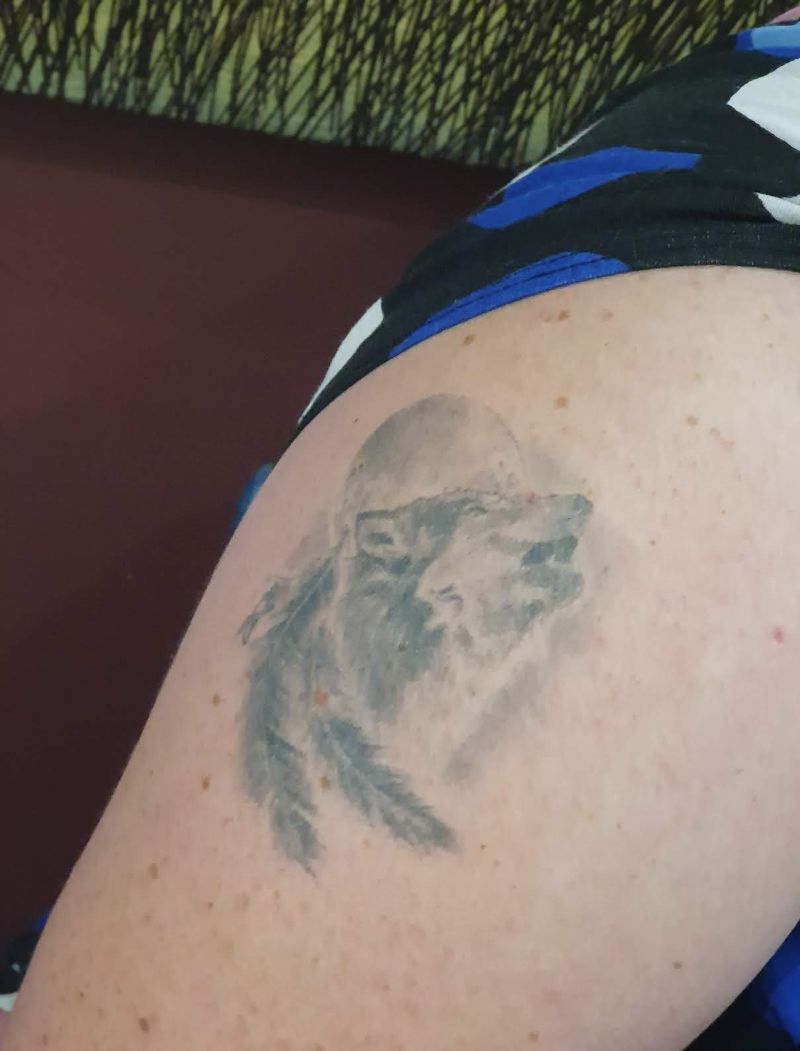

Bernadette20: Exoskeleton Operations Through Anticipated Failure
Bernadette has lived with chronic pain for more than thirty years. She brings a large conceptual vocabulary from lived experience and a Master of Multi-faith Chaplaincy from UQ, which made for more conceptual conversation than Caitlin’s concise practice articulation required. She lives in inner-city public housing and has used Inclusive Health and Wellness Services, acupuncture, and myotherapy since they began ten years ago.
230623_BN_PM2
Dave: ‘How was the pain immediately after the fall?’
Bernadette: ‘Oh, that was nothing – In a stoic sense – just acute injury pain. I was helicoptered to Bundaberg and 84 days in a rotating bed. I already had a pain body from when I was abused by a Grade 1 teacher. It was like, hello old friend. More than that, it was like big, black karmic goo that I knew well and had to shed. Weltschmerz, I already had a sense of that.’
Dave, venturing: ‘A melancholic acceptance at the enormity of it?’
Bernadette: ‘Yeah, but there’s a reality to it, with death so close. Pressing in. Freud realising the death drive when soldiers returned from the war.’
Weltschmerz, the ‘pain of the world’, is a German literary term recognising that reality cannot satisfy the mind’s expectations for restitution (Beiser, 2016). Bernadette later elaborated that she also treats it as a calibration of expectation, that perpetrators of harm need to be met with grace as they too have been harmed (030823_BN_PM3).
230623_BN_PM2
Dave: ‘What other concepts were around at the time?’
Bernadette: ‘Definitely dignitas, or my dad’s weird gay version of it, it doesn’t matter what you look like as long as you have an image of yourself as confident, capable, stylish.’ Her father was a fashion model. ‘And then, of course, the exoskeleton, I got that from my dad too. He came to visit in hospital a lot, one day he said, “it would be great if you were an invertebrate and could regrow your spine.” Then, laughing: next thing I was racing ninety-year-olds in the corridor.’
The generative tracing begins not with the pain but with the medical framework that met it. After the fall, twenty-five metres into a limestone cave, crushing her right foot and breaking twenty-seven bones, the medical apparatus that received her was organised by recovery presupposition, spinal fusion, foot amputation, pharmacological central mechanisms, each presupposing a body that should move toward a disability state the apparatus could recognise (le Goullon, 1995). Her father’s remark at the rotating bed articulates a different presupposition, wishing her body legible to another logic. The exoskeleton is traced from materials assembled long before the fall, the skeleton plate in a childhood Pears Encyclopedia, a worn picture-book she called her ‘Bones’ book, and ancestral stories of armour (le Goullon, 2025), alongside her father’s hospital image. It is a concrete mixed semiotic composed across decades from family, illustration, and clinical encounter. The figure does not seek medical restoration. It begins from a body that will not be restored and asks what can be composed there.
Bernadette performs several transformational translations between the registers she lives across. The first reworks Weltschmerz from a melancholic literary term into the point where composition can begin with imperfection rather than collapse into it. When our third process meeting turned toward the political drama around her accident, Bernadette pulled me up with a boundary-setting tone, ‘That’s the trauma, it’s got nothing to do with what I’m doing now’ (030823_BN_PM3). What she is doing now is composing her life through figurative adventure.
The second translation concerns the disability-income apparatus, the payment and eligibility system through which incapacity is recognised. The epistemic-injustice literature describes a paradox of mandatory failure, requiring people with chronic pain to exhaustively undertake evidenced therapies and document them as certification of entitlement to care (Heggen & Berg, 2021). Continued recognition requires both that cognitive intervention has been undertaken and that impairment persists despite it (Moseley & Butler, 2017). ‘Your Explain Pain course was very useful to my OT report’ (230623_BN_PM2), Bernadette on her bemused participation in an Explain Pain group I ran in 2020. She composes from this condition rather than against it. Her dispensation is grounded in physical incapacity the apparatus reads directly, the crushed vertebrae, the fractures, the osteoporosis (le Goullon, 2025), so it does not depend on her submitting to the cognitive register. Her protocol, consistent since the 1990s pain clinics, holds no cognitive retraining and no pharmacological central mechanisms, ‘I’m a pain-o, not a drug-o’ (230623_BN_PM2).
The apparatus produces the lines of sight along which people become visible to it (Deleuze, 1992), and those lines read only for incapacity, so Bernadette registers along them as an incapacitated body while the composition through which she lives a workable life does not register at all. That composition is her exoskeletal figuration, organising movement and pace around pain rather than reporting it as deficit. To the apparatus it is neither a symptom to be scored nor a recovery to be certified, so it passes unread. This is the register-blindness Chapter 2 diagnoses, and for someone who already holds a dispensation it is protective, since a sustaining practice that stays unread stays unthreatened by the recovery category that might otherwise end her support.
A third translation is older and more public. From the early 1990s Bernadette organised against the location of pain in the psychological register, contributing to the ‘DSS Makes Us Sick’ campaign (see images App. 5) and working through a senate process toward a disability criterion that would recognise pain as biological (le Goullon, 1996). Her play Mystery Plays, Poetry for a Dollar (le Goullon, 1995), staged several times since, composes the same critique satirically, with medical authority as an oracular figure and the consent form as the device that authorises what follows. Two decades before the CAMP and BAMP vocabulary, Bernadette had argued, in terms the welfare apparatus could register, that pain is not resolved by addressing cognition.
From these materials Bernadette extracts a single operative figure, and the diagrammatic function is the exoskeleton. It isolates, from the unformed matter of a damaged and shifting skeleton, the capacity to hold a body in sustainable crisis, a support that organises movement without promising coherence. In her writing she describes standing outside her body to see it as a structure seeking the best placement for its bones, a malleable space in which bones might still grow (le Goullon, 1995). The figure does the work discombobulation does for Caitlin, but in the opposite direction. Where Caitlin’s practice prevents the pain consolidating a coherent body, Bernadette’s composes a coherent-enough body through the constraint itself, organised not toward a recovery that will not arrive but, in her phrase, around ‘racing ninety-year-olds in the corridor’ (230623_BN_PM2).
The figure is effectuated as worn, not merely held. Her father’s dignitas, that an image of oneself as confident and capable matters more than appearance (030823_BN_PM3), operates here as a principle enacted in dress and movement rather than as self-esteem. Bernadette moves through the city in co-designed rolling boots, earlier a repurposed pram for load and stability and now a sportier NDIS-funded Danish version, because urban walking is otherwise impossible. Her therapeutic contacts are distributed and partial, QUT student clinic, a particular Japanese physiotherapist, a West End osteopath for cervical mobility, me for neurodynamic and barefoot movement work, because no single practitioner can hold the whole. She calibrates her days to institutions with predictable hours, libraries, a bowling club, a courthouse lobby, and describes these locations and collaborators as co-conspirators in her destiny, each playing a part in something that should not be workable but is.
Bernadette’s case makes the absence of any route to recognition into compositional ground rather than obstacle. She composes at the register the practice itself reaches. I learned from her to hold contradiction without resolving it, the exoskeleton holding her spine not toward independence but toward a crisis she keeps liveable.
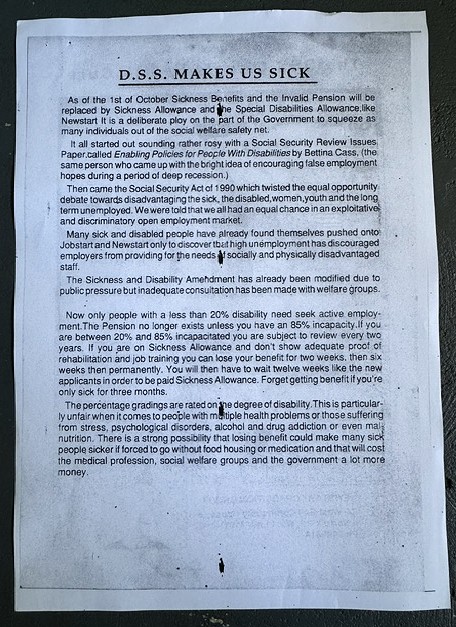
The Immanent Pole: Compositional Work Without Dispensation
Katharine Hepburn21
Caitlin holds dispensations decoupled from her pain, Bernadette a dispensation conditional on the incapacity it certifies and partly secured by the work that contests it, and Katharine none. Presenting with chronic pain, rather than the neurodivergence that grants Caitlin a dispensation or the ‘damage’ that grants Bernadette one, she earns no reprieve from the welfare apparatus, and her figurative work must do double duty. That work is already audible in how she frames her days.
Every day is a festival.
Zeal and enthusiasm are the wings allowing every problem to become entertainment.
The more I hurt, the more I give. (020823_KH_NB)
These are not consolations laid over the pain. They are the formulations through which she composes a workable life with it, and they are the kind of work the analysis that follows reads. Because Katharine holds no dispensations, that work has to carry what an apparatus dispensation would otherwise carry, and the generative tracing therefore begins where her pain begins, before any single apparatus encounter.
Katharine’s pain precedes the apparatus. A breech birth left one leg longer than the other, corrective callipers were fitted in childhood, and the medical apparatus produced iatrogenic injury it never acknowledged, ‘Passed around like a slab of meat. Pain, from birth’ (020823_KH_NB). Domestic violence in adulthood crushed her sinus cavities, and her body rejects most medications. Her continuity of medical care has been broken repeatedly by violence-driven relocation, so the longitudinal record a general practitioner would hold does not survive the moves, and the tenancy history housing applications ask for is unavailable for the same reason (080326_KH_AN3). These are not background. They are the structural texture the analysis attends to.
A field of convergent refusal organises the conditions in which she composes. The employment apparatus, through Centrelink’s mutual-obligation regime, presupposes a jobseeker who can sustain continuous job-search contact and holds no category for homelessness (Stambe, 2022), while the welfare apparatus increasingly does not infer her chronic pain as opening for support (Collie et al., 2022), and ‘Family does not recognise the pain at all’ (080326_KH_AN3). Both welfare and her family withdraw when she cannot meet their normative ideals, a person who can work, who will improve, whose pain indexes a treatable condition. As Katharine makes sense of her situation and her future, she engages with the ‘worse to come’ field. Katharine is not catastrophising her pain but reading her situation accurately and living a life of chronic pain within it.
At the immanent pole the relay specified in the Research Design (Appendix 3) runs in full, her figurative pass doing double duty, modulating the pain at the register where modulation occurs and standing in for the dispensation she has not been granted.22 That the figurative pass stands in for the dispensation is a claim about function, not about orientation. Katharine does not compose toward the dispensation and meet refusal, and she does not route composition through the grid of deservingness at all. The disregard is itself compositional, a dignity that does not depend on the grid it declines, close to the Bartleby formula in Deleuze’s (1993/1997) reading yet populated by figurative composition rather than emptied. All three stages of the relay become legible. Triggering is a-signifying, actualising directly on material access without passing through what the precarity means to her (Guattari, 1979/2011): the dominant series is housing precarity and family dismissal, where violence-driven relocation and the unavailable tenancy record keep the threat of losing a place to live and fire PANIC/GRIEF rather than propositional content (Panksepp & Biven, 2012), ‘my dad and I had a connection my mother and sisters didn’t share, they resented me for it, he died when I was 32 and they cut me out’ (020623_KH_PM2). Inferential capture follows as the housing apparatus assigns her the social-concern designation of the ‘vulnerable older woman’, overcoding the composition into a fixed apparatus position (Deleuze & Guattari, 1987). Refusal and re-modulation follow most powerfully as Red Queening, which labilises the field toward continued recomposition rather than letting the capture settle.
101123_KH_CTC4
Katharine describes the women in the ‘housing vulnerable-older-women’s programme’ she entered in early 2021 as ‘the venerables‘, a portmanteau of ‘venerable and vulnerable’.
The shared temporary accommodation was not at all to her style, with its curfews, petty vendettas, and competition for entitlements. ‘Venerable’ is Katharine’s own inferential operator, and the transformational specification turns on it. The formulation works passionally and post-signifyingly (Deleuze & Guattari, 1987), naming a position the housing programme could not recapture into its grid of deservingness. It speaks the programme’s language of vulnerability, but the surplus it adds, venerability, names a standing the VI-SPDAT grid cannot score, because dignity is not a degree of incapacity and the institutional grid produces only vulnerability categories.23 What escapes recapture is a surplus lodged inside vulnerability, the passional line along which Katharine takes the programme’s term and proceeds past where it can close. That line returns her to the streets, recruiting street friends against their dangers, so the ‘venerable’ formulation wins a standing the institutional grid cannot score without winning safety. Katharine, near tears, recounts her rapport with ‘Bo-Jangles’, ‘he protected me from the worst of street life’ (120922_KH_PM3; see image, Appendix 5).
131022_KH_PM1
Katharine calls her distributed practice White Rabbiting: she has bags containing paraphernalia for all eventualities, and her life’s possessions are spread across nine Brisbane locations she moves between, continually acquiring and shifting contents.
020823_KH_NB
Katherine documents her street-survival strategies on the fly in public spaces: ‘The cleanliness of a cat, the scavenging of an ibis, the intuition of a curlew, the cunningness of a fox.’
The cat’s cleanliness is an actual practice she teaches others, accessing showers and staying presentable on the street ‘for next to nothing’: Aldi rose body-wash, then lotions, then rose oil drops. It’s all about the layering. Smelling good equals feeling good’ (032023_KH_CTC3). White Rabbiting distributes the operator across material practices, each an intensive modulation rather than a metaphor. The scent layering composes directly with periaqueductal grey modulation, engaging the intensive-semiotic without cortical mediation, an entirely different mechanism from representational reframing (Panksepp & Biven, 2012). ‘The more I hurt, the more I give’ works as a calibration of intensive distribution and concrete practice at once, reading court documents for friends who cannot, going to legal aid, accumulating the reciprocal help she calls ‘the Minions: they call me the Erin Brockovich of Brisbane’ (011222_KH_CTC2). The minions provide security and join her with the White Rabbitting of her possessions around Brisbane. None of this is separable from the pain. It is the form the pain work takes when no apparatus relieves the demands around it.
Following an assault by one of the minions, Katharine sets hard boundaries, going directly to support workers and housing services rather than negotiating. She knows her Lewis Carroll and moves from the Rabbit Hole to the surface world of Through the Looking Glass, ‘Off with his head!’, she says of removing a dangerous presence from her field (011222_KH_CTC2). Red Queening is the diagrammatic extraction the minion-violence threshold produces. Where White Rabbiting distributed and withdrew, Red Queening suspends the presuppositions rather than negotiating within them, neither accepting the housing apparatus’s terms nor inverting them but moving to a plane where they no longer hold. She declines the fixed position of the grateful, manageable supplicant. As she puts it with the Little Britain reference, ‘Computer Says No’, the administrators stay at their stations in suspended animation while she moves materially forward (011222_KH_CTC2).
Red Queening is effective, and its effectiveness is where the pain and the housing are most clearly the same operation rather than two. It modulates the pain through sustained intensity, future threat turned into productive charge through repetition rather than resolved, and it does the apparatus-facing work that secured her tenancy at Common Ground. For a participant with no dispensation, these cannot be separated, since the composition that gets her housed is the composition that holds the pain liveable.
The image series below documents a trajectory from homeless to housed. See Red Queening trajectory series: Katharine Hepburn, Appendix 5.
Red Queening trajectory series: Sequential images between September 2022 and September 2023. The visual progression from rain-soaked to regal anticipates a consolidation of the Red Queening operation when Katharine ‘stabilises’ at Common Ground Brisbane



Early images show a rain-soaked figure alone and mobile in the city, and later images grow regal and consolidated, crowned and more formally composed. Over the same window Katharine came to occupy a recognised position at Common Ground, the institution naming her in terms close to her own, ‘venerably vulnerable’, another tenant calling her ‘the Saviour of Common Ground ‘ and the CEO recruiting her for sector promotional videos (100923_KH_CTC4). The figuration that emerged in response to violence was acquiring institutional recognition, and the images register that tendency toward a settled, positional identity. As we see shortly, they do not confirm it as outcome.
This is the point at which figuration risks capture. Deleuze and Guattari (1987) hold that a functioning BwO requires continuous deterritorialisation, without which the formation hardens into a new stratum. What White Rabbiting held, and Red Queening risked losing, was the capacity to remain distributed and to withdraw, and the scent layering and the curlew’s withdrawal held open what sovereign intensity threatened to close. The recomposition continued after the study window as what Katharine calls Pink Queening, a more relational and less sovereign configuration. ‘I am a Darwinist’, she writes in the margin of the penultimate draft, ‘continuous revolutionisation’ (080326_KH_AN3).
The Cautious Curlew: The Affective Operator Learned from Katharine
The route out of the frozen position was an intensive affective operator, and I learned it from Katharine.
081222_DM_FJ
Katharine Hepburn, alone, and sometimes with Bo-Jangles followed curlews at night between Teneriffe, New Farm, and the CBD, large-eyed, pausing in shrubs, then crossing open ground with deliberation. They wail at frequencies that escape capture and are as present in absence as in appearance.
My first version of the figure was too romantic, and Katharine corrected it on a late draft (080326_KH_AN3): curlews are slow and cautious, and the wail is not only a withdrawal but the cry for the endangered chick, out of sight, an audible vulnerability pitched where institutional channels do not register it. The affective operator produces from the knowledge that no apparatus will reciprocate, rather than from the hope that one will or the despair that none does.
The difference from the DLC is semiotic, not temperamental. The inferential operator that opened this chapter freezes because its refusal stays bound to the subjectification point, the wounded ‘I’ of the passional series. The intensive operator continues because it works a-signifyingly, producing presence at the body register that fired rather than petitioning the apparatus that captured. In the vocabulary of the relay (Appendix 3), the DLC is held at capture while the Cautious Curlew completes the third operation, re-modulation toward transduction. This is a BwO approached with caution rather than emptied at a stroke (Deleuze & Guattari, 1987), keeping the SEEKING system open with PLAY and CARE and deterritorialising by situated dosage rather than all at once (Panksepp & Biven, 2012). The curlew’s wail is the separation-distress cry of the PANIC/GRIEF system pitched as tentative composition rather than numbed, the operational opposite of the frozen operator sliding toward burnout, “botching” the BwO in the attempt (Deleuze & Guattari, 1987, p. 161).
The participants taught the limits of the inferential operator directly. Bernadette declined my narration of her history as passional injury, and Caitlin’s dissolution showed a body composing by refusing to know itself where my training had been to help it know itself better. What enabled them to operate where the DLC initially froze was that their composition did not wait on the apparatus to return anything. The reflexive finding is that my recognition of their figurative expertise was itself a figurative practice, learned in the encounter and conducted from a shared position rather than from clinical exteriority.
Coupled, the Dead Letter Clerk and the Cautious Curlew let the thesis work proceed: inferential compliance continues and the thesis is written, while the affective positioning stays exterior to the apparatuses it documents. The coupling is what allowed the participants’ compositional expertise to be recognised, and the mode of that recognition is what matters for Social Work. It did not proceed through empathy in the sense Chapter 2 questions, the worker folding self into other through Einfühlung, but through co-composition in a shared field, what social pedagogy terms the Common Third (Husen, 1996; McCreadie, 2020). Here the common term was the ‘worse-to-come’ condition itself, the field of refused dispensation within which Katharine and I both compose. This is the transitive compositional figuration Chapter 2 proposed, the practitioner’s figurative tradition turned toward sustaining what the participant has already composed.
Diagrammatic Extraction: Differential Dispensation and the Intensive-Semiotic Necessity
The three participant compositions and the researcher’s compound form concrete assemblages whose comparison extracts a common diagrammatic function intended to operate beyond this site and, with it, a structural differentiation. The function is figurative style-practice as intensive modulation of the register where signification-based intervention cannot operate. The differentiation is in the conditions under which that modulation has to work. Each composition is placed under a different pressure in relation to apparatus dispensation, and the section is organised by that pressure, from positions where the apparatus has left a node open to positions where it converges in refusal.
Caitlin and Bernadette compose where the apparatus has left a node open. Caitlin’s discombobulation prevents pain consolidating as organising principle, the wolf and eagle extracting pack-dependency and solitary clarity at once, a diagram durable enough to be inscribed on her body and to keep composing as the Common Ground world changes around it. Whether the apparatus relaxed its presignifying demands or whether this composition kept the apparatus from finding the node from which to press them is not decidable from the material, and the figurative work may be part of what keeps the triggers from firing rather than a practice some prior dispensation made room for. Bernadette’s exoskeleton composes through anticipated failure, Weltschmerz operating as the certainty from which composition begins rather than the point at which it collapses. Both form a durable constraint that sustains her ongoing capacity to support troubled friends and neighbours through injustice and crisis and that she has turned outward in public refusal of the apparatus that would diminish her. Her dispensation is partly engineered through that work rather than conferred on her. Where Caitlin’s assemblage dissolves the conditions pain requires, Bernadette’s composes through them as material ground. In both, the dispensation and the composition are co-produced, so the figurative work is primary and not substitutive, running alongside a modulation it has partly helped to secure.
Katharine’s case operates at the immanent pole. Where Caitlin and Bernadette found the apparatus open enough for the composition to act on it, Katharine faces convergent refusal, so the route that partly engineers a dispensation is foreclosed and the same expertise has to do double duty instead. The durability of the compositions a dispensation supports is registered from here as something this position cannot secure, with the compositional capacity present and no node available for the composition to work. The figurative work cannot run alongside a modulation performed elsewhere. It stays primary, the composition that holds her life, and it now also substitutes for the modulation no dispensation performs, doing at the body’s register what the apparatus declines at its own. This doubled load is what drives the composition toward the Abstraktion pole and toward recomposition on the fly. The ‘venerably vulnerable’ operator composed at the passional-postsignifying register, White Rabbiting distributed it across the material practices populating the organic intensive-semiotic row of the double-articulation table (Appendix 1), and Red Queening emerged when convergent refusal and intimate violence required a threshold change rather than navigation, the ongoing Pink Queening registering its continuation beyond re-capture.
The Dead Letter Clerk and Cautious Curlew operate at the same pole, since the academic apparatus offers no designation that releases the presignifying demands of completion. The Dead Letter Clerk is the inferential operator, and it freezes because its refusal stays bound to the point of subjectification, the wounded position of the passional series that requires the apparatus to eventually reciprocate (Deleuze & Guattari, 1987). The Cautious Curlew is the affective operator learned from Katharine, and it produces from knowledge of non-reciprocity rather than from hope of it or despair at its absence. It does not resolve the Clerk’s passional regime. It couples with it, completing the third operation the relay specifies (Appendix 3), re-modulation toward transduction, so the body that types can continue from knowledge that typing fails. The Curlew carries, at the researcher’s register, the substitutive re-modulation that Red Queening and the distributed operators carry at Katharine’s.
What the four share is the operative register. Each composes at the intensive-semiotic level where subcortical affective systems operate through gain control and threshold calibration (Panksepp & Biven, 2012), the modulatory logic Deleuze (1992) identified as control society’s mechanism. What differentiates them is whether the apparatus left a node the composition could turn into a pass or converged in refusal, and the burden that difference places on figurative practice. The BAMP register that Moseley and Butler’s (2017) framework concedes as the more evidentially robust pathway becomes the operatively necessary one.
The two capture operations of the relay (Appendix 3) do not bear equally across the gradient. Where the apparatus has left a node open, inferential capture predominates and passional capture runs light, and figurative transduction runs alongside an apparatus that has performed some of the modulatory work. Where it converges in refusal, both run at full weight, passional capture in particular, since anger at apparatus refusal and hope held as a placeholder are the affective economy of the position where dispensation is refused (Stambe & Parsell, 2023), and figurative transduction bears the whole load of a re-modulation the apparatus performs nowhere. The substitutive burden on figurative practice rises as the apparatus closes. What this necessity asks of Social Work is the question Chapter 5 takes up.
‘I am a Darwinist’, Katharine annotates, ‘continuous revolutionisation’. The figurative composition does not arrive at an endpoint. It composes under conditions that require persistent recomposition for the operation to continue at all.
Discussion: Social Work, the Encounter, and the Figurative Register
This study set out to document the figurative style-practices developed by participants living with chronic pain within a supportive housing setting. What emerged was evidence of an operative register distinct from the empathic identification social work has positioned as its core competence. The findings extend social workers’ intuitions of the operative register of pain. They suggest reorienting from empathy for acceptance of pain and social conditions, to more active attunement with figurative style practices. The attention is directed to the relational conditions and resources that enable figurative compositions through which people already compose sustainable intensive lives within apparatus constraints.
Social Work has long held that its therapeutic work runs through the quality of the encounter rather than through technique, but it has largely theorised that encounter as empathy, the worker projecting into the client’s experience. Lynch’s (2012) account of the encounter provides a disciplinary grounding, and this study contributes a theorised mechanism for that encounter’s efficacy. The figurative practices documented with Katharine, Caitlin, and Bernadette work through the construction of a shared intensive field in which threshold modification becomes possible. Evaluating the balance of evidence, this thesis theorises subcortical catalytic transduction operating materially through the a-signifying register of the PAG-RVM system as the therapeutic focus over digital cortical (re)inferencing.
This distinction carries consequences. Social work’s empathy framework, grounded in Einfühlung, the identificatory folding of self into other, assumes the worker’s emotional attunement is the operative mechanism of therapeutic change. The self-care and boundaries apparatus exists because this operation is understood as inherently depleting, with practitioners requiring protection through withdrawal and replenishment. The empathy-burnout-boundaries circuit is internally consistent once one accepts that the operative register is Einfühlung.
The empirical findings point to a register the body runs beneath identification. The figurative practices documented here operate through what Guattari (1979/2011) identified as the a-signifying register, intensive, subcortical, and irreducible to the signifying surface of diagnostic categories or intersubjective identification. The PAG-RVM does not respond to empathic projection. It responds to a-signifying inputs, and specifying these in everyday practice is essential if the distinction is to have operational consequence. Rhythmic co-regulation, the pacing and affective prosody of speech, walking speed matched to the participant, and the temporal texture of activity without agenda, entrains autonomic systems directly, prior to and independent of conversational content, modulating vagal tone through what Porges (2011) specifies as the social engagement system. Consistent material presence functions as a conditioning operation rather than as the signifying virtue of reliability, where repeated co-occurrence of relational safety with specific spatiotemporal cues produces anticipatory shifts in tonic opioid and oxytocin availability. Humour operates a-signifyingly when it produces somatic discharge through transient PLAY-system activation (Panksepp & Biven, 2012), distinct from the joke as semiotic performance. Somatic resonance operates without identification, the worker’s body responding to the participant’s affective state through direct autonomic coupling beneath conscious awareness on both sides (McParlin et al., 2022). Practitioners recognise these operations immediately, and the empathy framework provides no account of why they work.
The discussion develops in three movements. The first reads the encounter against the social work literature and specifies the a-signifying mechanism that existing frameworks reach toward without naming it. The second differentiates the affective capacities this mechanism draws on, separating acuity, generation, and responsivity from the unitary skill that emotional intelligence assumes. The third examines how institutional apparatus constrains each capacity differentially, and how figurative practice operates as counter-control where the apparatus would modulate on the person’s behalf. The apparatus-pass gradient developed in Chapter 4 runs through all three, from compositions sustained under a relative pass to those doing substitutive work where the pass is withheld.
The Encounter in Social Work Literature: What Existing Frameworks Struggle to Theorise
This first movement positions the documented register within the social work literature. Chapter 3 drew the double articulation from Hallahan’s (2013) recognition that affliction exceeds signifying intervention and set out the pragmatic analytics that recognition reached toward. With the analytic in place, a wider field of social work scholarship comes into view, each line of it reaching toward the same operative register without the account of mechanism that would specify it. The point is not that these contributions missed something available to them. It is that the register they describe becomes analysable once double articulation names where it works.
Reynolds (2019) identifies two failure modes, enmeshment and disconnection, and proposes the Zone of Fabulousness as the space of connection between them, recognising that self-care individualises the response to structurally produced harm. She does not, however, theorise what occurs within the zone that differs from empathic identification. Read through the consistency developed here, the zone names the relational conditions under which a-signifying encounter becomes possible, where workers construct assemblage conditions for intensive threshold modification rather than identificatory merging, without investing the identificatory resources whose exhaustion manifests as burnout. Jerwood et al. (2021) provide patient-side evidence of what disconnection costs, documenting people with severe mental illness and terminal physical conditions abandoned by professionals doing what the empathy-burnout-boundaries apparatus prescribes. Their finding that patients valued the quality of relational attunement, not knowledge or procedure, aligns with the operative register theorised here.
Shevellar and Barringham (2016) name the boundary tensions specific to community-based practice, documenting workers who cannot speak their practice in the language the profession provides. The author’s earlier work (Shevellar et al., 2014), on the search for belonging, drew on the figurative resources of Christian community and embodied theology. Parsell and Stambe (2024) extend this, examining how Christian faith functions as a figurative resource for charity workers, an a-signifying operator of embodiment irreducible to identification and presence operating at the intensive level. Stambe and Parsell (2023), however, demonstrate the limits of hope as a figurative resource within residual welfare capitalism. Hope enacted through postsignifying charity, where the volunteer’s compassion proceeds as a passional line from their own point of subjectification, reinscribes self-responsibilised subjectivity in the recipient rather than composing relational capacity. The charitable apparatus captures hope precisely because it circulates within signifying-passional regimes rather than operating at the a-signifying register where compositional transformation becomes possible.
5.1.1 Clinical Staging and the Lateral Encounter
The practical context of this study provides further evidence for the operative distinction. Micah Projects Ltd funds its workforce to attend Blue Knot Foundation complex trauma training, grounded in Herman’s (1992/2015) stabilisation-processing-integration model and the window of tolerance (Ogden, 2015; Siegel, 1999), clinical psychology’s own movement toward the intensive register and its recognition that signifying interventions alone are insufficient for complex trauma. The window of tolerance, the range of arousal within which adaptive functioning is possible, roughly maps in extensive terms what this thesis theorises as the exploit/explore dopaminergic threshold governed by PAG-RVM dynamics and figuratively as a sustained intensive state of the BwO. The vlPAG passive coping columns preferentially recruited by sustained deep-tissue pain (Tinoco Mendoza et al., 2023) produce the stillness, autonomic quieting, and affective flattening, the dorsal vagal immobilisation familiar from polyvagal-informed practice (Porges, 2011). Clinical staging reads as ‘not yet ready for therapeutic work’, yet the lateral encounters workers describe as most meaningful may operate precisely at this register, co-regulating an autonomic state that signifying intervention cannot reach.
These approaches tend, however, to be organised within staged clinical frameworks of bounded sessions, referral pathways, and treatment episodes. Within Micah Projects, this framing distinguishes Support and Advocacy workers, associated with stage one stabilisation, from the Wellness team, understood as contributing to stages two and three. Yet case workers at Micah consistently reflect that their most meaningful relational work occurs in interstitial contexts, the car travelling to appointments, walking alongside participants to Centrelink, or sitting together in a waiting room, rather than in formal settings. These lateral encounters, unstructured, embodied, and situated within shared institutional navigations, suggest that the conditions under which the exploit/explore threshold shifts are broader than the clinical frame captures. The worker relating in the car is co-regulating at the vlPAG register, contributing through incidental encounter to the assemblage conditions within which the threshold can move, rather than providing stage one stabilisation as a precondition for later work.
During the first three months of the study window the researcher occupied both roles, support and therapy, and across both, chronic pain was the affective territory through which many encounters were navigated rather than a diagnostic category. The figurative practices documented with Katharine, Caitlin, and Bernadette emerged through durational, embedded, laterally situated somatic encounter rather than staged clinical process. The signifying-regime capture documented in the literature review, where vlPAG passive coping is recoded as depression, learned helplessness, malingering, or noncompliance, is reproduced in the staging framework’s own logic (Christensen et al., 2022). Here the person presenting with autonomic quieting is assessed as not yet ready for therapeutic work, when the lateral encounter is already engaging the register where transformation occurs.
5.1.2 Figurative Contraction and the Missing Framework
What connects these contributions is a shared orientation toward something existing frameworks have not fully theorised, the intensive relational register through which the discipline’s own practitioners already work.
What follows for social work practice is an affirmation of attention to relational work. The Dead Letter Clerk (DLC) has produced enough protocols to know they arrive dead. Instead of treating people as subjects who should be tending toward equilibrium, attention turns to the compositional operations already occurring where equilibrium was never available as ground. Clinically, the practitioner’s task is to recognise figurative style-practice without converting it into apparatus-legible output, whether measurable outcomes or standard categories. The capacity is to engage without fixing and to attend without capturing.
These operations also describe the research relationship that produced the findings. The DLC and the Cautious Curlew name the researcher’s position within it, and the reversal Chapter 4 traced is an instance of the register specified here. The inferential operator could not generate the figurative, and what moved the work was recognition of what the participants had composed, reached not by projecting into what they felt but by attending to the figurative style itself. Co-composition was generative for the research as much as for the participants’ modulation of pain, since the material documented here emerged through the encounter rather than being extracted across it. The reflexive move past empathy is therefore the same move the practice findings describe, performed in the register of method.
The contemporary condition is one in which the figurative work most available to the profession has contracted to a striating function at the extensive, representational pole (Deleuze & Guattari, 1987). This is the operation through which identity politics generates identity, marginalisation, and subjectivity while working the signifying surface of representation and recognition. Where this striating mode is the figurative resource most readily to hand, the intensive relational register is left under-resourced, and the profession has relied on the empathy-boundaries apparatus even where practitioners sense something else is needed. This thesis suggests somewhere else to go.
This is why the researcher’s position, framed through the conventions of critical reflexive practice (Healy, 2001) as a pragmatic choice that made the reflexivity section legible to examination, should be read against the grain of the thesis’s argument. Healy’s reflexivity locates the ethical work in the practitioner’s discursive self-management, where the Common Third ethic (Husen, 1996) locates it in the activity undertaken between practitioner and participant. In neoliberal welfare settings, reflexivity-as-self-management functions as an individualising technology, maintaining the practitioner as an accountable subject within institutional contradiction without disturbing the apparatus that produces it. The DLC and Curlew figuration of Section 4.4 is instead a diagrammatic extraction of the researcher’s operative position, what the inferential and affective registers were doing and where they diverged under apparatus demand. Reflexivity that asks what kind of subject the practitioner is reproduces the apparatus. A diagrammatic account of what the compositional field produces opens the possibility of a practice that does not.
Differentiating Affective Capacities: Acuity, Generation, and Responsivity
The second movement turns from the encounter to the capacities it draws on. The dominant clinical framing of emotional intelligence (Goleman, 1995) presupposes affects as discrete categorical states amenable to inferential management, where one identifies anger, deploys empathy, regulates fear, each operation a cortical inferential discrimination followed by strategic selection, a digital process treating affective life as an object for cognitive manipulation. The figurative practices documented here operate instead through subcortical analogue modulation (Panksepp & Biven, 2012), navigating continuous intensive variation without digitising it into named categories. Considering the findings and what the methodology and participants were doing, three differentiated capacities emerge: acuity, generation, and responsivity.
5.2.1 Affective Acuity
Affective acuity designates the capacity to discriminate intensive gradients, registering shifts in the affective field as continuous variation rather than categorical recognition. Where emotional intelligence frameworks ask, ‘what emotion am I feeling?’, affective acuity operates as sensitivity to modulation itself, to changes in tonic intensity, threshold proximity, and the differential relations between primary-process affects as these compose and recompose in real time (Davis & Montag, 2019; Panksepp & Biven, 2012). Acuity in this sense is closer to its clinical uses, naming the fineness of gradient discrimination rather than the accuracy of categorical identification.
5.2.2 Affective Generation
Affective generation names the active composition of new figurative materials, seeking encounters that expand the palette available for modulation. This is a dopaminergic SEEKING-system operation (Panksepp & Biven, 2012), assembling heterogeneous materiality into the figurative assemblage. Katharine exemplifies this capacity, her engagement with art exhibitions, cinema, volunteer ecological surveys, and cultural encounters constituting continuous production of compositional resources for the figurative repertoire from which her Red Queening operates. Generation requires access to cultural materials, mobility, and encounters with heterogeneous assemblages, and is therefore directly constrained by apparatus conditions and employment obligations. Caitlin provides a productive contrast, having long established the Wolf-Pack/Eagle and so requiring less ongoing generation, able to deploy existing figurative materials for compositional problems beyond her own pain-affect assemblage.
5.2.3 Affective Responsivity
Affective responsivity names the capacity to modulate the figurative palette in real time as affective conditions shift, the analogue control operation proper. It is distinct from acuity and generation, since a person may demonstrate fine-grained discrimination and prolific production while showing limited capacity to recalibrate when the intensive field transforms beneath them. Katharine’s case is instructive because this differential is visible, her affective generation sustained and diverse while her responsivity in modifying her figurative and inferential palette when conditions change does not always match it. This is a specific configuration of separable operations, each with distinct developmental conditions and distinct vulnerability to apparatus disruption and disingenuity rather than a deficit in emotional intelligence understood as a unitary skill.
Apparatus Constraints and the Counter-Control Function
The third movement takes the gradient as its explicit object. The differentiation of acuity, generation, and responsivity bears on how institutional apparatus constrains figurative practice, differentially across the apparatus-pass gradient. Acuity is attenuated where pharmaceutical intervention flattens analogue modulation, serotonergic medications reduce pain while also “dampening every motivational and emotional urge in the brain” (Davis & Montag, 2019, p. 250). Generation is constrained where the material conditions of composition are consumed by compliance monitoring and administrative demand. Responsivity is constrained where the apparatus requires continuous representational accounting, drawing the person out of analogue self-modulation into the stressors of digital inferential processing (Payne et al., 2015).
Pharmaceutical modulation operates at the same primary-process level as figurative practice, which constitutes it as a rival modulation on the same analogue field. The affective blunting reported in a majority of patients on serotonergic medication (Christensen et al., 2022; Goodwin et al., 2017) is an attenuation of the graded affective intensities through which the figurative palette is composed. Where the apparatus has granted a dispensation, that attenuation can be folded into the composition as one calibrated input, where Caitlin’s figurative diagram can sustain day-to-day intensities. Where it has refused the dispensation, the same attenuation narrows the analogue field at the register where the figurative work has to be done. Figurative practice is in this sense counter-control as well as counter-signifying, sustaining autonomous analogue modulation where control society (Deleuze, 1992) would modulate excessively on the person’s behalf through pharmaceutical calibration, algorithmic threshold management, and graded activity monitoring. The clinical bundling of pharmaceutical management with pain science education (Fitzcharles et al., 2021), obscures that these are operations on two registers, control operating on intensity and the signifying regime on expression. Chronic pain is increasingly drawn into mental health pathways whose central mechanism the World Health Organisation (2021) identifies as an obstacle to the person-centred, rights-based care its guidance sets out.
At the extensive, representational pole of the assemblage, where rights discourse operates, this withdrawal is legible as a compliance failure in the instruments themselves. Article 19(a) of the UNCRDP protects the opportunity to choose one’s place of residence and provides that persons with disabilities are not obliged to live in a particular living arrangement (United Nations, 2006). Australia’s Disability Strategy 2021–2031 renders the corresponding housing right as choice and control over where one lives, with whom, and who enters the home (Department of Social Services, 2021), without the protection against obligation to a particular arrangement. McCallum’s (2020) assessment for the Disability Royal Commission reports the Committee on the Rights of Persons with Disabilities finding that Australia lacks housing solutions for people with mental health disability ineligible for the NDIS, and the Australian Human Rights Commission identifies the Specialist Disability Accommodation framework as drawing those inside the scheme into a particular living arrangement as a condition of accessing supports (2019). Figurative style-practice is arguably the operation through which the omitted clause, ‘not obliged to live in a particular arrangement’, is materially exercised, the personal production of liveability that accommodation alone does not deliver. The omission at the representational pole articulates the same withdrawal the gradient traces at the intensive-semiotic register, the level where the apparatus withdraws the conditions for style is also where it withdraws the dispensation.
The study site holds this structure in a single provision. Micah staff complete an annual naloxone module as a condition of employment, so the apparatus mandates a certified, recurring capacity to reverse the opioid-emptied body at the point of arrest while funding none of the conditions under which a body sustains the appetitive openness a cautious BwO requires (Panksepp & Biven, 2012). The provision arrives at the terminus, the reversal of an emptying rather than relief of the conditions that produce it, the placeholder structure of welfare hope read at its limit (Stambe & Parsell, 2023). In the inferential reading the Dead Letter Clerk performs, this is the ‘worse to come’, the accurate anticipation that the apparatus will reliably provide the certified reversal and not the dispensation.
Limitations
The limitations are articulated through the methodology’s own logic rather than against criteria borrowed from a different epistemic regime. Assemblage thinking claims intensive specificity, the capacity to document operations in their concrete singularity, rather than statistical generalisability (DeLanda, 2002, 2006).
The study documents figurative style-practices developed by three women within a specific supportive housing assemblage in South Brisbane, where seven years of embedded somatic practice and attention constitutes the evidential warrant. Whether the mechanisms identified, a-signifying encounter, subcortical threshold modulation, and catalytic transduction, operate in other assemblages is a question for further research that follows from the design’s intensive specificity. The practitioner-researcher dual role is a methodological condition rather than a confound, since those years of embodied trust were the precondition for participants sharing figurative operations they do not ordinarily disclose to institutional actors. The decision to forgo recording and coding followed from the recognition that capture-based data production would convert a-signifying intensive material into signifying output, performing the operation the thesis critiques.
The all-women composition emerged as finding rather than design criterion. Women’s pain is rendered minoritarian through normative processes producing certain bodies and relations of care as less credible (Grosz, 1994), and this minoritarian positioning becomes a site of figurative innovation. The functive register complicates any clean separation of the social from the biological, since descending pain inhibition is itself sexually dimorphic, males modulating primarily through opioidergic pathways amenable to self-regulation while females engage non-opioid systems more dependent on social co-regulation through oxytocinergic mechanisms (Dean et al., 2024; Loyd et al., 2008). The individualist presupposition governing pain therapeutics may therefore be inadequate for women on two grounds at once, socially through normative marginalisation and neurobiologically through a male opioidergic supposition that does not describe how female pain modulation operates.
The convergence of minoritarian positioning with co-regulatory neurobiological necessity, taken together, may produce the conditions for the figurative innovation documented here, and a methodological consideration follows. A more rigorous assemblage method would attend to the figurative articulation and the physiology of a-subjective affects within the same assemblage rather than across borrowed ones. Massumi’s (2002) recourse to discrete physiological studies as evidence for affect remains open to the critique Leys (2011, 2021) develops, that affect theorised this way detaches physiological findings from the conditions that produced them. Subcortical tracking of the same assemblage under figurative study answers that critique by holding expression and physiology together, marking the relay point a differently equipped assemblage could pursue. The present study specifies the conceptual and aesthetic registers and leaves the functive register open for that parallel tracking.
Bounded Significance
These figurative practices, empirically documented with these participants in this setting, demonstrate an operative register distinct from Einfühlung, operating through a-signifying encounter rather than identificatory merging. This has consequences for how social work theorises its therapeutic function and its practitioners’ sustainability, and for its relationship to the psychiatric paradigm it is increasingly subordinating itself to (Morley & Macfarlane, 2019). This thesis contributes a framework for understanding what is already happening in the intensive margins of practice, the figurative work practitioners and participants do together, often without institutional recognition, to sustain viable affective ecologies under conditions that should not support them. The three registers, the scientific functive, the inferential conceptual, and the affective aesthetic, relay through each other without correspondence. Patterns can be tracked between the figurative capacities at inferential and intensive registers with participant collaboration in tracking subcortical tone. This is the iterative capacity of assemblage thinking, opening relay points between registers pursuable by differently equipped assemblages.
The same register suggests a reach the study does not test. Where belonging is recoded as sameness, through recognition politics or a monocultural politics of shared values alike, relation is made to depend on a shared signified identity. The Common Third and a-signifying encounter compose relation prior to that identity, which offers social work a way of engaging difference that does not require participants to share a culture, a history, or a creed. This is a direction the framework opens rather than a claim the study establishes.
What Katharine, Caitlin, and Bernadette demonstrate is that the people to come (Deleuze & Guattari, 1991/1994) are already here, composing under the very conditions the apparatus produces as deficit albeit it they do this through a different compositional logic, under different apparatus pressures, with a different configuration of acuity, generation, and responsivity. What the apparatus considers to be a deficit could be a productive activity that its own measures are unable to recognise or value.
Mazzucato’s (2019) economic distinction between value creation and value extraction helps explain this problem by highlighting the political-economic dimension that a differently equipped assemblage or system could pursue. Figurative style with pain and illness enable idiosyncratic yet socially and culturally engaged people, reframing the staggering economic cost quoted by all medical pain researchers. Social Work’s task is to recognise the interventions they have already designed, to provide the relational conditions under which those interventions can continue to function, and to develop the conceptual language through which their compositional expertise becomes transmissible. The challenge being to prevent, in the very act of transmission, converting it into the signifying regime’s currency and thereby losing the potential value of people’s agentic endeavours to manage pain and, indeed life, despite system failure and apparatus impossibility.
Conclusion and Recommendations
This thesis asked how people with chronic pain develop figurative style-practices enabling creative living through sustained apparatus impossibility, and what capacities, exceeding therapeutic recognition, emerge through navigating structural constraint. The question arose from a practitioner’s position, seven years of practice at Micah Projects’ Inclusive Health and Wellness Hub, during which it became evident that participants were doing something the dominant frameworks could not describe. What Katharine, Caitlin, and Bernadette demonstrated was compositional expertise, the sustained, skilled production of affective ecologies through figurative operations working at registers the signifying apparatus does not reach. This capacity sits outside resilience, coping, and acceptance as those terms operate within Explain Pain and acceptance-based therapeutics, which address the signifying subject the expertise exceeds.
Summary of Findings
The thesis established three interconnected claims. First, through the independent convergence of Guattari’s a-signifying semiotics and Panksepp’s primary-process affective neuroscience, it demonstrated that the operative register of chronic pain belongs to the a-signifying register rather than the signifying regime targeted by Cognition Associated Molecular Patterns (CAMPs) and pain neuroscience education. The operations at issue are subcortical threshold modulation through subcortical PAG and RVM dynamics, primary-process affective circuit activation, and opioidergic tone, all of which trigger, modulate, and activate without passing through meaning or representation. The clinical consequence is that signifying interventions such as cognitive reappraisal, psychoeducation, and narrative reframing address the modulatory overlay while leaving the generative machinery untouched.
Second, through assemblage thinking as methodology across a seven-year practitioner-researcher engagement and a one-year research ethics window, the thesis documented figurative style-practices operating at this register. The three-component framework of affective acuity, generation, and responsivity specified the capacities these practices mobilise, gradient discrimination, compositional resource production, and real-time modulation. Each participant demonstrated a different configuration. Katharine’s Red Queening assembled heterogeneous cultural encounters into continuous threshold maintenance, Caitlin’s Wolf-Pack/Eagle consolidated an established figurative assemblage deployable across shifting demands, and Bernadette’s exoskeletal practice composed constraint itself as generative structure. These operations exceed existing therapeutic and social work frameworks, which presuppose a representational subject amenable to signifying intervention.
Third, the thesis demonstrated that the institutional apparatus actively disrupts these capacities through operations on two registers. First, control-society modulation, through pharmaceutical titration and algorithmic threshold management, operates at the same primary-process level where figurative practices function. Second, signifying-regime capture, through compliance monitoring and representational accounting, pulls participants out of continuous analogue self-modulation. The clinical bundling of these operations as a single multidisciplinary intervention obscures the register distinction the thesis identifies as its central contribution.
Recommendations
The findings carry implications across practice, policy, and research, oriented by the thesis’s central reorientation, from designing interventions for people with chronic pain toward recognising the interventions they have already designed and providing the conditions under which those interventions can continue to function.
Practice. Social work education and supervision should develop conceptual resources for recognising a-signifying encounter as the operative mechanism of relational practice with people experiencing chronic pain, rather than empathic identification operating through the signifying register. The reorientation names what practitioners already do, modulating vocal tone, nuanced humour, and maintaining relational consistency across institutional disruption, as skilled practice at the register where therapeutic change occurs rather than incidental accompaniment to assessment, referral, and case management. Frameworks distinguishing signifying interventions such as psychoeducation and cognitive reappraisal from a-signifying encounter such as somatic co-regulation and durational consistency are also required, and the acuity-generation-responsivity framework offers one, enabling assessment of which capacity is constrained and by what mechanism. This recognition warrants confidence introducing people directly to artistic, creative and participatory practices as figurative intervention in its own right, ahead of medical referral. Micah Projects’ art, music and gardening groups already provide this infrastructure of heterogeneous encounter.
Policy. The convergence of figurative practice with supportive housing infrastructure at Common Ground Brisbane is structural rather than incidental, since figurative style-practices require durational conditions, material stability, relational continuity, and access to heterogeneous encounters, that housing precarity forecloses. Three implications follow. Firstly, the NDIS’s individualised funding model has withdrawn support from the collective and durational programmes this study identifies as holding the conditions for figurative practice across a population, and the 2026 restructure extends that withdrawal to psychosocial access itself, a reversal social work should contest through proactive advocacy for returned cohort funding (Australian Psychosocial Alliance, 2025).24 Secondly, Australia’s Disability Strategy 2021–2031 takes up Article 19’s right to choose where one lives while omitting its guarantee against being obliged to live in a particular living arrangement (Department of Social Services, 2021; United Nations, 2006), and the figurative style-practices documented here arguably exercise that foreclosed choice materially where no institutional provision exists. Thirdly, the Brisbane 2032 infrastructure programme threatens the remaining supportive housing and inner-city boarding house stock through renewal-driven displacement. Policy addressing chronic pain in disadvantaged populations must account for the relational and material infrastructure required for a-signifying modulation, not only the clinical programmes delivered within it.
Research. The framework anticipates physiological actualisations open to functive measurement. A protocol monitoring endogenous opioid-mediated descending inhibition through infrared pupillometry and salivary beta-endorphin assay would compose with the findings rather than validate them. The four-term transformational specification offers a replicable frame for settings where a-signifying operations are operative but untheorised. Further research should ask whether the mechanisms identified operate in assemblages beyond this configuration, including aged care, disability services, and community mental health settings. The dispensation gradient raises whether worker figurative attunement, through creative group facilitation, supports movement from high drug use and high-load un-passed figurative work toward sustaining intensive practices, with figurative work on art as theoretical relay (Buchanan & Collins, 2014). It also invites tracking dispensation-seeking, the organising activity of Australian social work under residual welfare, and the work and resourcing figurative style-practices require, as conjoint demands rather than alternatives.
Closing
The Dead Letter Clerk processes what the signifying system could not deliver. The Cautious Curlew maintains the wail not expecting the city to listen. Between them, the compound figuration performs the thesis’s concluding operation, sustained attention to what is already happening in the intensive margins of practice, where people compose viable affective lives under conditions they should not have to live with.
References
Adams, R. E., Boscarino, J. A., & Figley, C. R. (2006). Compassion fatigue and psychological distress among social workers: A validation study. American Journal of Orthopsychiatry, 76(1), 103–108. https://doi.org/10.1037/0002-9432.76.1.103
Akira, S., Uematsu, S., & Takeuchi, O. (2006). Pathogen Recognition and Innate Immunity. Cell, 124(4), 783–801. https://doi.org/10.1016/j.cell.2006.02.015
Allegretti, A., Borkan, J., Reis, S., & Griffiths, F. (2010). Paired interviews of shared experiences around chronic low back pain: Classic mismatch between patients and their doctors. Family Practice, 27(6), 676–683. https://doi.org/10.1093/fampra/cmq063
Australian Human Rights Commission. (2019). Information concerning Australia’s compliance with the Convention on the Rights of Persons with Disabilities. www.humanrights.org.au
Australian Psychosocial Alliance. (2025). Access denied: Psychosocial disability and the NDIS. https://psychosocialalliance.org.au
Baker, T., & McGuirk, P. (2017). Assemblage thinking as methodology: Commitments and practices for critical policy research. Territory, Politics, Governance, 5(4), 425–442. https://doi.org/10.1080/21622671.2016.1231631
Bantel, C., & Sörös, P. (2021). On pain – Virginia Woolf and the language of poets and patients. British Journal of Pain, 15(4), 497–500. https://doi.org/10.1177/20494637211009253
Barlott, T., & Setchell, J. (2023). Edge entanglements with mental health allyship, research, and practice: A postqualitative cartography. Routledge.
Beer, A., Daniel, L., Baker, E., & Lester, L. (2020). The Shifting Risk of Homelessness among Persons with a Disability: Insights from a National Policy Intervention. International Journal of Environmental Research and Public Health, 17(18), 6512. https://doi.org/10.3390/ijerph17186512
Beiser, F. C. (2016). Weltschmerz: Pessimism in German philosophy, 1860-1900 (First edition). Oxford University Press.
Bergson, H. (1977). The two sources of morality and religion. University of Notre Dame Press. (Original work published 1932)
Bochner, A., & Ellis, C. (2016). Evocative Autoethnography (0 edn). Routledge. https://doi.org/10.4324/9781315545417
Bonta, M., & Protevi, J. (2004). Deleuze and geophilosophy: A guide and glossary. Edinburgh university press.
Boundas, C. V. (with Baross, Z., Baugh, B., Bergen, V., Bogue, R., Boundas, C. V., Braidotti, R., Colebrook, C., Egyed, B., Mengue, P., Olkowski, D., Panagia, D., Smith, D. W., Valentin, J., & Villani, A.). (2022). Deleuze and Philosophy. Edinburgh University Press. https://doi.org/10.1515/9780748627196
Bozalek, V., & Hӧlscher, D. (2023). Reconfiguring Social Work Ethics with Posthuman and Post-anthropocentric Imaginaries. In D. Hölscher, R. Hugman, & D. McAuliffe (Eds), Social Work Theory and Ethics (pp. 1–30). Springer Nature Singapore. https://doi.org/10.1007/978-981-16-3059-0_20-1
Braidotti, R., & Hlavajova, M. (2018). Posthuman glossary. Bloomsbury academic.
Buchanan, I. (2021). Assemblage theory and method. Bloomsbury Academic.
Buchanan, I., & Collins, L. (Eds). (2014). Deleuze and the schizoanalysis of visual art. Bloomsbury.
Butler, D., & Moseley, L. (2021). Explain Pain (2nd ed). Noigroup Publications. (Original work published 2015)
Caneiro, J. P., Bunzli, S., & O’Sullivan, P. (2021). Beliefs about the body and pain: The critical role in musculoskeletal pain management. Brazilian Journal of Physical Therapy, 25(1), 17–29. https://doi.org/10.1016/j.bjpt.2020.06.003
Carr, E. C. J., McCaffrey, G., & Ortiz, M. M. (2017). The suffering of chronic pain patients on a wait list: Are they amenable to narrative therapy? Canadian Journal of Pain, 1(1), 14–21. https://doi.org/10.1080/24740527.2017.1316173
Charfe, L. (with Gardner, A.). (2019). Social Pedagogy and Social Work (1st ed). SAGE Publications.
Christensen, M. C., Ren, H., & Fagiolini, A. (2022). Emotional blunting in patients with depression. Part I: Clinical characteristics. Annals of General Psychiatry, 21(1), 10. https://doi.org/10.1186/s12991-022-00387-1
Cohen, M., Quintner, J., & Weisman, A. (2023). “Nociplastic Pain”: A Challenge to Nosology and to Nociception. The Journal of Pain, 24(12), 2131–2139. https://doi.org/10.1016/j.jpain.2023.07.019
Collie, A., Sheehan, L. R., & Lane, T. J. (2022). Changes in Access to Australian Disability Support Benefits During a Period of Social Welfare Reform. Journal of Social Policy, 51(1), 132–154. https://doi.org/10.1017/S0047279420000732
Connolly, W. E. (2002). Identity, difference: Democratic negotiations of political paradox (Expanded ed). University of Minnesota Press.
Courraud, C., Lieutaud, A., & Bois, D. (2016). Apports de la pratique de la fasciathérapie à l’exercice de la physiothérapie: Le point de vue des praticiens. 3, 49–58.
Cowles, L. A. (2012). Social Work in the Health Field: A Care Perspective, Second Edition. Taylor and Francis.
Craig, K. D., Holmes, C., Hudspith, M., Moor, G., Moosa-Mitha, M., Varcoe, C., & Wallace, B. (2020). Pain in persons who are marginalized by social conditions. Pain, 161(2), 261–265. https://doi.org/10.1097/j.pain.0000000000001719
Dassieu, L., Kaboré, J.-L., Choinière, M., Arruda, N., & Roy, É. (2019). Chronic pain management among people who use drugs: A health policy challenge in the context of the opioid crisis. International Journal of Drug Policy, 71, 150–156. https://doi.org/10.1016/j.drugpo.2019.03.023
Davis, K. L., & Montag, C. (2019). Selected Principles of Pankseppian Affective Neuroscience. Frontiers in Neuroscience, 12, 1025. https://doi.org/10.3389/fnins.2018.01025
De Landa, M. (2016). Assemblage theory. Edinburgh University Press.
DeLanda, M. (2002). Intensive science and virtual philosophy. Continuum.
DeLanda, M. (2006). New Philosophy of Society: Assemblage theory and social complexity. Bloomsbury Publishing PLC.
Deleuze, G. (1988). Foucault. University of Minnesota Press. (Original work published 1986)
Deleuze, G. (1989). Cinema 2: The time image. University of Minnesota Press. (Original work published 1985)
Deleuze, G. (1990). Postscript on the Societies of Control. October, 59, 3–7.
Deleuze, G. (1990). The logic of sense. The Athlone Press.
Deleuze, G. (1997). Essays critical and clinical. University of Minnesota Press.
Deleuze, G. (2014). Difference and repetition. (Original work published 1968)
Deleuze, G., & Guattari, F. (1987). A thousand plateaus: Capitalism and schizophrenia. University of Minnesota Press.
Deleuze, G., & Guattari, F. (1994). What is philosophy? Columbia Univ. Pr. (Original work published 1991)
Deleuze, G., Smith, D. W., & Greco, M. A. (1998). Essays Critical and Clinical. Verso. (Original work published 1993)
Deloitte Access Economics. (2019). The cost of pain in Australia. Deloitte. file:///C:/Users/davem/Downloads/deloitte-au-economics-cost-pain-australia-040419%20(1).pdf
Department of Social Services. (2021). Australia’s Disability Strategy 2021—2031. DSS Communications and Media. https://www.disabilitygateway.gov.au/document/3106
Dillon, M., Olson, R. E., Plage, S., Miciak, M., Window, P., Stewart, M., Christoffersen, A., Kilner, S., Barthel, N., & Setchell, J. (2023). Distress in the care of people with chronic low back pain: Insights from an ethnographic study. Frontiers in Sociology, 8, 1281912. https://doi.org/10.3389/fsoc.2023.1281912
Dodd, R., Rodrigues, N., Sequeira, T., & Watkins, L. (2020). Housing First Principles for Australia. Homelessness Australia. homelessnessaustralia.org.au.
Duff, C. (2014). Assemblages of health: Deleuze’s empiricism and the ethology of life. Springer.
Engel, G. (1978). The Biopsychosocial Model and the Education of Health Professionals*†. Annals of the New York Academy of Sciences, 310(1), 169–181. https://doi.org/10.1111/j.1749-6632.1978.tb22070.x
Fang, Q. Y., Campbell, N., Mooney, S. S., Holdsworth‐Carson, S. J., & Tyson, K. (2024). Evidence for the role of multidisciplinary team care in people with pelvic pain and endometriosis: A systematic review. Australian and New Zealand Journal of Obstetrics and Gynaecology, 64(3), 181–192. https://doi.org/10.1111/ajo.13755
Feely, M. (2020). Assemblage analysis: An experimental new-materialist method for analysing narrative data. Qualitative Research, 20(2), 174–193. https://doi.org/10.1177/1468794119830641
Feldman Barrett, L. (2018). How emotions are made: The secret life of the brain (Paperback edition). PAN Books.
Fields, H. (2004). State-dependent opioid control of pain. Nature Reviews Neuroscience, 5(7), 565–575. https://doi.org/10.1038/nrn1431
Fitzcharles, M.-A., Cohen, S. P., Clauw, D. J., Littlejohn, G., Usui, C., & Häuser, W. (2021). Nociplastic pain: Towards an understanding of prevalent pain conditions. The Lancet, 397(10289), 2098–2110. https://doi.org/10.1016/S0140-6736(21)00392-5
Foucault, M. (1991). The birth of the clinic: An archaeology of medical perception. Vintage Books. (Original work published 1973)
Fox, N. J., & Alldred, P. (2022). New Materialism, Micropolitics and the Everyday Production of Gender-Related Violence. Social Sciences, 11(9), 380. https://doi.org/10.3390/socsci11090380
Gerdes, K. E., & Segal, E. (2011). Importance of Empathy for Social Work Practice: Integrating New Science. Social Work, 56(2), 141–148. https://doi.org/10.1093/sw/56.2.141
Gitterman, A., & Germain, C. B. (2008). The life model of social work practice: Advances in theory and practice (3rd ed). Columbia University Press.
Goffman, E. (1986). Asylums: Essays on the social situation of mental patients and other inmates. Penguin Books. (Original work published 1961)
Goodwin, G. M., Price, J., De Bodinat, C., & Laredo, J. (2017). Emotional blunting with antidepressant treatments: A survey among depressed patients. Journal of Affective Disorders, 221, 31–35. https://doi.org/10.1016/j.jad.2017.05.048
Griffin, H., & Hay-Smith, E. J. C. (2019). Characteristics of a well-functioning chronic pain team: A systematic review. New Zealand Journal of Physiotherapy, 47(1), 7–17. https://doi.org/10.15619/NZJP/47.1.02
Grignon, S., Stavro, K., & Potvin, S. (2014). Could Schizophrenia Be a Refractory Condition to Central Pain Sensitization? In S. Marchand, D. Saravane, & I. Gaumond (Eds), Mental Health and Pain (pp. 157–171). Springer Paris. https://doi.org/10.1007/978-2-8178-0414-9_9
Grosz, E. (2017). The Incorporeal: Ontology, Ethics, and the Limits of Materialism. Columbia University Press. https://doi.org/10.7312/gros18162
Grosz, E. (1994). Volatile bodies: Toward a corporeal feminism. Allen & Unwin.
Grosz, E. (2004). The nick of time: Politics, evolution, and the untimely. Duke University Press.
Guattari, F. (2011). The machinic unconscious: Essays in schizoanalysis. Semiotext(e) ; Distributed by the MIT Press. (Original work published 1979)
Hallahan, L. (2013). Down the Rabbit Hole: Reflections on Thirteen Narratives of Living with the “Disabled” Label. Narrative Inquiry in Bioethics, 3(3), 229–234. https://doi.org/10.1353/nib.2013.0070
Healy, K. (2014). Social work theories in context: Creating frameworks for practice (Second edition). Palgrave Macmillan Education.
Heggen, K. M., & Berg, H. (2021). Epistemic injustice in the age of evidence-based practice: The case of fibromyalgia. Humanities and Social Sciences Communications, 8(1), 235. https://doi.org/10.1057/s41599-021-00918-3
Holdsworth, C. (2022). Making autoethnography: Crafting intimate, social and material relations. International Journal of Social Research Methodology, 1–14. https://doi.org/10.1080/13645579.2022.2160415
Howe, D. (2013). Empathy: What it is and why it matters (1st ed). Palgrave Macmillan. https://doi.org/10.1007/978-1-137-27643-8
Hudgens, A. J. (1978). The Social Worker’s Role in a Behavioral Management Approach to Chronic Pain. Social Work in Health Care, 3(2), 149–157. https://doi.org/10.1300/J010v03n02_03
Humphries, M. (2012). Dopaminergic control of the exploration-exploitation trade-off via the basal ganglia. Frontiers in Neuroscience, 6. https://doi.org/10.3389/fnins.2012.00009
Husen, M. (1996). Det fælles tredje [The common third]. Kultur & Pædagogik, 218–232.
Jepma, M., & Nieuwenhuis, S. (2011). Pupil Diameter Predicts Changes in the Exploration–Exploitation Trade-off: Evidence for the Adaptive Gain Theory. Journal of Cognitive Neuroscience, 23(7), 1587–1596. https://doi.org/10.1162/jocn.2010.21548
Jerwood, J., Ward, G., Phimister, D., Holliday, N., & Coad, J. (2021). Lean in, don’t step back: The views and experiences of patients and carers with severe mental illness and incurable physical conditions on palliative and end of life care. Progress in Palliative Care, 29(5), 255–263. https://doi.org/10.1080/09699260.2021.1887589
Kapos, F. P., Craig, K. D., Anderson, S. R., Bernardes, S. F., Hirsh, A. T., Karos, K., Keogh, E., Reynolds Losin, E. A., McParland, J. L., Moore, D. J., & Ashton-James, C. E. (2024). Social Determinants and Consequences of Pain: Toward Multilevel, Intersectional, and Life Course Perspectives. The Journal of Pain, 25(10), 104608. https://doi.org/10.1016/j.jpain.2024.104608
Kelley, P., & Clifford, P. (1997). Coping with Chronic Pain: Assessing Narrative Approaches. Social Work, 42(3), 266–277. https://doi.org/10.1093/sw/42.3.266
Kosek, E., Clauw, D., Nijs, J., Baron, R., Gilron, I., Harris, R. E., Mico, J.-A., Rice, A. S. C., & Sterling, M. (2021). Chronic nociplastic pain affecting the musculoskeletal system: Clinical criteria and grading system. Pain, 162(11), 2629–2634. https://doi.org/10.1097/j.pain.0000000000002324
Lakoff, G., & Johnson, M. (1985). Metaphors we live by (5. [Dr.]). Univ. of Chicago Press.
Lanzoni, S. (2018). Empathy: A History. Yale University Press. https://doi.org/10.2307/j.ctv5cgb7s
Larsson, K., Fredriksson, R. K., & Sjogren Fugl-Meyer, K. (2019). Health social workers’ assessments as part of a specialized pain rehabilitation: A clinical data-mining study. Social Work in Health Care, 58(10), 936–951. https://doi.org/10.1080/00981389.2019.1679322
Lee, J. J., & Miller, S. E. (2013). A Self-Care Framework for Social Workers: Building a Strong Foundation for Practice. Families in Society: The Journal of Contemporary Social Services, 94(2), 96–103. https://doi.org/10.1606/1044-3894.4289
Lennox Thompson, B., Gage, J., & Kirk, R. (2020). Living well with chronic pain: A classical grounded theory. Disability and Rehabilitation, 42(8), 1141–1152. https://doi.org/10.1080/09638288.2018.1517195
Leys, R. (2011). The Turn to Affect: A Critique. Critical Inquiry, 37(3), 434–472. https://doi.org/10.1086/659353
Leys, R. (2021). The trouble with affect. History of Psychology, 24(2), 126–129. https://doi.org/10.1037/hop0000168
Loeser, J. D. (2001). Pain and suffering. In Bonica’s management of pain (3rd edn, pp. 42–47). Lippincott Williams & Wilkins.
Louw, A., Puentedura, E. J., Zimney, K., Cox, T., & Rico, D. (2017). The clinical implementation of pain neuroscience education: A survey study. Physiotherapy Theory and Practice, 33(11), 869–879. https://doi.org/10.1080/09593985.2017.1359870
Lurie, H. (1965). Encyclopedia of social work. National Association of Social Workers.
Lynch, A. (2025). A review of empathy in social work: A relational and situated practice with directions for further research. Journal of Social Work, 14680173251353087. https://doi.org/10.1177/14680173251353087
Lynch, H. (2019). Esposito’s affirmative biopolitics in multispecies homes. European Journal of Social Theory, 22(3), 364–381. https://doi.org/10.1177/1368431018804156
Lynch, H. (2020). Giles Deleuze: Social work from the position of the encounter. In C. Morley, P. Ablett, & C. Noble (Eds), Routledge Handbook of Critical Pedagogies for Social Work (pp. 271–282). Routledge. https://www.routledge.com/The-Routledge-Handbook-of-Critical-Pedagogies-for-Social-Work-1st-Edition/Morley-Ablett-Noble-Cowden/p/book/9781138545748?gclid=EAIaIQobChMIi-Pg4vCI6gIVwu3tCh1dZQ-REAAYASAAEgLQkfD_BwE
MacDonald, J. E. (2000). A Deconstructive Turn in Chronic Pain Treatment: A Redefined Role for Social Work. Health & Social Work, 25(1), 51–58. https://doi.org/10.1093/hsw/25.1.51
MacLure, M. (2013). The Wonder of Data. Cultural Studies ↔ Critical Methodologies, 13(4), 228–232. https://doi.org/10.1177/1532708613487863
Marchand, S., Saravane, D., & Gaumond, I. (2014). Mental Health and Pain: Somatic and Psychiatric Components of Pain in Mental Health. Springer Paris. https://books.google.com.au/books?id=l47IAwAAQBAJ
Maslach, C. (1986). Burnout: The cost of caring (11. print). Prentice-Hall.
Massumi, B. (2002). Parables for the Virtual: Movement, Affect, Sensation. Duke University Press. https://doi.org/10.1215/9780822383574
Mazzucato, M. (2019). The value of everything: Making and taking in the global economy. Penguin Books.
McAuliffe, D., & Greenslade, L. (2025). Turn it and Turn it Again: The Updated Inclusive Model of Ethical Decision Making. Ethics and Social Welfare, 19(2), 161–173. https://doi.org/10.1080/17496535.2025.2483668
McCallum, R. (2020). The United Nations Convention on the Rights of Persons with Disabilities: An assessment of Australia’s level of compliance (Research report). Royal Commission into Violence, Abuse, Neglect and Exploitation of People with Disability. Royal Commission into Violence, Abuse, Neglect and Exploitation of People with a Disability. https://disability.royalcommission.gov.au/publications/united-nations-convention-rights-persons-disabilities-assessment-australias-level-compliance
McCreadie, E. (2020). Utilising the ‘common third’ to enhance social work education. International Journal of Social Pedagogy, 9(1). https://doi.org/10.14324/111.444.ijsp.2020.v9.x.006
McParlin, Z., Cerritelli, F., Friston, K. J., & Esteves, J. E. (2022). Therapeutic Alliance as Active Inference: The Role of Therapeutic Touch and Synchrony. Frontiers in Psychology, 13, 783694. https://doi.org/10.3389/fpsyg.2022.783694
Melville, H. (1986). Billy Budd, sailor and other stories. Penguin Books. (Original work published 1853)
Melzack, R. (2001). Pain and the neuromatrix in the brain. Journal of Dental Education, 65(12), 1378–1382.
Mescouto, K., Olson, R. E., Hodges, P. W., & Setchell, J. (2020). A critical review of the biopsychosocial model of low back pain care: Time for a new approach? Disability and Rehabilitation, 1–15. https://doi.org/10.1080/09638288.2020.1851783
Mills, S. E. E., Nicolson, K. P., & Smith, B. H. (2019). Chronic pain: A review of its epidemiology and associated factors in population-based studies. British Journal of Anaesthesia, 123(2), e273–e283. https://doi.org/10.1016/j.bja.2019.03.023
Moreton-Robinson, A. (2015). The white possessive: Property, power, and indigenous sovereignty. University of Minnesota Press.
Morley, C., Ablett, P., Noble, C., & Cowden, S. (Eds). (2020). The Routledge handbook of critical social work pedagogies. Routledge.
Morley, C., & Macfarlane, S. (2019). Repositioning Social Work in Mental Health. Critical Social Work, 11(2). https://doi.org/10.22329/csw.v11i2.5823
Moseley, G. L., & Butler, D. S. (2017). Explain pain supercharged: The clinician`s manual. Noigroup Publications.
Nietzsche, F. (2003). Beyond good and evil: Prelude to a philosophy of the future. Penguin Books. (Original work published 1886)
Ogden, P. (2015). Sensorimotor psychotherapy: Interventions for trauma and attachment (First edition). W.W. Norton & Company.
Panksepp, J., & Biven, L. (2012). The archaeology of mind: Neuroevolutionary origins of human emotions. W. W. Norton.
Park, J., Hirz, C. E., Manotas, K., & Hooyman, N. (2013). Nonpharmacological Pain Management by Ethnically Diverse Older Adults With Chronic Pain: Barriers and Facilitators. Journal of Gerontological Social Work, 56(6), 487–508. https://doi.org/10.1080/01634372.2013.808725
Parsell, C. (2018). The Homeless Person in Contemporary Society (1st edn). Routledge. https://doi.org/10.4324/9781315145877
Parsell, C., Petersen, M., Culhane, O., Lucio, D., & Dick, A. (2015). Brisbane Common Ground evaluation: Final report. Institute for Social Research, University Of Queensland.
Parvizi, J. (2009). Corticocentric myopia: Old bias in new cognitive sciences. Trends in Cognitive Sciences, 13(8), 354–359. https://doi.org/10.1016/j.tics.2009.04.008
Payne, P., Levine, P. A., & Crane-Godreau, M. A. (2015). Somatic experiencing: Using interoception and proprioception as core elements of trauma therapy. Frontiers in Psychology, 6. https://doi.org/10.3389/fpsyg.2015.00093
Pelizza, L., Pupo, S., Barbi, C., Incardona, M. A., Musetti, G., & Menchetti, M. (2026). Comorbid DSM-5 mental disorders and chronic pain: What kind of relationship? Findings from the P3 cross-sectional study. Journal of Psychosomatic Research, 203, 112549. https://doi.org/10.1016/j.jpsychores.2026.112549
Plage, S., Baker, K., Parsell, C., Stambe, R., Kuskoff, E., & Mansuri, A. (2023). Staying safe, feeling welcome, being seen: How spatio‐temporal configurations affect relations of care at an inclusive health and wellness centre. Health Expectations : An International Journal of Public Participation in Health Care and Health Policy, 26(6), 2620–2629. https://doi.org/10.1111/hex.13858
Porges, S. W. (2011). The polyvagal theory: Neurophysiological foundations of emotions, attachment, communication, and self-regulation (1st ed). W. W. Norton.
Roose, R., Roets, G., & Bouverne-De Bie, M. (2012). Irony and Social Work: In Search of the Happy Sisyphus. British Journal of Social Work, 42(8), 1592–1607. https://doi.org/10.1093/bjsw/bcr163
Saussure, F. de, Baskin, W., Meisel, P., Saussy, H., & Saussure, F. de. (2011). Course in general linguistics. Columbia University Press. (Original work published 1916)
Shevellar, L., & Barringham, N. (2016). Working in Complexity: Ethics and Boundaries in Community Work and Mental Health. Australian Social Work, 69(2), 181–193. https://doi.org/10.1080/0312407X.2015.1071861
Shinn, M., & Richard, M. K. (2022). Allocating Homeless Services After the Withdrawal of the Vulnerability Index–Service Prioritization Decision Assistance Tool. American Journal of Public Health, 112(3), 378–382. https://doi.org/10.2105/AJPH.2021.306628
Siegel, D. J. (1999). The developing mind: Toward a neurobiology of interpersonal experience. Guilford Press.
Sieppert, J. D. (1996). Attitudes Toward and Knowledge of Chronic Pain: A Survey of Medical Social Workers. Health & Social Work, 21(2), 122–130. https://doi.org/10.1093/hsw/21.2.122
Slavich, G. M., & Irwin, M. R. (2014). From stress to inflammation and major depressive disorder: A social signal transduction theory of depression. Psychological Bulletin, 140(3), 774–815. https://doi.org/10.1037/a0035302
Smith-Merry, Nicola Hancock, & John Gilroy. (2018). Mind the gap: The National Disability Insurance Scheme and psychosocial disability. Centre for Disability Research and Policy. https://apo.org.au/node/130666
Solms, M. (2021). The hidden spring: A journey to the source of consciousness (First edition). W.W. Norton & Company.
St. Pierre, E. A. (2019). Post Qualitative Inquiry in an Ontology of Immanence. Qualitative Inquiry, 25(1), 3–16. https://doi.org/10.1177/1077800418772634
Stambe, R., Kuskoff, E., Parsell, C., Plage, S., Ablaza, C., & Perales, F. (2023). Seeing, Sharing and Supporting: Assertive Outreach as a Partial Solution to Rough Sleeping. The British Journal of Social Work, 54(2), 723–740. https://doi.org/10.1093/bjsw/bcad251
Stambe, R.-M. (2022). Psychology, Punitive Activation and Welfare: Blaming the Unemployed (1st edn). Routledge. https://doi.org/10.4324/9781003112518
Stambe, R.-M., & Parsell, C. (2024a). Shame, Anger and Hope: The Messy Relations of Charitable Help within the Welfare State. Sociology, 58(3), 571–586. https://doi.org/10.1177/00380385231195790
Stambe, R.-M., & Parsell, C. (2024b). Shame, Anger and Hope: The Messy Relations of Charitable Help within the Welfare State. Sociology, 58(3), 571–586. https://doi.org/10.1177/00380385231195790
State of Queensland. (2022). Queensland’s Disability Plan 2022-27: Together, a better Queensland. Department of, Disability Services and Aboriginal and Torres Strait Islander Partnerships. https://www.dsdsatsip.qld.gov.au/resources/campaign/state-disability-plan/qdp-2022-27.pdf
Störkel, L. M., Karabatsiakis, A., Hepp, J., Kolassa, I.-T., Schmahl, C., & Niedtfeld, I. (2021). Salivary beta-endorphin in nonsuicidal self-injury: An ambulatory assessment study. Neuropsychopharmacology, 46(7), 1357–1363. https://doi.org/10.1038/s41386-020-00914-2
Subramanian, K., & Rose, S. D. (1988). Social Work and the Treatment of Chronic Pain. Health & Social Work, 13(1), 49–60. https://doi.org/10.1093/hsw/13.1.49
Tinoco Mendoza, F. A., Hughes, T. E. S., Robertson, R. V., Crawford, L. S., Meylakh, N., Macey, P. M., Macefield, V. G., Keay, K. A., & Henderson, L. A. (2023). Detailed organisation of the human midbrain periaqueductal grey revealed using ultra-high field magnetic resonance imaging. NeuroImage, 266, 119828. https://doi.org/10.1016/j.neuroimage.2022.119828
Trost, Z., Sturgeon, J., Guck, A., Ziadni, M., Nowlin, L., Goodin, B., & Scott, W. (2019). Examining Injustice Appraisals in a Racially Diverse Sample of Individuals With Chronic Low Back Pain. The Journal of Pain, 20(1), 83–96. https://doi.org/10.1016/j.jpain.2018.08.005
Wahlberg, A. (2022). Assemblage Ethnography: Configurations Across Scales, Sites, and Practices: Post-Structuralism. In M. H. Bruun, A. Wahlberg, R. Douglas-Jones, C. Hasse, K. Hoeyer, D. B. Kristensen, & B. R. Winthereik (Eds), The Palgrave Handbook of the Anthropology of Technology (pp. 125–144). Springer Nature Singapore. https://doi.org/10.1007/978-981-16-7084-8_6
Webster, F., Connoy, L., Sud, A., Rice, K., Katz, J., Pinto, A. D., Upshur, R., & Dale, C. (2023). Chronic Struggle: An Institutional Ethnography of Chronic Pain and Marginalization. The Journal of Pain, 24(3), 437–448. https://doi.org/10.1016/j.jpain.2022.10.004
White, M. (2007). Maps of narrative practice (1st ed). W.W. Norton & Co.
White, M., & Epston, D. (1990). Narrative means to therapeutic ends. Norton.
White, S., Fook, J., & Gardner, F. (2006). Unsettling reflections: The reflexive practitioner as ‘trickster’ in interprofessional work. In Critical reflection in health and social care (1 online resource (xiv, 273 pages) : illustrations). Open University. WorldCat. http://www.dawsonera.com/depp/reader/protected/external/AbstractView/S9780335228409
Williams, G. (2011). The Zen of Touch: The Art of Zenthai Shiatsu. Independently published.
Wimsatt, W. C. (2007). Re-engineering philosophy for limited beings: Piecewise approximations to reality. Harvard University Press.
Winslade, J. (2009). Tracing Lines of Flight: Implications of the Work of Gilles Deleuze for Narrative Practice. Family Process, 48(3), 332–346. https://doi.org/10.1111/j.1545-5300.2009.01286.x
Winslade, J., & Hedtke, L. (2008). Michael White: Fragments of an event. The International Journal of Narrative Therapy and Community Work, 2. www.dulwichcentre.com.au
Wirth, J. V., & Kleve, H. (2023). Systems Theory and Social Work. In D. Hölscher, R. Hugman, & D. McAuliffe (Eds), Social Work Theory and Ethics (pp. 39–59). Springer Nature Singapore. https://doi.org/10.1007/978-981-19-1015-9_3
Witkin, S. L. (Ed.). (2014). Narrating social work through autoethnography. Columbia University Press.
Wittgenstein, L. (1998). Philosophical investigations (2nd edn). Blackwell. (Original work published 1953)
Woolf, V. (2002). On being ill. Paris Press. (Original work published 1926)
World Health Organisation Mental Health and Substance Abuse Team. (2021). Guidance on Community Mental Health Services: Promoting person-centred and rights-based approaches. World Health Organisation. https://www.who.int/publications/i/item/9789240025707
Worringer, W. (1953). Abstraction and empathy; a contribution to the psychology of style (pp. xv, 144). International Universitites Press. (Original work published 1908)
Appendix 1: Double Articulation in Control Society: Becoming Under Modulatory Capture
| Stratum | Substance of Content (materials) | Form of Content (coding) | Form of Expression (coding) | Substance of Expression (emergent whole) | Modulatory Mechanism (Control Operation) after Deleuze 1992 tracing intensive-semiotic across strata |
|---|---|---|---|---|---|
| Organic: Digital–Cortical Stratum | Myelinated synaptic on/off transmission operating in milliseconds — point-to-point, temporally discrete; prefrontal executive networks processing through working memory cycles (seconds); cortical association areas; verbal processing areas connected to prefrontal networks; cortical-subcortical circuits that literalise language in momentary appraisal events rather than durational modulation | Signifier–signified relations operating through instantaneous substitution (‘my back is broken’ → ‘light at the end of the tunnel’ as discrete temporal event); propositional segmentation decomposing continuous experience into linguistic units; cognitive–behavioural functional analysis imposing temporal sequence (antecedent–behaviour–consequence); conditioned self-talk as repeated momentary interventions; ‘neurotag’ concept (speculative) presupposing pain is encoded as discrete representational network pattern amenable to cortical reorganisation — imports digital encoding logic into what operates as continuous analogue modulation; mindfulness as cortical mediation attempting to access durational present through temporally scheduled practice; as-if body loop (Damasio) operating through momentary imaginative projection | Binary classification producing temporal segmentation (pain/no pain, functional/non-functional at assessment points); linguistic parsing decomposing durational states into propositional moments; categorical threat/safety assessment as discrete evaluative events; graded exposure protocols operating through scheduled sessions with measurable intervals between them; activity pacing segmenting durational activity into clock-time portions; self-reported outcome measures taken at temporal assessment points (pre/post, weekly, discharge) | Named emotions as momentary categorical states rather than durational intensive processes; behavioural compliance measures aggregated at temporal intervals; functional units (attendance at work) measured per administered time period; diagnostic narratives imposing temporal arc (onset, trajectory, prognosis) onto durational experience; pain catastrophising scores as temporal snapshot of continuous modulation; representational hope as absent referent projecting into empty future — “light at the end of the tunnel” serialises intensive duration into sequential positions on an administered timeline | Self-monitoring / continuous self-adjustment: cognitive self-surveillance operating through repeated discrete self-checks imposed on durational experience; pain education that installs self-modulating subject who monitors in clock time; graded exposure as self-administered variation at scheduled intervals; apps and tracking as distributed control converting durational states into timestamped data; cortical override of subcortical inference presented as self-management — the subject becomes their own control operator, temporally segmenting their own duration |
| Social–Alloplastic Stratum | Waiting rooms imposing clock time on bodies operating in durational intensity; consultation temporalities (15-minute throughput modulation); imaging apparatus; pharmaceutical distribution networks governed by script renewal cycles; housing precarity operating through lease intervals, welfare reassessment periods; data tracking (VI-SPDAT, Primary Sense) aggregating continuous lived duration into administrative temporal snapshots; clinical environments as material assemblages with their own administered rhythms | Diagnostic categories as floating thresholds continuously recalibrated (ICD-11 nociplastic as shifting modulatory parameter, not fixed temporal classification); biopsychosocial protocols operating through scheduled session intervals; DIM-SIM frameworks requiring identification at assessment points rather than across duration; ‘neurotag’ pedagogical metaphor (Moseley) presupposing representational encoding of pain as discrete cortical network patterns — speculative extension treating distributed neural activity as digital tags rather than continuous analogue modulation; evidence hierarchies privileging temporal segmentation (RCT pre/post design) over durational tracking; signifying regime of clinical face; functional behavioural units as normalisation targets measured at intervals (attendance at work per week, not quality of durational experience) | Continuous assessment replacing disciplinary examination — but continuous in the sense of frequent segmented measurement, not durational continuity; algorithmic triage operating through real-time data feeds that spatialise duration into administrable intervals; short consultation times as throughput modulation; graded access thresholds recalibrated at review periods; welfare compliance as ongoing recalibration at bureaucratic intervals; waitlist temporalities that impose empty administered time between durational crises | Medical marginalisation as lived intensity accumulating across biographical duration — perceived injustice as chronic neuroplastic inscription (mPFC/vmPFC–NAc pathway changes) produced through durational exposure not discrete events; institutional iatrogenesis as cumulative durational effect invisible to episode-based assessment; stigma as molecular inscription through BAMPs operating across the full nested durational range of the organic stratum — institutional marginalisation produces behavioural patterns (sustained vigilance, sleep disruption, relational withdrawal under welfare conditionality) that inscribe molecularly through stress-immune pathways; this is the social stratum’s substance of expression articulating with organic substance of content, not cognitive representation producing molecular effects; social pain recruiting somatosensory neurons in durational persistence not momentary activation | Password / access modulation: welfare conditionality as continuous recalibration of access at administered intervals; diagnostic codes as passwords with temporal expiry requiring renewal; dividual rather than individual — data profiles (PHN clusters) that segment durational lives into temporal cross-sections; pharmaceutical access as modulatory gateway governed by script temporalities mismatched to molecular duration; continuous monitoring replacing disciplinary examination but converting duration into administered data points |
| Stratum | Substance of Content (materials) | Form of Content (coding) | Form of Expression (coding) | Substance of Expression (emergent whole) | Modulatory Mechanism (Control Operation) after Deleuze 1992 tracing intensive-semiotic across strata |
|---|---|---|---|---|---|
| Organic–Analogue Stratum | Unmyelinated fibre communication interfaces constituting slow, massive surface of body-brain communication (Damasio, 2021); cross-species primary-process affective substrates. Neuropeptide/opioid/glutamate molecular flows operating through volume diffusion (seconds–minutes, spatially diffuse rather than point-to-point); TLR surfaces and AMP molecular patterns: PAMPs (pathogen), DAMPs (damage), XAMPs (xenobiotic) operating through established immunological pathways; BAMPs (behaviourally associated molecular patterns) where embodied practices produce molecular inscription through stress-immune, HPA, and neuroimmune pathways; TLR molecular learning conserved across phylogenetic duration (Moseley & Butler, 2017) — substantive evidence base in allostatic load and behavioural immunology literatures | PAG–RVM gain setting operating through continuous tonic calibration; interoceptive predictive error (posterior–anterior insular gradient) as ongoing inference without discrete assessment points; primary-process affective circuits: SEEKING (VTA, lateral hypothalamus), FEAR (central/lateral amygdala, medial hypothalamus, dorsal PAG), PANIC/GRIEF (PAG, ACC, BNST, dorsomedial thalamus), RAGE (medial amygdala, hypothalamus, PAG) — persisting as tonic background valence across hours–days rather than phasic event-responses; immune set point adjusting across weeks–months through accumulated AMP inscription, with BAMPs providing the mechanism through which embodied behavioural patterns (sleep disruption, sustained vigilance, relational withdrawal) produce molecular recalibration of immune function across durational scales; allostatic load as biographical inference (mPFC/vmPFC–NAc pathway changes indexing lifetime chronic stress) | Tonic/phasic firing ratios modulating continuously without discrete switching points; intensity gradients varying across nested durational scales simultaneously (neuropeptide seconds, affective hours, immune weeks, allostatic years); autonomic modulation ratios (sympathetic–parasympathetic differential) as continuous safety/threat inference; endogenous opioid indexing as ongoing durational calibration; vagal tone as continuous rather than assessed modulation | Protective outputs as graded intensive states: pain, fatigue, inflammation, affective valence — persisting in durational continuity rather than presenting as discrete episodes amenable to pre/post measurement; ‘somatic markers’ as intensive thresholds operating across biographical duration rather than representational signs available to momentary cortical appraisal | Gain control / threshold calibration: pharmaceutical titration of opioid, serotonergic, noradrenergic flows — imposing script renewal intervals and dosage schedules onto continuous molecular duration; exogenous opioid flooding that upregulates neuroimmune response (OIH) across cumulative duration invisible to prescription temporality; homeostatic target-setting that captures analogue duration into measurable outcome trajectories; “worse to come” as projection of clock-time degenerative future onto durational present. Serotonergic–monoamine modulation |
| Figurative Practices (Destratification / Lines of Flight) at Intensive-semiotic register | Embodied performative techniques operating in durational present; interoceptive, proprioceptive, kinesthetic attention composing with analogue temporal scales rather than segmenting them; material-discursive assemblages composed with specific anticipatory fields; collaborative image production as durational practice; situated material iterations accumulating across biographical duration as ongoing composition not archived intervention | Compositional productions emerging from anticipatory fields — anticipation as durational orientation not clock-time projection; Red Queen (bureaucratic confrontation navigating administered temporalities from within durational intensity); Exoskeleton (productive constraint composing with protective outputs across their nested durational scales); Cautious Curlew (tactical presence/absence operating through durational attunement to environmental rhythms rather than scheduled assessment) | Intensive variation composing with analogue durational scales rather than imposing digital temporal segmentation; counter-signifying operations disrupting administered temporalities; postsignifying procedural chains that unfold in their own duration; far-from-equilibrium intensity maintenance as durational achievement — not a state reached at a point but continuously produced; endogenous opioid indexing as ongoing citizen science operating across biographical duration, not measurable intervention with outcome points | Minoritarian expertise as visible durational operation — expertise accumulated through biographical duration of living with pain, not credentialed at temporal assessment points; ‘people to come’ as durational present capacity, not projected future arrival; style-practice as material production in continuous duration; figurative membranes enabling multiple actualisations across nested temporal scales; adaptive flexibility through and within intensive crises (BwO) as durational composition rather than recovery trajectory toward homeostatic endpoint | Retuning / alternative gain settings operating in durational present: composing with same control knobs but in the temporality of analogue duration rather than administered intervals; maintaining far-from-equilibrium intensity as ongoing durational achievement rather than deviation from homeostatic timeline; producing modulations that exceed control’s anticipatory capacity because they operate in durational scales control cannot administer; ‘people to come’ against ‘worse to come’ — durational composition against clock-time projection |
Concept calibration tool — Hjelmslev’s net via Deleuze and Guattari (1987) and Deleuze (1992) control society modulation. Foucault (1977) disciplinary double articulation extended through Panksepp and Biven (2012) primary-process affective neuroscience. See Key References below for source mapping.
Notes on Use
Third synthesis: This table is a retroactive construction — the figurative practices row made the other articulations discernible.
Control not discipline: The modulatory mechanism column demonstrates that control operates through the same modulatory logic across all strata.
Worse to come = capture of duration into clock-time degenerative projection. People to come = composition in durational present.
Convergence across registers: “Control knobs” / “gain control” operates independently in Panksepp’s affective neuroscience and Deleuze’s control society — discovered convergence, not imposed correspondence.
Row 4: Figurative practices is not a fourth stratum but destratification — movements between and across articulations.
Durational indicators consistently show composition with analogue duration rather than imposition of digital/social temporality.
Durational indicators: Embedded within cells rather than separated into their own column because duration is immanent to each modulatory operation, not an independent variable.
Key durational insight: “Continuous assessment” in control society is not durational continuity — it is frequent temporal segmentation.
AMP evidence status: PAMPs, DAMPs, XAMPs are established immunological categories. BAMPs have substantive evidence base (allostatic load, behavioural immunology, stress-immune research).
CAMPs (cognitively associated molecular patterns) remain speculative — presupposing digital-register cognitive operations produce distinct organic molecular effects, lacking independent evidence base.
Key Table References
| Source | Contribution to Table | Stratum / Column |
|---|---|---|
| Deleuze & Guattari (1987) | Double articulation / Hjelmslev net; semiotic regimes; BwO; four pragmatic components; Geology of Morals | Structural framework |
| Deleuze (1992) | Control society; modulation vs moulding; password/dividual; continuous assessment | Modulatory mechanism column |
| Foucault (1977) | Discipline and Punish — enclosure, examination, segmentation (contrasted with control) | Social stratum (what control replaced) |
| Panksepp & Biven (2012) | Primary-process affective circuits; analogue modulators; gain control; cross-species affective substrates; SEEKING, FEAR, PANIC/GRIEF, RAGE | Organic–analogue stratum |
| Moseley & Butler (2017) | AMPs: PAMPs, DAMPs, XAMPs (established); BAMPs (substantive); CAMPs (speculative); ‘neurotag’ (speculative pedagogical metaphor) | Organic + social strata |
| Kosek et al. (2016) | Nociplastic pain; decreased mPFC-DMN connectivity; increased insular connectivity proportional to pain intensity | Organic stratum — interoceptive inference |
| Ossipov et al. (2014) | PAG–RVM–dorsal horn axis; descending modulation; rACC priming; frontal cortical inputs | Organic stratum — PAG–RVM |
| Payne et al. (2015) | Cortical appraisal interfering with subcortical self-regulatory action; somatic trauma therapies | Digital–cortical / organic interface |
| Sapolsky (2018) | Cortical-subcortical circuits literalise language | Digital stratum — substance of content |
| Damasio (2010; 2021) | Somatic marker hypothesis; as-if body loop; unmyelinated fibre surfaces; insula mediation | Organic + digital interface |
| Friston (2010) | Active inference; interoceptive predictive processing; variational free energy | Organic stratum — inferential architecture |
| Solms (2021) | Affective consciousness; subcortical primacy | Organic stratum |
| DeLanda (2016) | Assemblage theory; emergence; non-hierarchical composition | Structural framework |
| St. Pierre (2019) | Critique of humanist cherry-picking of Deleuzian concepts without ontological integration | Methodological consistency |
Appendix 1b Application: The Register-Discipline Audit in Operation
Appendix 1 functions as the instrument of the register discipline the analysis maintains, described as a combined operation in the generative-AI acknowledgement. Its application to an earlier draft is summarised here. Each analytical sentence was tested against the table to establish whether it described an operation at the register the operation occupies or had drifted into the representational and inferential vocabulary of the digital-cortical stratum, the corticocentric bias Parvizi (2009) specifies. The audit catalogued the drift in three forms. Direct misattribution lodged an organic operation in the digital register through a single term. Imported framing applied information-theoretic or representational concepts to organic operations. Negative definition, the most frequent at around forty instances, described intensive-semiotic operations by negating digital-cortical ones, so that each negation re-centred the digital register as the reference point.
The exemplars below pair the formulation the audit flagged with the outcome carried into the present draft. Where a passage was recomposed rather than corrected at the level of the phrase, this is marked.
A. Direct misattribution. A single term lodges an organic operation in the digital register.
| Formulation flagged in the audit | Register Fault | Outcome in the present draft |
|---|---|---|
| “the body’s registration of this impossibility” (Dead Letter Clerk) | “Registration” names representational recording, a sign received and logged, which is digital-cortical form of content. The pain is the organic stratum producing protective outputs through allostatic inference. | Recomposed. The registration formulation no longer appears, the audit having proposed allostatic articulation. |
| “scales back to affective coefficients” | “Scales back” frames the move to affective coefficients as a descent from a higher register to a lesser one, re-centring the digital register as the position cognition occupies. | Recomposed. The descent framing no longer appears, the move now read as a shift to the register where affective coefficients operate as gain settings. |
| “reduce affective intensity through better inference” | “Better inference” treats the digital register’s inference as superior when the operation runs on a different stratum. Reframing does not lower intensity but attempts to override analogue gain settings through propositional substitution. | Recomposed. The formulation no longer appears. |
| “she maintains the threshold consciously” (Caitlin) | “Consciously” lodges a tactical social-alloplastic navigation in digital-cortical propositional self-monitoring. | Present draft reads “she calibrates it tactically.” |
B. Imported framing. Information-theoretic or representational concepts are applied to organic operations
| Formulation flagged in the audit | Register fault | Outcome in the present draft |
|---|---|---|
| “affective entropy” | Imports discrete-state information-theoretic framing into continuous intensive modulation. | Present draft reads “modulatory saturation”, gain driven beyond tonic operating range. |
| “the body knows before thought arrives” (Cautious Curlew) | “Before” positions organic inference on the digital register’s timeline rather than granting it its own durational register. | Recomposed. The before-thought formulation no longer appears. |
C. Negative definition. Intensive-semiotic operations are described by negating digital-cortical ones, the pattern recurring around forty times.
| Formulation flagged in the audit | Register fault | Outcome in the present draft |
|---|---|---|
| “not a metaphor” and the “not metaphorical” family (recurring) | Each negation re-centres metaphor, a signifier-to-signified substitution, as the operation figuration is taken to be confused with. | Distinction established once, practices led positively. The scent layering reads as “an intensive modulation rather than a metaphor”. |
| “this isn’t self-care narrative” and “wasn’t coping strategy” (findings) | Each negation imports the therapeutic category it denies. | Replaced by positive description at the intensive-semiotic register, contrast retained only as register difference where load-bearing. |
| “olfaction enters periaqueductal grey before cortical processing” (Katharine) | “Before cortical processing” places the organic operation on the digital timeline. | Present draft reads the scent layering “composes directly with periaqueductal grey modulation … without cortical mediation”. |
| “pain doesn’t require choosing between these modes” (Caitlin, wolf and eagle) | “Choosing between” is a digital-register binary operation. | Present draft reads the two modes as “simultaneous intensive variation”. |
The instrument supplied positive coordinates rather than prohibitions, so an operation could be described through what it does rather than through what it is not. The gain was twofold. Replacing negation with positive description recovered an estimated two to four hundred words across the findings while tightening the argument, and it held the participants’ practices legible as expertise rather than recapturing them into the deficit categories the dominant pedagogy is equipped to correct, such as catastrophising and coping. The instrument that surfaced the drift is the operation that holds the analysis at the register where the practices run.
Appendix 2: Intensive-Semiotic Operations: Triggering, Modulation, and Labilisation
| Operation | What it does | Apparatus mode (capture) | Figurative mode (transduction) | Affective substance |
|---|---|---|---|---|
| triggers | Crosses an affective threshold and fires a circuit | Binary control adjustment fires a circuit a-signifyingly. Separation-threat fires PANIC/GRIEF. Thwarting fires RAGE (Deleuze, 1992; Panksepp & Biven, 2012). | A-signifying activation opens a transductive passage rather than firing aversively. | Aversive at capture: PANIC/GRIEF and RAGE. Appetitive at transduction: SEEKING and PLAY. |
| modulates | Varies intensity along the affective continuum | Gain set externally through eligibility state and compliance state. | Graded self-modulation of intensity along the continuum. | All circuits, by degree. |
| labilises | Renders a threshold labile, lowering it toward a state ready to change (Simondon, 2020) | Sensitisation toward a locked, low-threshold field that re-fires the same aversive affect. | Metastabilisation toward an open, transduction-ready field where a locked affect can shift | Aversive circuits at the refused dispensation end. Appetitive circuits at the released end. |
Appendix 3: Trigger-to-Capture Relay
| Stage | Register | Operation |
|---|---|---|
| 1. Trigger | BAMP, intensive-semiotic | Apparatus control adjustment fires the circuit a-signifyingly, without passing through meaning (Guattari, 1979/2011). |
| 2a. Inferential capture | CAMP, signifying | The fired affect is overcoded into an interpretive chain and reattributed to cognition, the reframe the dominant pedagogy installs (Deleuze & Guattari, 1987; Moseley & Butler, 2017). |
| 2b. Passional capture | social-alloplastic, postsignifying | The fired affect is bound to a point of subjectification and run along a linear series. Anger at apparatus refusal is recoded as deviant or defendable conduct, and hope is installed as a placeholder that sustains the apparatus while its conditions remain intact (Deleuze & Guattari, 1987; Stambe & Parsell, 2023). |
| 3. Refusal or re-modulation | BAMP, intensive-semiotic | Figurative practice is proposed as working beneath both captures, re-modulating or labilising the field toward transduction. |
Appendix 5: Participant Data
HREC research window: 27/08/22 to 30/09/23
David Monson: Researcher data
Figurative Journal (FJ)
030922_DM_FJ
141022_DM_FJ
081222_DM_FJ
030223_DM_FJ
100523_DM_FJ
Caitlin Nuffer
Final Consent Selection A
Process Meetings (PM)
130523_CN_PM1
130923_CN_PM2
230923_CN_PM3
Common Third Context (CTC)
120623_CN_CTC1
240823_CN_CTC2
250823_CN_CTC3
Draft Feedback
160626_CN_CN_draft4_annotations
Bernadette le Goullon
Final Consent Selection A
Process Meetings (PM)
120922_BN_PM1
230623_BN_PM2
030823_BN_PM3
140426_BN_PM4
Common Third Context (CTC)
050922_BN_CTC1
041323_BN_CTC2
290723_BN_CTC3
Shared and Public Writing
le Goullon, 1996, “DSS Makes Us Sick”, Media Statement
le Goullon, 2025, “Personal Statement for WHODAS Self-Assessment.”
le Goullon, 1995, “Poetry for a Dollar.” Mystery Plays West End
le Goullon, 1995, “Self-Synopsis: personal reflection on pain”
Thesis draft annotations:
080326 Bldraft3_annotations
Katharine Hepburn
Final Consent Selection B
Process Meetings
131022_KH_PM1
020623_KH_PM2
120922_KH_PM3
Common Third Contexts
140922_KH_CTC1
011222_KH_CTC2
200323_KH_CTC3
101123_KH_CTC4
020823_KH_shared notebook (including red queen drawing)
080326_KH_draft3_annotations
Images – shared from phone
081922KH_Bo_Jangles
030523KH_Curlew_Milton
AI image prompts
131022_KH homeless red queen, Brisbane CBD, rain soaked city background (mid_journey)
020623_KH red queen at home, stylish, couture
050823_KH red queen self-sovereignty
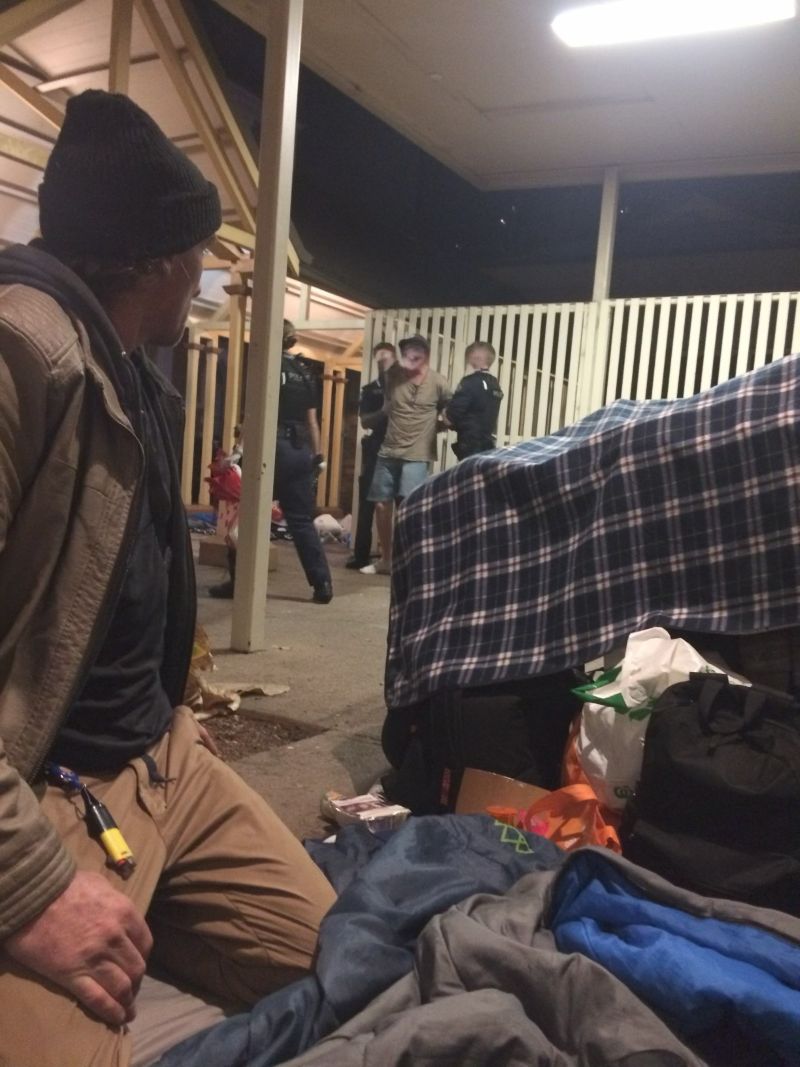
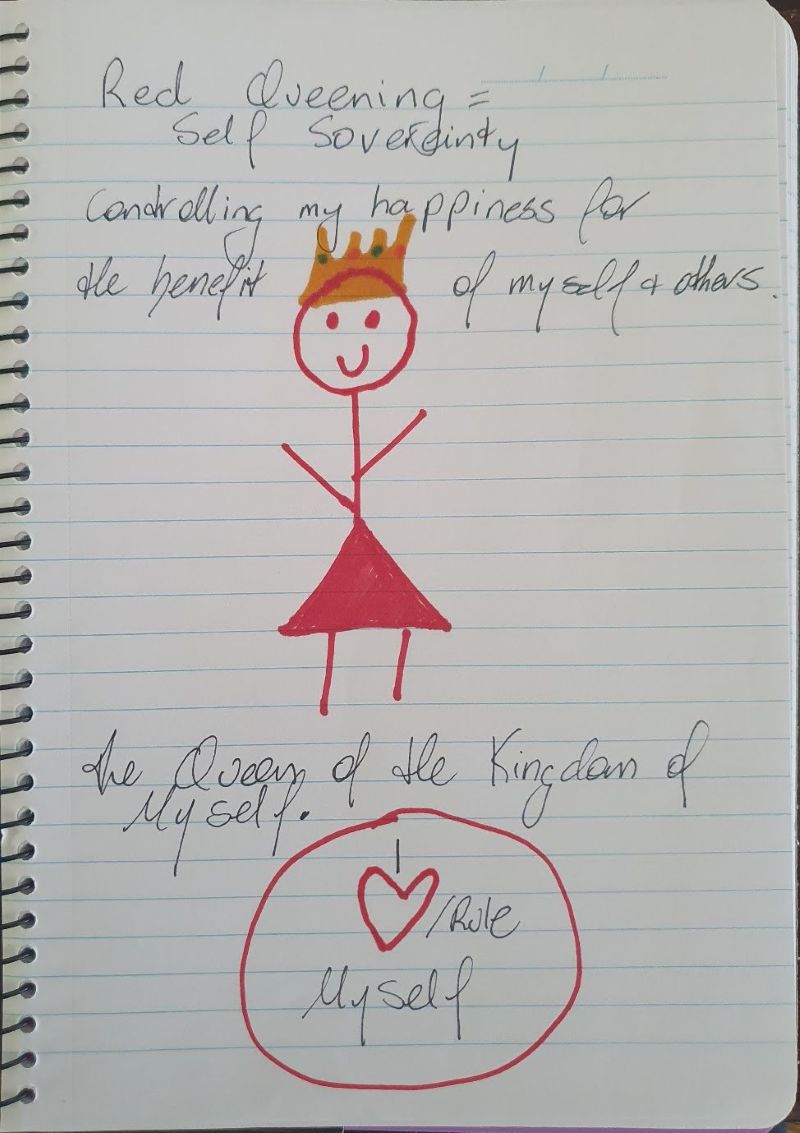

Appendix 6: Glossary
Affective blunting. The affective blunting reported in 50–60% of SSRI/SNRI patients (Christensen et al., 2022; Goodwin et al., 2022) constitutes pharmaceutical attenuation of the analogue modulation that enables figurative practice. What is clinically described as ‘emotional blunting’ is, in the terms of this thesis, a reduction in the graded affective intensities through which participants compose their navigational capacities.
Analogue modulators. Subcortical affective systems that operate through slowly-firing, graded neurodynamic processes rich in neuropeptides and transmitters including oxytocin and opioids, generating continuous variations in intensity rather than discrete on/off states (Panksepp & Biven, 2012). These cross-species, ancient analogue processes provide intrinsic values and organic pressures that guide behaviour through evolutionarily-prepared emotional systems, as opposed to the binary, digital processing associated with the synaptic on/off cortical cognitive systems.
Apparatus (dispositif). Following Deleuze on Foucault (1992), the specific configurations by which institutions act on populations through four lines: visibility, enunciation, force, and subjectification. Apparatus captures; assemblage composes.
A-signifying semiotics. Following Guattari (1979), signs that operate—triggering, modulating, activating—without passing through meaning or representation. Distinguished from signifying semiotics, which produce meaning through chains of signification. In the context of this thesis, a-signifying operations include PAG threshold modulation, autonomic patterning, and primary-process affective circuit activation.
Assemblage. Following DeLanda (2016), a heterogeneous composition of people, materials, institutions, affects, and expressive forms with two irreducible dimensions: extensive (spatial, measurable, institutionally recognisable) and intensive (affective, modulatory, gradient). Material contents and expressive forms in reciprocal presupposition. Agencement in French is both a noun and verb, clumsily assemblage-ing in English, it emphasises ongoing processes rather than fixed structures.
Body without Organs (BwO). The body taken as an intensive field rather than as an organised set of functions, that is, a body considered in terms of what affects and intensities can pass through it before those intensities are fixed into organs, roles, and stable coordinations (Deleuze & Guattari, 1987). The term does not name a body stripped of its physical organs. It names the body released from the fixed organisation that locks intensity into fixed function (Bonta & Protevi, 2004). The BwO is approached by caution rather than by force, because it carries two failure modes: a body so destratified it empties or cancels itself, and a body so restratified it hardens into rigidity. Composition therefore proceeds between these, either loosening fixed coordinations toward intensity or restratifying them just enough to hold a body together. In this thesis the BwO is the body on which figurative practices operate at the intensive-semiotic register, and Chapter 4 reads the participants’ practices as the two cautious operations the concept specifies (cf. Section 3.1(c); Appendix 1).
Catalytic transduction. The thesis’s term for figurative compositions that shift an affective threshold (the exploit/explore threshold) through intensive rather than representational means. The formulation draws Simondon’s (1964/2020) transduction together with catalysis, the shifting of a threshold without the catalyst being consumed in the reaction. Figurative practice functions a-signifyingly as the catalyst of a structuring propagation across the organic stratum rather than as a representation of one (Guattari, 1992/1995; Simondon, 1964/2020). In the intensive-semiotic register, transduction is the released mode, contrasted with capture (see Intensive-semiotic register).
Coding Parameter. The degree to which assemblage components are fixed by linguistic or symbolic operations; overcoding imposes content, decoding releases constraint (DeLanda, 2006; Deleuze & Guattari, 1987).
Common Third. Following Husen (1996), the shared activity through which practitioner and participant compose together rather than through helper-helped relations. The activity is the third term mediating the relation, with the relation composing through the activity rather than through the practitioner’s professional self being projected toward the participant’s need.
Cortical Reinstatement Move. The theoretical operation by which subcortical-affective processes are re-described as cortical output decisions, reinstating signification surfaces onto a-signifying operations — the systemic failure of Moseley & Butler’s (2013) CAMPs framework (after Guattari, 2011).
Corticocentric drift. Following Parvizi (2009), corticocentric bias or ‘myopia’— analytical drift toward representational, inferential, computational, and predictive language when describing intensive-semiotic operations. The methodology guards against this drift through the register-discipline instrument specified in Appendix 1.
Double Articulation. The two-tier organisation of any stratum: first articulation stabilises substances into functional unities (territorialisation); second articulation organises those unities into coded relations (Deleuze & Guattari, 1987).
Figurative practices. Material-discursive techniques composing with graded intensive states through embodied performance, operating across nested durational scales of organic modulation. Categorically distinct from representational thinking (including but not limited to metaphorical reframing), which operates through cortical propositional segmentation. Figurative practices maintain productive intensities while enabling tactical navigation.
Figurative style-practice. Compositional operations that are patterned, embodied ways participants arrange themselves in relation to intensity, environment, and others through personae, prosody, and expressive habits. Distinguished from figurative modulation, which names what these practices do materially, including modulation of subcortical affective intensity and loosening of rigid cortical priors. Developed for this application after Deleuze 1987.
Functive. Deleuze and Guattari’s (1991/1994) term for the element proper to a scientific function, standing to science as the concept stands to philosophy and the percept and affect to art. A function references actualised states of affairs on a plane of reference, and its functives are the variables and limits the function articulates there. In this thesis the term marks the scientific side of the cross-register relay. The exploit and explore functives set by the dopaminergic threshold relay with the fabulation distinction, and the gain-setting functive of periaqueductal grey opioid modulation relays with figurative modulation of protective output (Fields, 2004). The periaqueductal grey to rostral ventromedial medulla axis sets this gain bidirectionally, inhibiting or facilitating nociceptive transmission, which is the molecular correlate of the bidirectional labilisation the register runs at the un-passed pole. In each case the functive and the concept stand in reciprocal presupposition rather than one grounding the other. Each functive also carries a candidate non-invasive proxy for ongoing assemblage iterations. Pupillometry indexes the explore and exploit control state through locus coeruleus adaptive gain (Jepma & Nieuwenhuis, 2011), and salivary β-endorphin assay offers an ecological measure of endogenous opioid activity (Störkel et al., 2021), the latter held as exploratory given the limited relation between peripheral and central opioid signalling. The instrument is developed as a future research direction in the Limitations (see 6.3).
Haecceity. A mode of individuation proper to events and assemblages rather than to persons, subjects, or things (Deleuze & Guattari, 1987, pp. 261–263). Following Duns Scotus, a haecceity is individuated by intensity rather than by category: a season, an hour, a date has an individuality lacking nothing, composed of relations of movement and rest and capacities to affect and be affected. The thesis operationalises the term methodologically, naming the dated and located encounter-contexts (haecceity or Common Third contexts) at which participants’ compositional work was performed and documented.
Intensive / Extensive. Intensive properties are non-divisible differences (temperature, pressure, opioid gradient) that drive processes; extensive properties are divisible quantities (length, count) that result from those processes. Assemblages are constituted through the intensive (DeLanda, 2006).
Intensive-semiotic register. The register at which a-signifying operations run, identified independently by Guattari (1979/2011) as a-signifying semiotics and by Panksepp and Biven (2012) as organic-analogue gain control. Intensive designates gradient and modulatory variation in DeLanda’s (2016) sense rather than extensive and metricised quantity. Semiotic designates sign-functioning in the wide field within which a-signifying catalysis operates, distinct from the signifier-bound semiology the register is not naming. The register runs in two modes across strata: transduction, where participant figurative composition propagates a structuring operation across the organic stratum, and capture, where apparatus control modulates eligibility and compliance across the social-alloplastic stratum. Catalytic transduction is the register’s diagrammatic operativity, the a-signifying sign operating as catalyst of a structuring propagation rather than as representation of one (Guattari, 1992/1995; Simondon, 2020). The register is cross-stratal by construction rather than confined to a sign-side or to neurochemistry. The thesis’s central conceptual commitment.
Lability (labilisation). A threshold operation of the intensive-semiotic register, naming the lowering of an affective threshold toward a state ready to change its activation (Panksepp & Biven, 2012). Distinguished from triggering, which crosses a threshold, and from modulation, which varies intensity along the affective continuum. Labilisation runs in two directions. The apparatus sensitises a threshold toward a locked, low-threshold field that re-fires the same aversive affect. Figurative practice metastabilises a threshold toward an open, transduction-ready field where a locked affect can shift (Simondon, 2020). The bidirectional operation is the register’s shared mechanism where the dispensation is refused, where the apparatus and figurative practice labilise the same field toward opposite ends.
Milieu Negentropy. Viable affective ecologies maintained under hostile extensive conditions; local negentropy designating the capacity of a somatic or relational practice to sustain intensive viability against entropic institutional pressures (after Friston, Deleuze and Guattari 1987).
Minor science. Deleuze and Guattari’s (1987) term for ambulant, problem-oriented practices operating at institutional margins, contrasted with Royal Science’s standardised protocols and regulatory architectures.
Modulatory saturation. The thesis’s term for intensive overload where continuous a-signifying modulation exceeds its own parameters. Distinguished from entropy, which implies discrete states and informational disorder. Modulatory saturation names an intensive-semiotic register phenomenon: the body’s gain systems driven beyond tonic operating range under sustained structural impossibility. (see Solms, Panksepp)
Nociplastic pain. Chronic pain arising from altered nociceptive processing without clear tissue damage or nerve injury, carrying the strongest association with psychosocial adversity (Fitzcharles et al., 2021; Kosek et al., 2021).
Organic-analogue. A stratum-level designation rather than a register. Organic designates the biological stratum in Deleuze and Guattari’s (1987) stratal vocabulary. Analogue designates the neuromodulatory gradient specified by Panksepp and Biven (2012), where subcortical affective systems operate through graded neurodynamic variation rather than digital on-off states. The organic-analogue names the organic-stratum specification of the intensive-semiotic register, the level at which a-signifying transduction actualises as periaqueductal grey threshold modulation and primary-process affective activation. It is one stratum across which the intensive-semiotic register operates and does not name the register as a whole (see entry: intensive-semiotic register).
People to come. Following Deleuze and Guattari (1991/1994, p. 109), not future subjects but present expertise exceeding institutional recognition frameworks. In this thesis, the figurative style-practices developed by participants navigating chronic pain under worse to come conditions—capacities that standardised pain management categories cannot consolidate.
Person-centered practice. WHO framework emphasising people’s capacity to participate in decisions affecting their health, maintain social relationships and exercise agency in care processes. In this thesis, person-centred practice is specified as recognition of the participant’s compositional work at the register at which the work occurs, rather than at the cognitive-representational register where the dominant apparatus operates. Pharmaceutical interventions that reduce empathic capacity or emotional responsiveness contradict these principles by impairing the social-affective capacities necessary for person-centered engagement (WHO, 2023).
Phase Space / Attractor Basin. The space of all possible states of a dynamical system (phase space); attractors are stable states the system tends toward. Central sensitisation as deepened attractor basin: perturbations do not dissipate but accumulate (DeLanda, 2006).
Plane of immanence. In Deleuze and Guattari’s (1991/1994) account, the plane of immanence is the horizon of thought on which philosophy creates its concepts, the milieu that makes conceptual thinking possible rather than a concept among others. Immanence names the exclusion of any transcendent term, an essence, a category, or an authority beyond the field, that would organise thought or being from outside or above it. Components on this plane hold together through their relations to one another rather than through subordination to a higher unity. In this thesis the plane of immanence carries the philosophical specification of the intensive-semiotic diagram, paired with the plane of reference, where the functive carries its scientific specification (see Functive; Diagrammatic extraction).
Register. From semiotic theory, particularly Guattari’s (1979/2011) typology distinguishing signifying, symbolic, and a-signifying semiotics. A-signifying operations trigger, modulate, and distribute intensities without requiring propositional or representational translation. The organic-analogue register names the semiotic level at which a-signifying operations cohere with organic-stratum embodied operations.
Representational thinking. Cognitive and linguistic approaches operating at cortical levels through signifier-signified relationships, binary categorisations and meaning-making systems. Metaphorical reframing constitutes one subset of representational approaches that attempt to address pain through cortical processing while missing subcortical affective modulators.
Semiology vs semiotics. Throughout this thesis semiotic names the field of sign-functioning in Guattari’s (1979/2011) sense, within which signifying semiology is one regime that a-signifying operations exceed. The distinction carries the register’s headword. Semiology designates the signifier-dominated science modelled on Saussurean linguistics, the regime against which a-signifying operations are specified. Semiotic designates the wider field of sign-operation within which a-signifying catalysis runs. The term intensive-semiotic therefore designates a register of sign-functioning matter, the level at which a-signifying triggers modulate intensities directly rather than through representation (Guattari, 1979/2011).
Territorial Parameter. The degree of internal coherence or stabilisation of an assemblage; admits of continuous degrees and reversibility rather than binary categories (DeLanda, 2006, 2016).
Third synthesis of time. Deleuze’s (2014) temporal mode where future events reorganise past conditions of emergence retroactively. This is a philosophical concept. A scientific functive developed in this thesis is the labilisation mechanics of the PAG preconditioning future potential behaviours.
Transduction. The passage of an intensive condition into the body, where it propagates as a structuring operation rather than arriving as information to be interpreted. The body has its own register for this, the level at which behaviour-associated molecular patterns operate (BAMPs; Moseley & Butler, 2017), where relational and structural conditions produce molecular inscription rather than representational content. Prosocial conditions transduce here to productive effect. Relational co-regulation, consistent presence, and shared play propagate as an appetitive structuring, arranging the SEEKING, PLAY, and CARE circuits and shifting tonic opioid and oxytocin availability toward viability (Panksepp & Biven, 2012; Porges, 2011). Also see catalytic-transduction.
Transitive compositional figuration. The deployment of Social Work’s figurative tradition toward recognition of the participant’s own register-performative compositional work, as distinct from reflexive deployment (sustaining the practitioner) or allied externalising deployment (refusing apparatus capture). Developed in Chapter 2.
Virtual. Productive empirical field that drives many actions and actualisations and events but does not determine the specificity of those actions.
Worse to come. Following Deleuze (1983, 1992), the material anticipatory field generated by apparatus operations where non-compliance produces exclusion, abandonment, and systemic violence. Distinguished from catastrophising as cognitive distortion: worse to come names structural conditions, not individual prediction errors.