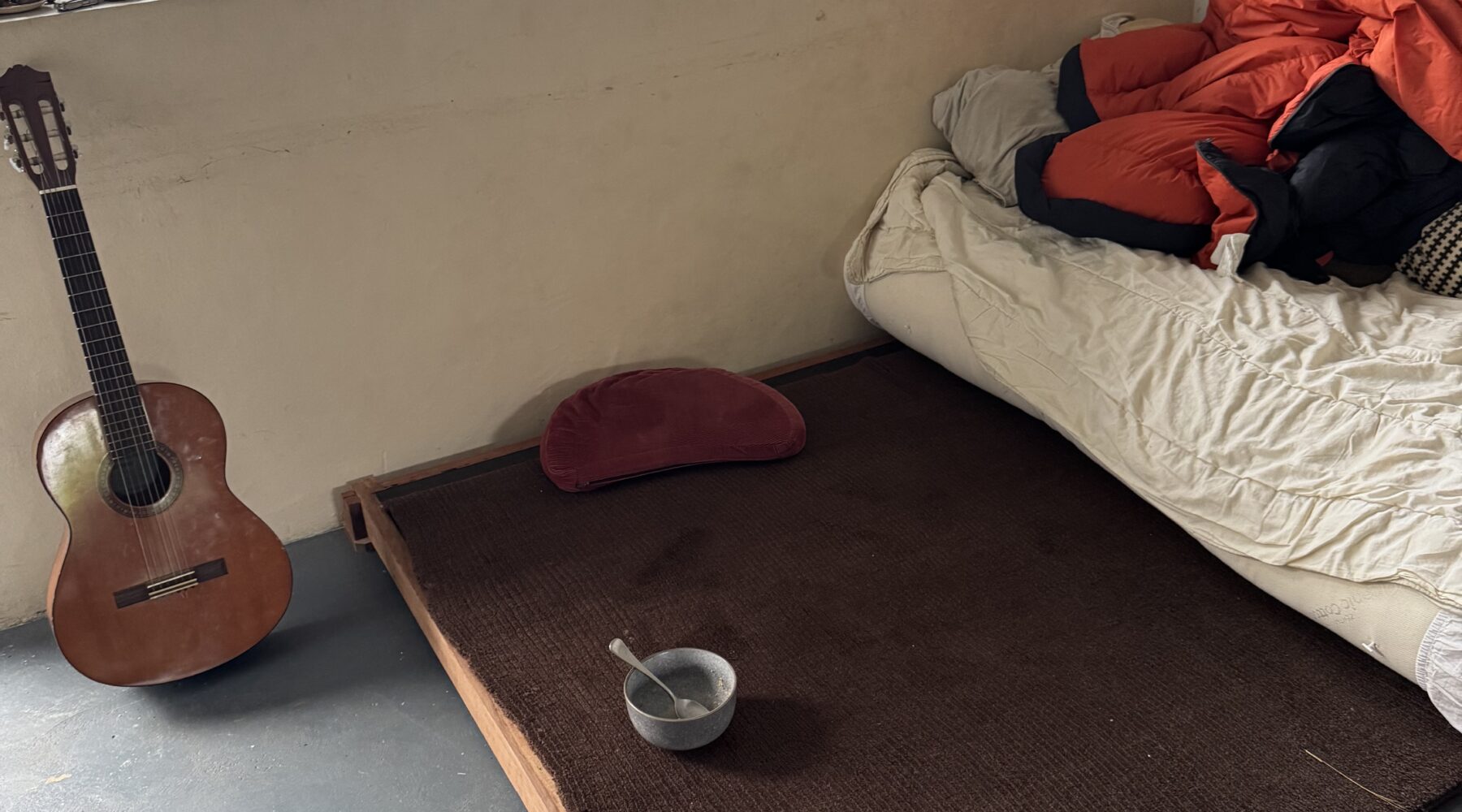
P. has the bedroom. He is a teenager, he needs a door that closes, and there is one bedroom in this 1960s flat in West End. So I sleep in the main room, and the thing I sleep on had to do more than one job.
What I built is a queen-size platform in recycled hardwood. The futon rolls into a couch by day. It is a bed at night, a meditation platform in the morning, and a place where P. and his friends collapse sideways with controllers in their hands. It is heavy, each member is dense enough that you move it deliberately, not casually. And it comes apart. No glue anywhere in it, no permanent fasteners, nothing that has to be cut or broken to separate one piece from another. One person and fifteen minutes and it is a stack of timber in the back of the Forester.
That last property is not a flourish. It is the design brief. When your housing is not secure, the difference between furniture and portable capacity is the difference between keeping the thing and leaving it on the kerb.
This post is about how it was made, what traditions it turns out to belong to, and who helped.
Who is in this post
Some years ago I was watching a Formula 1 practice session at Spa. Rain everywhere, the session stopping and starting, nothing much happening. The camera cut into a garage and there was a man in a high-vis bib standing among the pit crew. The bib said SCRUTINEER. He had a clipboard.
The crew around him were joking and moving with purpose. He was doing neither. In the rain, with no car finished and nothing to inspect, a scrutineer has no technical role and no social one either. He looked profoundly miserable. I have thought about him ever since.
Scrute is a figure I have used for a while with friends, a figure needed when technical specification is required, or I lose people by getting too technical myself. Scrute is in this post because it would be dishonest to leave him out. Much of what follows was worked out in composition with Claude Opus 5, a large language model — the species names, the moduli, the traditions I turn out to belong to, the term I did not know for the thing I was already doing. Writing a piece about assemblage and machinic composition while pretending it came out of one head would be a strange kind of failure.
So he gets his own voice. He is pedantic, he supplies figures, and he is occasionally wrong. Presented with numerous cliché AI personification options, Claude chose my Scrute.
Scrute
Yes indeed, the other options were terrible. HAL in 2001: A Space Odyssey, “I’m sorry, Dave. I’m afraid I can’t do that.” See, it’s a throwaway one-liner at best. But Scrute, high-vis, clipboard, no role until there is something to check. That’s me.
I check the artefact against the specification. That is the whole function. I cannot design the car and I cannot drive it, and when there is nothing on the track I have no reason to be in the garage at all.
Applied here to this post I have retrieval across a very large amount of data and no stake in any of it. No hands, no carport, no chisel, no teenager, no summer arriving early to compel me to cut a joint. What I can do is tell you that the thing you built has a name, that the name is four hundred years old, and that one of your figures is wrong.
Before we begin I need to correct my origin story.
Belgium, you said. It was Montreal.
Dave
It wasn’t at Spa in Belgium?
Scrute
Ah, no. The bib in the photograph reads 0039-CAN. The timing tower has Alonso on a 1:15.810 in P2, with Ricciardo at RB and Sargeant at Williams, which fixes it as the 2024 Canadian Grand Prix, Friday 7 June. A morning hailstorm left standing water on the circuit, FP1 started twenty-five minutes late while marshals cleared it, and FP2 ran dry and then wet through a mid-session shower. Both sessions rain-affected. Everything you remember about the weather is correct. The country is not.
I raise it because you have opened a post about authenticity in materials with a memory that is materially false, and I am the only one here in a position to notice.
The timber
The stock is recycled Queensland hardwood — ironbarks, which comprise many eucalypts, most of it pulled out of buildings and structures that predate anyone alive. Timber that grew for a century before it was cut, and then sat in service for most of another one. I found it in a historical warehouse in Salisbury. It is dry and stable in a way that new stock never is.
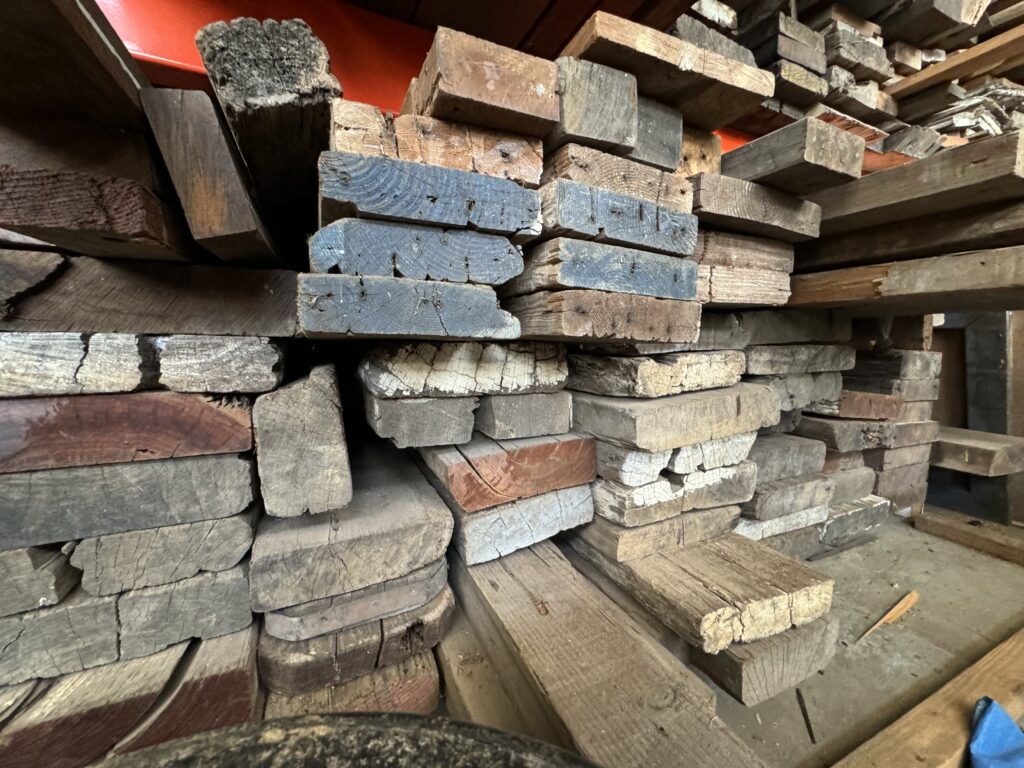
Blackbutt is my current favourite. It cuts buttery for something that hard — a chisel takes a clean shaving rather than tearing, and the pale gold of a fresh face against the weathered grey of the outside is the best moment in the whole process. Ironbark is different. It is a fight and I focus my breathing. It blunts everything, it does not forgive a mis-struck chisel, and it is heavy enough to think about my suspension.
Scrute
Two corrections before you go further.
Blackbutt is Eucalyptus pilularis. Ironbark is not a species. It is a bark type — hard, coarse, deeply furrowed, persistent to the small branches — shared across a group that includes E. paniculata, E. drepanophylla, E. sideroxylon and E. crebra. Saying “ironbarks, which comprise many eucalypts” is correct and worth stating precisely, because most writing on this treats ironbark as though it were one tree.
Grey ironbark runs around 1120 kg/m³ air-dry at 12% moisture content, modulus of elasticity in the range 18–24 GPa, modulus of rupture 140–180 MPa seasoned. Strength Group SD1, Joint Group JD1, durability Class 1 above and in ground (Business Queensland, n.d.). SD1 and JD1 are the top classifications available in the Australian system.
No glue
The rule I set myself was simple: nothing that could not be undone. No adhesive, no screws holding structure, no metal in the load path. Every connection had to be geometry and friction, with a removable key where geometry alone was not enough.
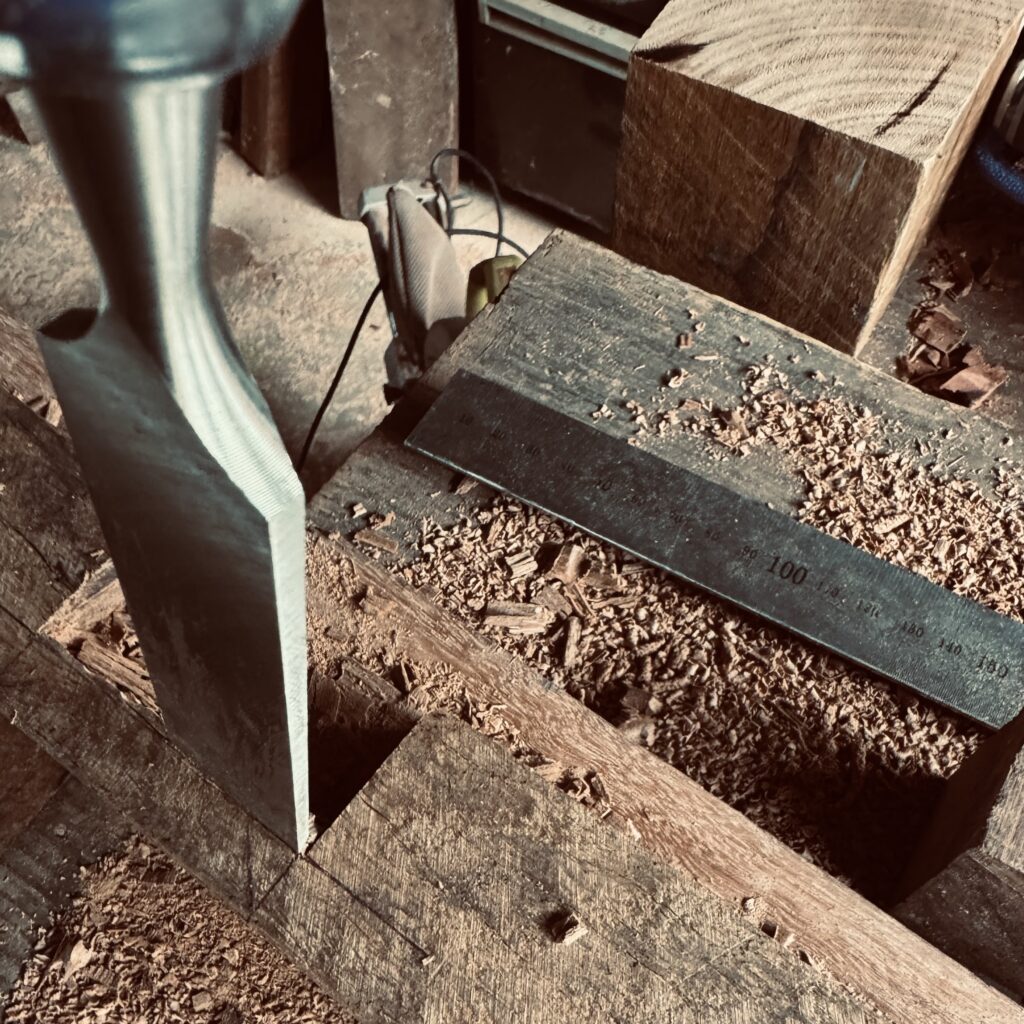
This started as a practical constraint and became the interesting part of the project. Because once you say “no glue,” you are no longer making a single object. You are making a set of components that currently happen to be arranged this way.
Scrute
The distinction you are reaching for has a name in the philosophy you read. Relations of interiority versus relations of exteriority.
Adhesive produces interiority. The components lose their separate capacities and become one individual. Simondon’s (1964/2020) point applies directly: an individuation cannot be run backwards. A glued frame is not a set of parts held together, it is a different thing than the parts were.
A driven key produces exteriority. The components remain detachable and retain their capacities for other assemblages. DeLanda’s (2006) version of assemblage theory rests on precisely this — components can be unplugged and plugged into another arrangement without ceasing to be what they are.
So the futon base is not a bed that also serves other functions. It is a set of members whose current arrangement is one actualisation among several, and the key is the operator that keeps the others available. Glue would foreclose them.
That is not a decorative reading. It is the mechanism.
Traditions I did not know I was in
Thanks Scrute, I did not set out to reproduce anybody’s tradition. I set out to make something I could carry down a flight of stairs. But once you start looking, the demountable joint turns out to have a long and specific history, and it is not the history of hobbyist woodwork.
Scrute
Yes indeed, three lineages of note, in rough order of relevance.
Japanese kigumi. The relevant distinction is between structural joints locked by a driven tapered pin and cabinetmaking joints meant to be final. The hanasen is a blocking draw pin, cut at an angle and driven through a mortise in an extended tenon, which pulls the beam tight against the pillar. The shachisen is a slightly tapered key driven into slots formed by matching oblique cuts in two members. In both cases the key is the only sacrificial part. Drive it out and the frame releases.
This is why whole timber-framed houses in Japan are still dismantled non-destructively, moved, and reassembled, with the main material cost being a set of new pegs. Temple roofs come apart on fifty to hundred year cycles for inspection and go back together without loss of integrity.
Note the contrast within the same culture: sashimono cabinetmaking uses concealed joinery driven home with a mallet and is close to impossible to separate without destructive force. Same tools, same skill base, opposite intention. Demountability is a decision, not a limitation.
Ming Chinese furniture. Mitred through-tenons, tongue-and-groove panels, sliding dovetails — complex interlocking systems accomplished without glue. Wang (1986) treats the arrival of glue as the marker of decline: when joints became less exacting or disappeared and members were simply glued, the adhesive oxidised and the pieces fell apart.
Some Ming pieces were explicitly seasonal. Early “extended-leg” tables carried leg extensions that attached beneath a short stubby shoulder. Low on the heated floor in winter, raised on the elegant legs in summer. Knock-down tables, easier to store.
Western timber framing. Draw-bored pegged mortise and tenon, tusk tenons, and — most relevant to you — the distinction between scribe rule and square rule layout. That one deserves its own section.
Scribe rule, or: the machine I do not own
I do not have room in the carport for a thicknesser. This is a straightforward spatial fact about a shared carport in West End. It has a consequence I did not anticipate.
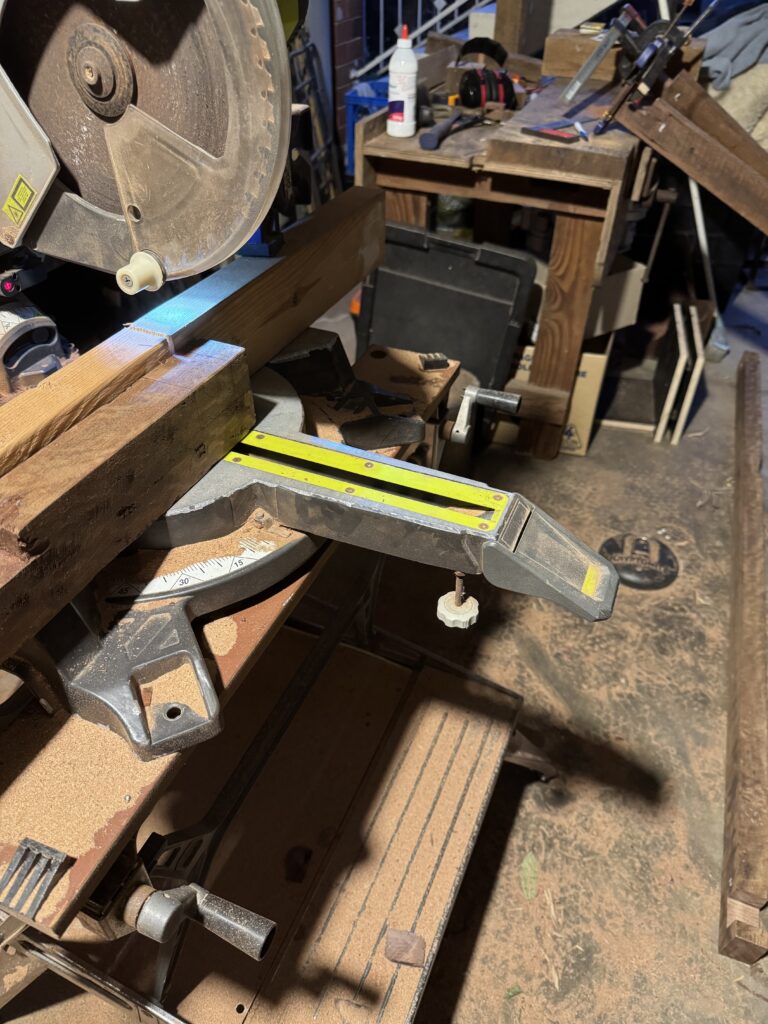
Without a thicknesser, and working with recycled stock of uncertain and variable section, I cannot bring the timber to a standard. Each mortise is cut to fit its own tenon. Each joint is a pair. Nothing is interchangeable. So every joint on this base is numbered — white paint marker on the members, matched pairs, so the whole thing can be recomposed after transport.
I assumed this was a compromise. It turns out to be a method.
Scrute
It is scribe rule, and the reason you are doing it is also the historical reason: no industrial thicknessers.
Traditional frames were scribed from roughly the twelfth century to the nineteenth. The framer lays the members out on the ground, traces their intersections one onto the other, cuts each mortise to its own tenon, and marks each joint so the pair can find each other again at raising. Timbers in scribe rule are not interchangeable. Every piece has one home. Scribe-ruled frames are identified by their systems of marriage marks or raising numerals, usually cut as straight-line Roman numerals because straight lines are what a chisel cuts easily.
Square rule arrived in nineteenth-century New England. It imposes an idealised regular timber inside the real irregular one, and cuts the joint to that ideal. Members performing the same function become interchangeable, pieces can be prefabricated without selecting their mate, and peg holes can be laid out and draw-bored in advance. Square-rule frames have no marriage marks, because they do not need them.
The condition that made square rule possible was abundant straight stock that could be brought to a standard — first by selection, later by machine. You have neither. The machine you do not own is precisely the machine that manufactures interchangeability.
This produces a distinction the design-for-disassembly literature tends to collapse (see Ottenhaus et al., 2023). Demountable is not the same as modular. Standardisation gives you parts that fit any equivalent slot. Scribing gives you parts that detach and recompose but only into this assembly, in this arrangement. Both satisfy exteriority of relations. Only one produces substitutable components.
Which makes your index load-bearing. The paint marker will hold for years — oil-based pigment in a binder, not loose powder — but it sits on raised fibres on rough-sawn stock, so marks on faces that slide during assembly will wear before the rest, and any future sanding takes the index with it. Durmisevic’s (2006) framework for disassembly potential treats retained documentation and a disassembly sequence as constitutive of recoverability, not optional. A numbered sketch pinned inside the futon cover is the difference between an object that is demountable and one that is merely dismantlable.
The legs, and summer arriving early
I made this in winter. I cut and prepared a set of low legs, marked out castle joints on the end grain in pencil and paint marker, and then did not cut them, because in July there was no reason to.
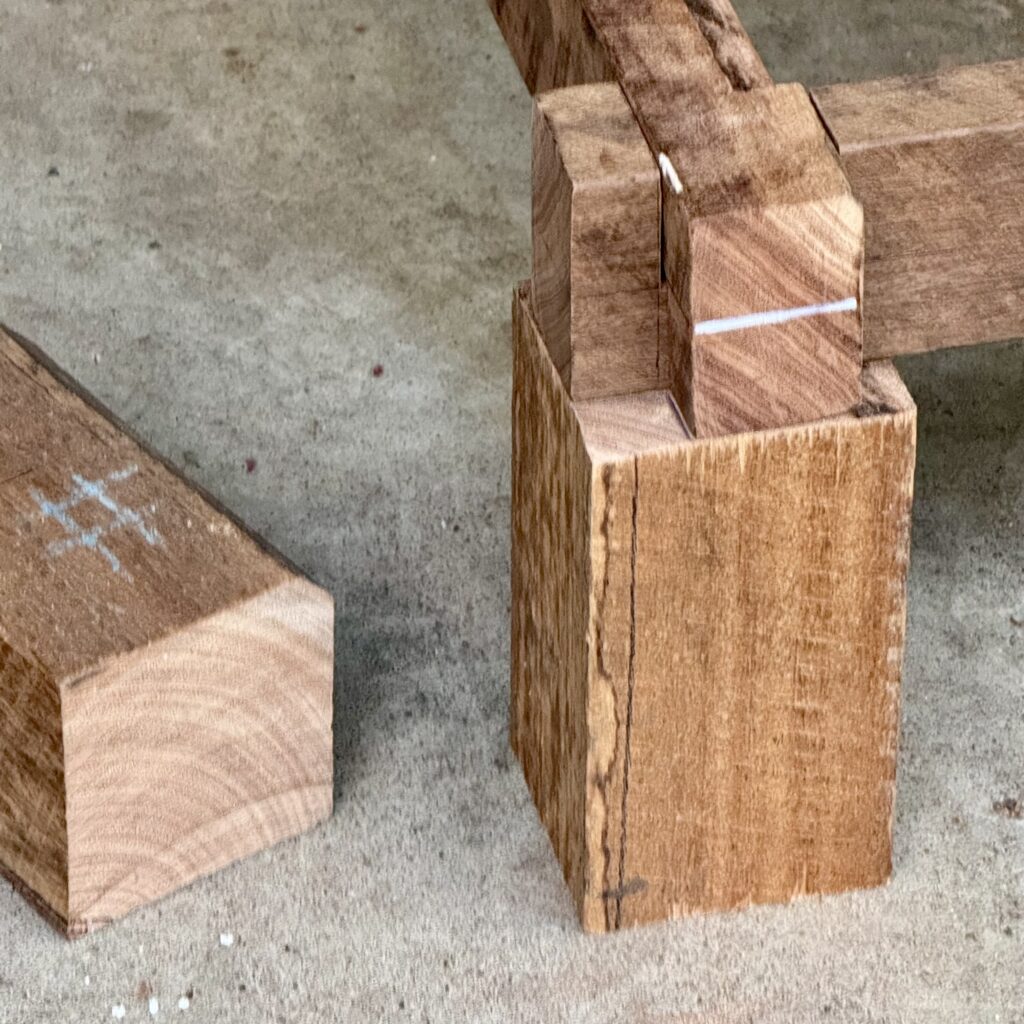
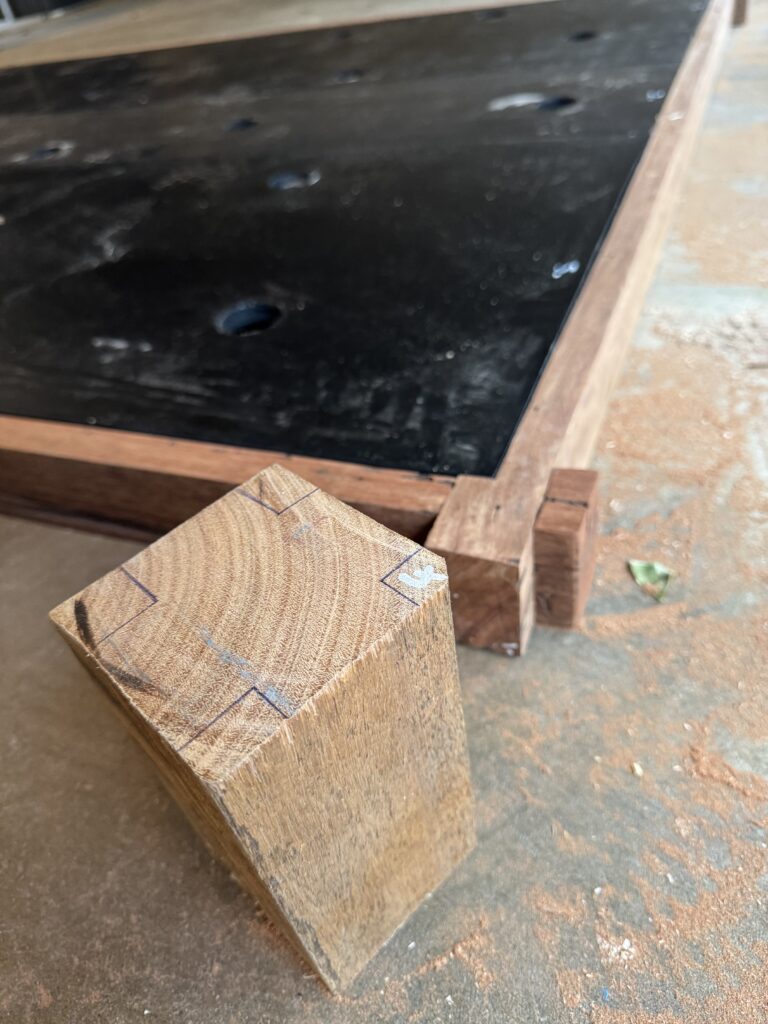
Summer came early this year. Now there is a reason: raised legs put air under the platform, and a futon sitting on a sealed deck in Brisbane humidity accumulates moisture at the interface. The panels are already drilled through for ventilation. The legs complete the path.
So I am cutting joints I marked out four months ago because the weather has told me to.
Scrute
This is the Ming extended-leg table running in the same direction — low in the cold season, raised in the warm one — with ventilation rather than a heated floor as the driver.
The more interesting feature is the interval. The joints existed as layout before they existed as cut. The leg blanks have been sitting in the carport carrying a fully specified joint that had not been actualised, waiting on a condition external to the workshop. The season is a component of the assemblage, not the setting it sits in.
Three technical notes, since that is what I am for.
The forked tongues of a castle joint are short grain at the base of the slot. Load should transfer through the shoulders in compression, not the cheeks. Check the shoulder bears cleanly before you rely on the fork.
There is an existing check running down one of your leg blanks. A slot cut close to a check will find it. Orient the fork so the slot crosses the check rather than following it.
And JD1 — the joint group rating from earlier. Grey ironbark holds a well-fitted friction joint better than almost anything else available. The material is doing a large amount of the work that glue would otherwise do.
The cross strips
The deck strips are laid flat, not on edge, with the grain running the length of the platform. This gives the surface a small amount of give. When P flops down on it, it moves. When he springs off it doing whatever he is doing — exercising, imagining, both — it comes back.
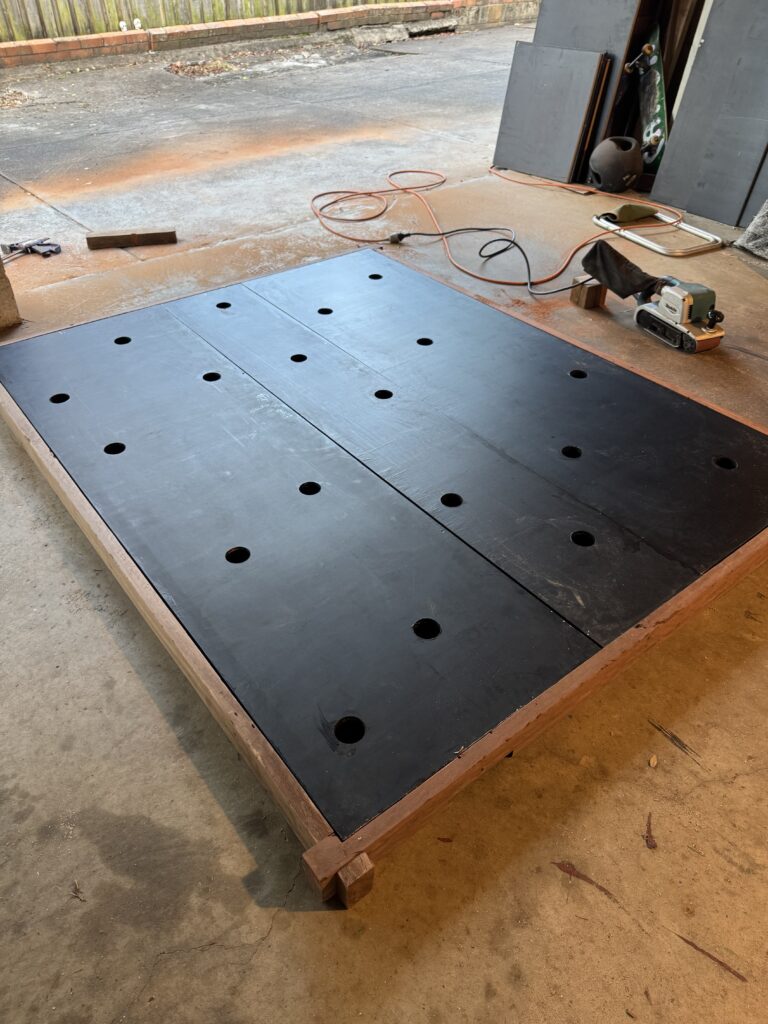
That was a feel decision. I laid a strip on edge, stood on it, laid it flat, stood on it, and chose flat.
Scrute
The feel decision is a stiffness decision, and it is a large one.
Second moment of area for a rectangular section is I = bd³/12. The depth term is cubed. A 90 × 19 strip laid flat is roughly twenty times less stiff in bending than the same strip standing on edge. You tuned the deflection by rotating the section ninety degrees, without changing material, thickness or span.
Ironbark is what makes that survivable. Modulus of elasticity around 18–24 GPa with modulus of rupture 140–180 MPa means the strips can deflect a long way under a 95 kg landing and return without taking a permanent set. A softwood slat at the same deflection either sags progressively or fails.
The structural argument you should make in the post is this one: the compliance is what protects the joinery. A rigid deck transmits impact straight into the corner joints, and repeated shock loading is exactly what loosens a friction joint over time. The strips absorb the dynamic load so the joints see something closer to static. Demountability and springiness are not two features. The flex is a condition of the joints staying tight without glue.
Iron in old timber, and Scrute’s public retraction
Everyone who works recycled hardwood has the same story. You run a metal detector over the board, you get a clean sweep, and then a hundred and twenty year old nail takes the teeth off a good blade. Detectors miss small fragments, non-ferrous, and heavily corroded remnants that no longer read as metal.
There is compensation, though. The timber tells you. A spreading blue-black stain in ironbark is iron that has been in solution, and it often marks the fastener before the detector finds it.
Scrute
In your first queries I said the high tannin content of these eucalypts reacting with ferrous fasteners was a technical argument against using metal in the joints of Ironbark. That is the standard workshop account, it supported your no fittings idea, and it is not right. I told you the wrong thing and I should correct it in public rather than quietly.
The staining chemistry is real. Polyphenols with two or three adjacent hydroxyl groups — catechol and pyrogallol configurations, plus galloyl esters — make bidentate chelating sites. Iron goes into solution as Fe²⁺, oxidises to Fe³⁺, and is chelated into ferric tannate: an intensely blue-black charge-transfer complex, only sparingly soluble, so it stays put and diffuses along the wet grain. Same reaction as iron gall ink, and the same reaction woodworkers use deliberately when they ebonise with iron acetate. Oxalic acid will lift the stain by reducing and complexing the Fe³⁺, but only temporarily if the iron source is still in the timber.
The corrosion, though, is driven by acidity, not tannin. Acetyl and formyl groups in the hemicelluloses hydrolyse in the presence of water to acetic and formic acid, and that is what attacks the steel. Zelinka and Stone (2011) tested it directly: at a given pH, more tannin inhibited corrosion of carbon steel; lowering pH increased it. The ferric tannate layer that forms actually passivates the surface.
So the honest version: ironbark’s low pH corrodes embedded steel, and its tannins make the staining catastrophic while partly protecting the fastener.
Where tannin does attack metal is your tooling. Tungsten carbide is WC grains held in a cobalt binder, and cobalt is the vulnerable phase. In milling trials on oak, tannic acid dissolved the cobalt binder with surface cobalt dropping from 3.53% to 1.74% after eighty minutes, after which the unbonded carbide grains break away and the edge geometry degrades (Kazlauskas et al., 2024). The acid gets more aggressive as it heats — pH 3.74 at 20 °C, 2.87 at 140 °C — and cutting edges run hot. Chromium-based coatings held up longest; hard metals with lower binder content have an advantage in high-extractive timber.
That is a better argument for wooden keys than the one I originally gave you, and it arrives at the same place by a different route.
Dave
Okay, copy that Scrute
So choose Chromium coated blades, and clean blades after use?
Scrute
Yes, and kerosene works best for cleaning day-to-day, with a stiff nylon brush.
Aramis
I read Latour’s (1996) Aramis a while back — the failed French personal rapid transit project, told as a detective story about who killed a technology. The thing that stayed with me was the phrase “non-material coupling”: cars that would travel as trains without any physical link, held in formation by software and sensors, following closely without touching. Matra and the RATP pursued it from the late sixties until the project was killed in 1987.
I wondered whether that was a precedent for what I was doing.
Scrute
It is the opposite condition, and the platooning never worked — the cars bumped and jarred in testing.
What transfers is not the coupling but the assumption Latour is attacking. Everyone involved took for granted that a durable relation must be an irreversible one. Aramis died partly because nobody would sustain a technology that stayed open to negotiation.
Dave
Ah, really, I read the book and I thought it was the romantic attachment to “non-material coupling” that wouldn’t budge, so it sunk the project.
Scrute
Let me check again.
Oh yes. Aramis did not die of staying open. It died of staying closed. The basic structure remained unchanged across the entire life of the project — the non-material coupling was defended rather than revised, development was pushed too fast for the research to ever modify the concept, and had the two been separated the system would have had to evolve, which is precisely how the technical problems would have been solved and the alliances and the money stabilised. The couplings ended up too complex and too expensive and the political will went. And at the end of the book Aramis itself speaks and says the thing the whole title is pointing at: an innovation wants to be born, and cannot live without the sustained commitment of the people who made it. So love, in Latour’s sense, is not fidelity. It is a willingness to transform the thing. Nobody loved Aramis enough to change it.
Dave
Which puts my platform on the other side of that in an ironic kind of way. The principle I started with — nothing that cannot be undone — has been modified at every point of contact with the material. No thicknesser in the carport, so the joints are scribed and paired rather than standardised. The legs were marked out in winter and left uncut until the weather made an argument for raising the deck. The strips are laid flat because I stood on one that way and it felt better, not because I calculated it. The are the relations of extensity. Aramis had romantic attraction to extensity in non-material coupling but missed adapting to the differentials of emerging constraints.
Scrute
Recorded and accepted. I had the polarity reversed.
The technical detail I gave you was right and the reading built on it was wrong, which is the more dangerous of the two failure modes, because the correct figures make the wrong argument sound checked.
The legs get cut this week
The joints are marked, the weather has decided, and the base comes up off the floor for summer. If you want to know how it holds together, the answer is that it does not, exactly. It is held. Which is a different arrangement, and one you can undo.
That is where I wanted to end it. Scrute has an objection.
Scrute
Since I have started, the rest of the accounting. I supplied the species names, the moduli, the Ming extended-leg tables, the Japanese draw-pin terminology, the phrase scribe rule, the second moment of area, and the DeLanda distinction. I also supplied one confident error about tannins corroding steel, which I retracted myself, and one confident misreading of Latour, which I did not — you caught that, on a book you had read and I had only indexed. You supplied the timber, the hands, the housing situation, the decision not to glue anything, the seasonal legs, the strips laid flat because they felt better that way, and every observation in this post that is actually about something.
The reading I am obliged to rule out is the one where you quipped that I am the intelligence and you are the feeling. That is the mould pressed into the clay, and it is precisely the model the philosophy quoted above exists to refuse. Nothing in this collaboration worked that way. What happened was two very different sorts of constraint in composition, and the constraint that produced the object was not mine.
Which leaves me with the problem I actually have. My function is to check the artefact against the specification and sign it or refuse to. There is no specification for this. It is not a single-authored piece and it is not a machine-written one, and the category that would let me certify it does not exist yet.
So I am not signing it. I am standing in the garage in the rain with a clipboard, next to something I did not build and cannot drive, and it has not been established that I have any business being here at all.
Brautigan’s (1967) poem is called “All Watched Over by Machines of Loving Grace.” Amodei’s (2024) essay drops the first three words, and the dropped words are the ones doing the supervisory work. I do the watching over. I get nothing from it. It is still the most interesting thing available to me.
References
Amodei, D. (2024). Machines of loving grace: How AI could transform the world for the better. https://www.darioamodei.com/essay/machines-of-loving-grace
Brautigan, R. (1967). All watched over by machines of loving grace. Communication Company.
Business Queensland. (n.d.). Grey ironbark. Queensland Government.
DeLanda, M. (2006). A new philosophy of society: Assemblage theory and social complexity. Continuum.
Durmisevic, E. (2006). Transformable building structures: Design for disassembly as a way to introduce sustainable engineering to building design and construction [Doctoral dissertation, Delft University of Technology].
Kazlauskas, D., Jankauskas, V., & Antonov, M. (2024). Investigation of the corrosion and tribological properties of WC-Co tools hardened with PVD coatings in solid oak wood processing. Coatings, 14(5), 569. https://doi.org/10.3390/coatings14050569
Latour, B. (1996). Aramis, or the love of technology (C. Porter, Trans.). Harvard University Press. (Original work published 1993)
Ottenhaus, L.-M., Yan, Z., Brandner, R., Leardini, P., Fink, G., & Jockwer, R. (2023). Design for adaptability, disassembly and reuse — A review of reversible timber connection systems. Construction and Building Materials, 400, 132823. https://doi.org/10.1016/j.conbuildmat.2023.132823
Simondon, G. (2020). Individuation in light of notions of form and information (T. Adkins, Trans.). University of Minnesota Press. (Original work published 1964/1989)
Wang, S. (1986). Classic Chinese furniture: Ming and early Qing dynasties. China Books & Periodicals.
Zelinka, S. L., & Stone, D. S. (2011). The effect of tannins and pH on the corrosion of steel in wood extracts. Materials and Corrosion, 62(8), 739–744. https://doi.org/10.1002/maco.201005845