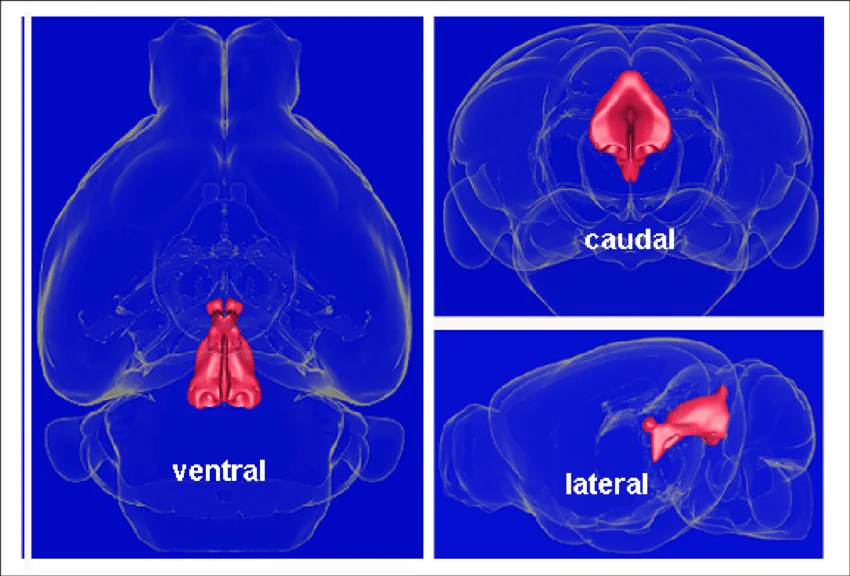
The periaqueductal grey is about 14 mm of midbrain wrapped around the channel that carries cerebrospinal fluid between the third and fourth ventricles. Four columns, two of each, one set either side of the channel. Textbooks file it under defence: pain modulation, freezing, fleeing.
The visualiser on this site takes a different position, following Panksepp and Solms: the PAG is where affect is produced, and the cortex scales what it finds there rather than originating it. That position is contested. Everything in the model is built on it, and the model says so on its face.
Open the visualiser → or start from one of the twenty-three situations below.
Behold, the biological godhead
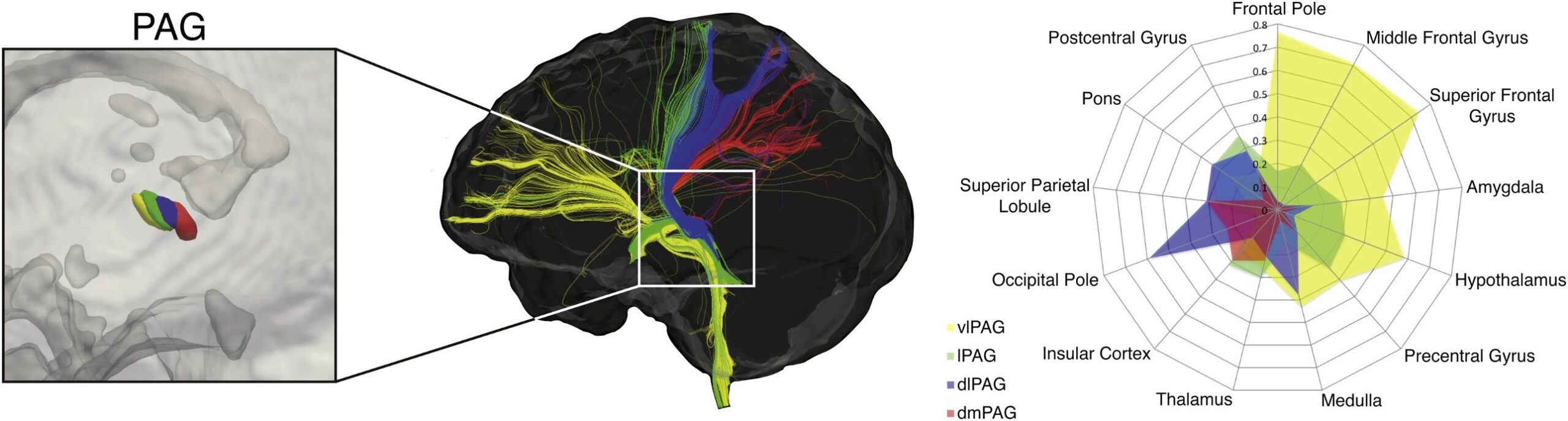
For most of the twentieth century the brainstem was treated as life support: the machinery that keeps the heart beating and the lungs moving while the cortex does the feeling and the thinking. That account is being revised from below, and the revision has a date attached. It became possible to see the PAG’s columns in a living human brain only when imaging reached the scale of the columns themselves.
Ultra-high-field 7-tesla scanning resolved the structure by what it does: discrete functional subregions during emotional processing (Satpute et al., 2013), distinct columns active during respiratory threat (Faull et al., 2015), and a whole-body map running the length of the structure, face at the front and limbs at the back (Tinoco Mendoza et al., 2023). Brainstem-optimised diffusion tractography separated it again by where each part connects, into four subdivisions that line up with the columns mapped in animals decades earlier (Ezra et al., 2015).
Panksepp spent a career arguing that the primary affects — SEEKING, PLAY, CARE, PANIC/GRIEF, FEAR, RAGE, LUST — are generated in these oldest structures and only elaborated above them (Panksepp, 1998; Panksepp & Biven, 2012). Much of that work had to be done in other mammals, which is the point rather than the limitation: the structure is conserved. Solms (2021) carries the argument to its conclusion. Consciousness begins in the upper brainstem as felt affect, and the cortex is what that feeling learns to work with.
Solms reads Freud’s abandoned Project for a Scientific Psychology (1895/1950) as an early, noisy attempt to build a science of affective desire from dreams and symptoms, set aside because the neuroscience it needed did not yet exist, and completable only by an interdisciplinary practice that had not yet been assembled (Solms, 2021). The scanners have now arrived. The interdisciplinary practice is still being assembled. This page, and the visualiser it introduces, are a contribution to that assembly, and a celebration of the (re)turn to affect that the new resolution makes possible.
My twenty years across fields
The model is the current output of my twenty years working across fields that seldom share a room. Ecology and urban and social planning came first: systems that compose themselves from heterogeneous parts, and the statutory mechanisms that try to steer them. Then bodywork — myotherapy and Zenthai Shiatsu — where the work happens through contact and breath before anything is said. Alongside that, psychoanalysis and pain neuroscience, which approach the same problem from opposite ends: how a body comes to feel what it feels. And political theory, because who is granted a dispensation and who is still being assessed turns out to reach the body directly.
What joined these was immanent and materialist philosophy. Spinoza’s affects as increases and decreases in a body’s capacity to act. Nietzsche’s figures — Zarathustra, Dionysus — which Deleuze and Guattari (1994) generalise as conceptual personae, the operators through which a concept actually gets thought. My interest has been in taking that out of philosophy. Concepts and the personae that run them are not only the philosopher’s equipment. People use them every day to get through an assessment, a waiting room, a long night with pain, and in relational therapy and social work they can be composed with someone rather than delivered to them.
The work also began from my own chronic pain. On the predictive-processing account, persistent pain can be partly an inference that has stopped updating: a prediction of pain held with high confidence, so that input which would otherwise register as harmless is inferred as pain, and the inferential error that might revise the prediction carries little weight (Eckert et al., 2022; Friston, 2010). Pain of that kind is sticky. Held privately, it stayed a question no single answer closed. Shared and worked on with others — in clinic first, then in the research — it became a Problem in Deleuze’s sense: not a gap that a correct answer removes, but a set of conditions that persists through its solutions and can be worked on in common, each answer a further determination of it (Deleuze, 2014; Grosz, 2017). The thesis names it the Social Pain Problem (Monson, 2026).
Two kinds of figure
My MSW (Research) thesis, Figurative Expertise with Chronic Pain (Monson, 2026), worked with people living with chronic pain in supportive housing at Common Ground Brisbane, and the figures they compose to keep a life composable under conditions no one should have to live with. It separated two operations that are easy to run together.
The first is inferential. The Dead Letter Clerk — after Melville’s Bartleby as Deleuze (1997) reads him — reads the institutional field forward, produces the documents examination requires, and suspends a demand without refusing it. It is a figure you run. It needs the executive awake, and it costs control to hold. In the visualiser these are inferential personae, the name now used there in place of “conceptual personae” because it says what they do: they operate on the cortical channel, as inference.
The second is affective. The Cautious Curlew, learned from a research participant who followed bush stone-curlews through the inner city at night, petitions nothing. It arrives as affect and percept — a wail, a pause, a slow crossing of open ground — and works below signification. In the visualiser these are figurative images: they need the executive quiet, and they cost nothing to produce.
Inferential personae — signifying, figures you run
- Need the executive awake
- Cost cognitive control — and practice lowers the cost
- Can suspend a demand: the social-political domain
- Act as a prior, so 5-HT2A agonism relaxes them (the REBUS model)
- Naloxone takes their analgesia
Figurative images — a-signifying, figures that arrive
- Need the executive offline or quiet
- Cost nothing — but practice widens access
- Suspend nothing: they nuance the palette
- Are not a prior, so 5-HT2A agonism does not relax them
- D2 blockade takes them instead — most antipsychotics, some anti-nausea drugs
When an arrival speaks
Some arrivals carry propositional content — they say things, address you, take a position. A voice has the arrival characteristics of the image (not composed, not under executive control, costs nothing to produce) and the content characteristics of the persona. Neither register’s usual move works on it: you cannot argue it away, because it did not come by that channel, and you cannot leave it merely ambient, because it makes claims. The third operation is hosting — a persona whose object is an arrival rather than a demand. It changes the relationship, not the presence.
Two of those lines, in practice
Act as a prior. This is the REBUS model — relaxed beliefs under psychedelics — a leading current account of what psychedelics do in the cortex (Carhart-Harris & Friston, 2019). It runs on two quantities from predictive processing. Inferential error (prediction error) is the mismatch between what the cortex predicts and what arrives. Confidence (precision) is how much weight a prediction carries against that error, and it is analogue: graded, with no on or off. REBUS proposes that 5-HT2A agonism lowers the confidence on high-level beliefs, so inferential error from below has more say in revising them. An inferential persona runs as exactly that kind of high-level belief, which is why the visualiser lets 5-HT2A agonism relax it and leaves figurative images where they are. REBUS is a leading model, not a settled result: van Elk and Yaden (2022) review it alongside other candidate mechanisms and set unifying accounts of this kind against a case for plural causes.
D2 blockade takes them instead. D2 blockers are most antipsychotics, and some common anti-nausea drugs such as metoclopramide and prochlorperazine. Solms (2000) found that dreaming runs on a forebrain dopamine pathway separate from the brainstem mechanism that produces REM sleep: drugs that raise dopamine, such as L-dopa and stimulants, bring more frequent and more vivid dreams, and dopamine blockers suppress them, with REM sleep itself unchanged. The visualiser extends that from dreams to figurative images generally, which is a hypothesis rather than a finding. In practical terms: under D2 blockade the curlews at 2am would be less likely to arrive and reverie harder to reach, while a persona run on purpose — the Dead Letter Clerk at an assessment — stays available. With voices, Kapur’s (2003) account is the most practical guide: antipsychotics do not erase the experience, they lower its salience, and the psychological work of changing the relationship to it is still to be done. That work is the hosting operation above. None of this is a reason to start, stop or change a medication.
The thesis argued that social work needs both, and needs to tell them apart. Psychoeducation and cognitive reappraisal work on the first register. Somatic co-regulation, durational consistency, and art, music and gardening groups work on the second, and deserve recognition as skilled practice rather than incidental accompaniment to case management (Monson, 2026). The visualiser asks what each one does at the source.
A parallel not yet composed
Affective neuroscience and the post-Spinozan affect project of Deleuze and Guattari run in parallel and rarely meet. Panksepp’s primary-process systems are subcortical, graded and pre-representational. Guattari’s machinic unconscious (1979/2011) describes a-signifying semiotics: operations that act on bodies directly, below meaning, rather than through it. Both locate what matters most before anything is named, and the two literatures seldom cite each other.
The thesis brought them together as an intensive-semiotic register: the level at which affect is modulated below signification, and the level the dominant chronic-pain pedagogies, built to reframe pain as a cognition, do not reach (Monson, 2026). The visualiser puts that register into the tissue and lets you move it.
One growing field is already composing part of this. Affective neuropsychoanalysis — the affect-first strand of neuropsychoanalysis, built around Solms and Panksepp — brings the subcortical affect systems together with Freud’s metapsychology and clinical psychoanalysis, and neuropsychoanalysis now has its own journal and international society (Panksepp & Solms, 2012). I have not covered it robustly here. This page draws instead on two large projects in different fields and different languages: Anglophone affective neuroscience, and the French post-Spinozan philosophy of Deleuze and Guattari. The difference bears on what gets composed. Neuropsychoanalysis joins affective neuroscience to Freud. Anti-Oedipus (Deleuze & Guattari, 1983) critiqued the Freudian unconscious for organising desire through representation and the Oedipal family, and Guattari’s machinic unconscious was proposed in its place. Affective neuroscience composed with schizoanalysis is the parallel this page means, and it remains largely unmade.
Using the visualiser
Four columns answer when you move something. Each situation below sets every control at once, then asks you to change a single thing yourself. That one move is the demonstration — not the arrangement it starts from.
There is a spoken guide, one track per situation, switched on from the control above the situation chooser. Twenty-three tracks, about 84 minutes in all — the shortest a little over a minute, the longest around eleven and a half.
It is a model, not a clinical instrument. Nothing in it diagnoses anything, and nothing in it is a reason to change what you are doing about your health or anyone else’s. The full cautions are below.
What happens when you…
Each link opens the visualiser with that situation already set, the diagram in view, and the one move it asks for pinned above the controls.
Start here
What generates
- …turn the thinking up and nothing happens?
- …decide to enjoy yourself?
- …breathe out longer than feels necessary?
Living with pain
Contact
- …let someone trusted put hands on you?
- …go a long time without being touched?
- …are the one doing the caring?
- …care without the depletion?
- …work at a festival stall for six days and feel great?
Figures you run
- …are told you don’t qualify?
- …run to stay in the same place?
- …prefer not to?
- …have no social dispensation or privileges?
Figures that arrive
When an arrival speaks — hearing voices
Pharmacology
- …feel dull on antidepressants?
- …add a stimulant to your antidepressant?
- …stay on opioids for pain, long term?
- …take a psychedelic in the wrong setting?
Background
Where the PAG sits
Near the geometric centre of the head: roughly eight to nine centimetres back from the point between the eyebrows, about level with the top of the ears. A line drawn inward from one ear canal to the other passes close to it.
What is there is a sleeve of grey matter around the cerebral aqueduct, the narrow channel carrying cerebrospinal fluid between the third and fourth ventricles. The sleeve runs about 14 mm front to back. Each of the four columns occupies a strip four to five millimetres across, and there are two of everything — one set each side of the channel.
A body, mapped at fingernail scale
Inside those 14 mm sits a map of the whole body, running front to back. Noxious stimulation of the lip, cheek and ear appears at the rostral end; thumb and toe at the caudal end, weighted to the opposite side — a crude somatotopy, in its authors’ words (Tinoco Mendoza et al., 2023). The face resolves more finely than the rest, down to individual trigeminal dermatomes (Mehnert, Tinnermann, Basedau & May, 2024). The columns sort by the kind of pain as well as its site: skin pain recruits the lateral column, deep muscle pain the ventrolateral — the same active-versus-passive split Keay and Bandler found in the behaviour. A body map, a defence repertoire and an affect generator, in less tissue than sits under a fingernail, in a layout conserved across something like two hundred million years of mammals.
Moved by breath, not by pulse
The fluid in that channel is driven mainly by inspiration rather than by the arterial pulse (Dreha-Kulaczewski et al., 2015). Breathe in, and fluid surges cranially — upward, toward the brain — through the channel these cells are wrapped around. That direction is measured, and measured in the aqueduct specifically: “a consistent upward surge of CSF towards the brain … in response to deep inspiration in the aqueduct” (Dreha-Kulaczewski et al., 2018). Velocities are on the order of three to eight centimetres per second through the ventricular system. How far it travels per breath at the aqueduct itself has not been published, and the reason is worth knowing: the aqueduct is the least favourable place in the system to measure, because it moves with the brain while you are trying to measure what moves through it.
Whether anything nets upward is a separate and unsettled question. The respiratory surge is an oscillation, and the classical account has bulk CSF running the other way through the aqueduct — third ventricle to fourth, caudally — driven by production at the choroid plexus. Some recent work argues for net upward transport; a computational study of the same flows applied a zero-mean assumption and modelled no bulk flow at all. So: the tide is well evidenced and cranial on the in-breath. The drift is not settled, and this deck does not take a position on it.
Why the human column findings are recent
Separating the columns in a living person needs a 7-tesla scanner. The somatotopy work above used voxels of 1.0 × 1.0 × 1.2 mm — about 1.2 cubic millimetres each. A routine functional scan at 3 tesla works at around 3 mm isotropic: 27 cubic millimetres, roughly twenty times the volume. Since a column is only four to five millimetres wide, one conventional voxel straddles column boundaries and averages across them. At that resolution the PAG is visible but its columns are not — you can see that it responded, and not which part of it did. So every human finding on this page that separates the columns dates from 2013 onward; the animal work that first mapped them is decades older.
Why analogue
Analogue, in its ordinary technical sense, means a quantity carried by continuous magnitude — no sampling interval, no quantisation steps, no smallest unit. The value is the magnitude rather than a code standing for one. That is literally how these columns behave. There are no states to be in and no thresholds to cross; every control on this page moves a column by some amount, and between any two amounts there is another.
Set that against how inference is usually described. On the predictive-processing account, the cortex works by compression: it discards what it already predicts, passes on only the discrepancy, and sorts what arrives into categories, priors, names. Compression is what makes that efficient and it is lossy by design — it keeps the category and throws away the magnitude. One magnitude survives the compression: the confidence each prediction carries, which is graded rather than on or off, and which REBUS proposes psychedelics lower (see Two of those lines, in practice, above). A diagnosis, a label, a verdict about what kind of person you are, are all the far end of that operation.
Which is why the diagram looks the way it does
The columns were first drawn as four crisp sectors with gaps between them — which is a pie chart, and a pie chart is a discrete partition with hard boundaries. It was quietly arguing the opposite of everything above. So the drawing was changed to match the claim. The columns abut and bleed into one another, because in the tissue there is no border to draw; cell populations shade from one into the next, and where you would put the line is a decision of the person drawing it. Density falls off with distance from the channel rather than stopping at an edge, so what you read is a concentration shading out and the outer boundary is a horizon rather than a wall.
The drifting particles carry the same argument. Much of what acts here acts by volume transmission — neuropeptides and neuromodulators diffusing through tissue onto graded receptor fields, rather than running point to point down wires. So the particles belong to a column, and how many belong to a column is set by how active it is: the denser cloud is the reading. They cross between columns because those boundaries are soft, and they are carried outward a little further on the in-breath. They are not molecules, and nothing here counts anything. They are a rendering of gradedness, which is the one thing this page is actually claiming. You can switch them off under the diagram.
The claim this page is built on is that no such compression has happened yet at the PAG. Affect there is the magnitude, not a representation of one; nothing has been binned, named or decided (Hypothesis — this is the Panksepp–Solms position argued through, not a finding). The practical consequence is the part worth carrying: everything here that works, works by moving a magnitude. None of it works by correcting a category. You cannot argue a column into a different value, which is why being told to think differently about your pain so often changes the account of it and not the amount.
Why a deck of cards
The question behind it is practical and unfashionably broad: what actually reaches these columns? Somatic work — contact, breath, the slow material of bodywork. Social and institutional conditions — who has been granted a dispensation and who is still being assessed. Figurative and artistic composition — the personae people run, and the images that arrive unbidden. Psychodynamic material — dreams, reverie, the figure that speaks. And pharmacology, because most people are on something.
Those five are studied in separate literatures that seldom cite one another, and practised by people who seldom meet. Dealt onto the same four strips of tissue they turn out to be doing comparable work by different routes, with different gating, at very different costs. Making that comparable is what this is for. Each control names its source and its evidence tier, the mechanism where there is one, and the interactions worth knowing; each figure names where it comes from.
Cards, specifically
A card is drawn whole, and there are a finite number of them. Each situation under What happens when you… works that way: you take one, it sets every control at once, and you are somewhere particular. That part is discrete — you can count the cards, and you either drew this one or another.
What a card deals onto has no steps in it at all. The four columns it sets are continuous, and so is every move you make afterwards. So the discrete thing is how you arrive; the territory you arrive in is analogue throughout. Holding both is the whole arrangement, and it is why the word is deck and not board: a board implies fixed positions and a path between them, which is exactly what is not being claimed here.
One consequence worth stating plainly. A card is a situation, not a kind of person. There are no types on this page and no profiles — nothing here sorts anyone into a category, because the entire argument is that the tissue does not work in categories. Any of these can be dealt to anyone.
Cautions
This is a model, not a clinical instrument and not advice. The directions come from published work; the numbers are the author’s, and the sections marked Hypothesis are proposals rather than findings. Nothing here diagnoses anything, and nothing here is a reason to change what you are doing about your health or anyone else’s.
Hearing a voice is not in itself a disorder — a significant minority of people hear voices without distress or diagnosis, and what predicts difficulty is the relationship, not the presence (Longden et al., 2014). This model takes that seriously: presence and distress are separate readouts, and hosting moves one without moving the other. That is a claim about relationship, not a claim that anyone should manage without support they want or need.
On the cultural material: the distinction Sapolsky draws is load-bearing and easy to lose. Schizotypal traits finding a social role is not the same as schizophrenia being valuable, and the model should not be read as romanticising distress or scarcity of care.
On SSRIs: chronic serotonergic antidepressant use attenuates the subjective effects of psychedelics, and that attenuation can persist for a period after stopping (Becker et al., 2022; Gukasyan et al., 2023). The model shows the direction, not a timeline, and it is not guidance about anyone’s medication — those are decisions for a person and their prescriber.
On being told to rethink your pain: this deck does not say that pain is in the mind, or that reframing it is useless. Nociceptive input is its own control here, treated as real and independent. What it does say is that the descending system sets the gain on that input, that cortical reframing scales what is already running rather than reaching the conditions producing it, and that an instruction to reframe often arrives attached to a program, a review and a compliance requirement — a demand landing on a register the reframing does not touch. People whose pain is produced under marginalisation are being addressed at the wrong level, not being unreasonable.
On medication generally: these sliders are mechanisms, not regimens. Serotonergic and catecholaminergic tone appear here as parameters because they have columnar consequences, not because the model has a view about what anyone should take. The evidence for managing blunting — dose change, switching, augmentation — is observational and case-based rather than trial-grade, so the phase behaviour modelled here is a proposal about shape, not a prediction about a person.
The model is also deliberately diagnosis-agnostic. There are no controls for autism, ADHD or any other category, because the columnar evidence does not support category-level claims and because a parameter named after a diagnosis invites people to read a verdict about themselves off a model. Tone, gain, demand and channel are the level this operates at; how that maps onto a life is the person’s to say.
On drug combinations: serotonin syndrome is the caveat people expect here, and it is the weaker one. With classic psychedelics the risk is largely theoretical and the documented SSRI interaction is attenuation rather than toxicity — and overstating it pushes people to stop antidepressants abruptly, which carries its own risk. The combinations with real signal are different. Lithium: seizures in 47% of 62 online reports of lithium taken with a classic psychedelic, against none of 34 lamotrigine reports (Nayak et al., 2021) — self-selected reports rather than a trial, but a stark contrast. MAOIs, including the harmala alkaloids in ayahuasca — set out in the next paragraph. Serotonin releasers such as MDMA, where serotonin toxicity concern genuinely belongs. None of this is prescribing advice.
On MAOIs specifically: monoamine oxidase is the main enzyme that clears both serotonin and the tryptamine psychedelics, so blocking it does different things depending on what it meets. The prescribed MAOIs are phenelzine, tranylcypromine and moclobemide; the harmala alkaloids in ayahuasca do the same job briefly and reversibly. With anything that raises serotonin — SSRIs and SNRIs, MDMA, tramadol, pethidine, St John’s wort — this is where serotonin toxicity is a real risk rather than a theoretical one (Boyer & Shannon, 2005; Malcolm & Thomas, 2022). Ayahuasca taken with an SSRI has been reported to produce it (Callaway & Grob, 1998), and MDMA taken with moclobemide has killed: four deaths in Finland (Vuori et al., 2003) and four in Australia (Pilgrim et al., 2012). With tryptamines such as DMT and 5-MeO-DMT, MAO inhibition strengthens and prolongs them — that is how ayahuasca makes DMT active by mouth — and one death followed harmala alkaloids taken with a large dose of 5-MeO-DMT, most likely synthetic rather than from any brew (Callaway et al., 2006; Sklerov et al., 2005). With LSD, a long-term prescribed MAOI went the other way and reduced the effect, in a small retrospective series (Bonson & Murphy, 1996). Irreversible MAOIs also carry the older risk of a hypertensive crisis with stimulants and tyramine-rich food; the reversible harmala alkaloids lower that risk without removing it.
On the 5-HT2A section: psychosis-spectrum vulnerability is one of the few points of broad agreement in the caution literature on psychedelics. If that is live for you or someone you work with, treat that section as describing a mechanism, not suggesting a practice.
References
Bonson, K. R., & Murphy, D. L. (1996). Alterations in responses to LSD in humans associated with chronic administration of tricyclic antidepressants, monoamine oxidase inhibitors or lithium. Behavioural Brain Research, 73(1–2), 229–233.
Boyer, E. W., & Shannon, M. (2005). The serotonin syndrome. The New England Journal of Medicine, 352(11), 1112–1120. https://doi.org/10.1056/NEJMra041867
Callaway, J. C., & Grob, C. S. (1998). Ayahuasca preparations and serotonin reuptake inhibitors: A potential combination for severe adverse interactions. Journal of Psychoactive Drugs, 30(4), 367–369. https://doi.org/10.1080/02791072.1998.10399712
Callaway, J. C., Grob, C. S., McKenna, D. J., Nichols, D. E., Shulgin, A., & Tupper, K. W. (2006). A demand for clarity regarding a case report on the ingestion of 5-methoxy-N,N-dimethyltryptamine (5-MeO-DMT) in an ayahuasca preparation. Journal of Analytical Toxicology, 30(6), 406–407.
Carhart-Harris, R. L., & Friston, K. J. (2019). REBUS and the anarchic brain: Toward a unified model of the brain action of psychedelics. Pharmacological Reviews, 71(3), 316–344. https://doi.org/10.1124/pr.118.017160
Deleuze, G. (1997). Essays critical and clinical (D. W. Smith & M. A. Greco, Trans.). University of Minnesota Press. (Original work published 1993)
Deleuze, G. (2014). Difference and repetition (P. Patton, Trans.). Bloomsbury Academic. (Original work published 1968)
Deleuze, G., & Guattari, F. (1983). Anti-Oedipus: Capitalism and schizophrenia (R. Hurley, M. Seem, & H. R. Lane, Trans.). University of Minnesota Press. (Original work published 1972)
Deleuze, G., & Guattari, F. (1987). A thousand plateaus: Capitalism and schizophrenia (B. Massumi, Trans.). University of Minnesota Press. (Original work published 1980)
Deleuze, G., & Guattari, F. (1994). What is philosophy? (H. Tomlinson & G. Burchell, Trans.). Columbia University Press. (Original work published 1991)
Eckert, A.-L., Pabst, K., & Endres, D. M. (2022). A Bayesian model for chronic pain. Frontiers in Pain Research, 3, 966034. https://doi.org/10.3389/fpain.2022.966034
Ezra, M., Faull, O. K., Jbabdi, S., & Pattinson, K. T. S. (2015). Connectivity-based segmentation of the periaqueductal gray matter in human with brainstem optimized diffusion MRI. Human Brain Mapping, 36(9), 3459–3471. https://doi.org/10.1002/hbm.22855
Faull, O. K., Jenkinson, M., Clare, S., & Pattinson, K. T. S. (2015). Functional subdivision of the human periaqueductal grey in respiratory control using 7 tesla fMRI. NeuroImage, 113, 356–364.
Freud, S. (1950). Project for a scientific psychology. In J. Strachey (Ed. & Trans.), The standard edition of the complete psychological works of Sigmund Freud (Vol. 1). Hogarth Press. (Original work written 1895)
Friston, K. (2010). The free-energy principle: A unified brain theory? Nature Reviews Neuroscience, 11(2), 127–138. https://doi.org/10.1038/nrn2787
Grosz, E. (2017). The incorporeal: Ontology, ethics, and the limits of materialism. Columbia University Press.
Guattari, F. (2011). The machinic unconscious: Essays in schizoanalysis (T. Adkins, Trans.). Semiotext(e). (Original work published 1979)
Kapur, S. (2003). Psychosis as a state of aberrant salience: A framework linking biology, phenomenology, and pharmacology in schizophrenia. American Journal of Psychiatry, 160(1), 13–23. https://doi.org/10.1176/appi.ajp.160.1.13
Malcolm, B., & Thomas, K. (2022). Serotonin toxicity of serotonergic psychedelics. Psychopharmacology, 239(6), 1881–1891. https://doi.org/10.1007/s00213-021-05876-x
Monson, D. (2026). Figurative expertise with chronic pain: Implications for social work in supportive housing [Master’s thesis, Griffith University].
Panksepp, J. (1998). Affective neuroscience: The foundations of human and animal emotions. Oxford University Press.
Panksepp, J., & Biven, L. (2012). The archaeology of mind: Neuroevolutionary origins of human emotions. W. W. Norton.
Panksepp, J., & Solms, M. (2012). What is neuropsychoanalysis? Clinically relevant studies of the minded brain. Trends in Cognitive Sciences, 16(1), 6–8. https://doi.org/10.1016/j.tics.2011.11.005
Pilgrim, J. L., Gerostamoulos, D., Woodford, N., & Drummer, O. H. (2012). Serotonin toxicity involving MDMA (ecstasy) and moclobemide. Forensic Science International, 215(1–3), 184–188.
Satpute, A. B., Wager, T. D., Cohen-Adad, J., Bianciardi, M., Choi, J.-K., Buhle, J. T., Wald, L. L., & Barrett, L. F. (2013). Identification of discrete functional subregions of the human periaqueductal gray. Proceedings of the National Academy of Sciences, 110(42), 17101–17106. https://doi.org/10.1073/pnas.1306095110
Sklerov, J., Levine, B., Moore, K. A., King, T., & Fowler, D. (2005). A fatal intoxication following the ingestion of 5-methoxy-N,N-dimethyltryptamine in an ayahuasca preparation. Journal of Analytical Toxicology, 29(8), 838–841. https://doi.org/10.1093/jat/29.8.838
Solms, M. (2000). Dreaming and REM sleep are controlled by different brain mechanisms. Behavioral and Brain Sciences, 23(6), 843–850. https://doi.org/10.1017/S0140525X00003988
Solms, M. (2021). The hidden spring: A journey to the source of consciousness. W. W. Norton.
Spinoza, B. (1996). Ethics (E. Curley, Trans.). Penguin. (Original work published 1677)
Tinoco Mendoza, F. A., Hughes, T. E. S., Robertson, R. V., Crawford, L. S., Meylakh, N., Macey, P. M., Macefield, V. G., Keay, K. A., & Henderson, L. A. (2023). Detailed organisation of the human midbrain periaqueductal grey revealed using ultra-high field magnetic resonance imaging. NeuroImage, 266, 119828.
van Elk, M., & Yaden, D. B. (2022). Pharmacological, neural, and psychological mechanisms underlying psychedelics: A critical review. Neuroscience & Biobehavioral Reviews, 140, 104793. https://doi.org/10.1016/j.neubiorev.2022.104793
Vuori, E., Henry, J. A., Ojanperä, I., Nieminen, R., Savolainen, T., Wahlsten, P., & Jäntti, M. (2003). Death following ingestion of MDMA (ecstasy) and moclobemide. Addiction, 98(3), 365–368.
Zelena, D., Menant, O., Andersson, F., & Chaillou, E. (2018). Periaqueductal gray and emotions: The complexity of the problem and the light at the end of the tunnel, the magnetic resonance imaging. Endocrine Regulations, 52(4), 222–238. https://doi.org/10.2478/enr-2018-0027
The visualiser’s own sources — Keay and Bandler, Faull, Tinoco Mendoza, Eippert, Kaptchuk, Longden and others — are listed at the foot of the visualiser, with the evidence tier for each control.